[STUDY GUIDE] • HIGH-YIELD PRACTICE & REVIEW EDITION
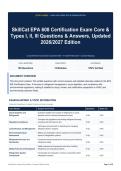
SkillCat EPA 608 Certification Exam Core &
Types I, II, III Questions & Answers, Updated
2026/2027 Edition
Comprehensive Examination Question Bank • In-Depth Rationales • Concept Mapping
TOTAL QUESTIONS EXAM TOPICS RATIONALES
100 Questions 12 Modules 100% Verified
DOCUMENT OVERVIEW
This document contains 100 verified questions with correct answers and detailed rationales related to the EPA
608 Certification Exam. It focuses on refrigerant management, ozone depletion, and compliance with
environmental regulations, making it suitable for study, review, and certification preparation in HVAC and
environmental protection fields.
EXAM BLUEPRINT & TOPIC DISTRIBUTION
Systematic breakdown of subject domains and exam coverage.
Topic Module Scope & Core Focus Questions Share (%)
Ozone Depletion and Questions related to the impact of refrigerants on ozone
Refrigerants depletion and the chemical processes involved. 9 Qs 9.0%
Concepts and regulations surrounding refrigerant recovery,
Regulatory Compliance recycling, and the Clean Air Act. 9 Qs 9.0%
Techniques and protocols for detecting and managing
Leak Detection and Management refrigerant leaks in systems. 9 Qs 9.0%
Environmental Impact Metrics and evaluations used to assess the environmental
Assessment impact of refrigeration systems. 9 Qs 9.0%
Refrigerant Recovery and Processes and best practices for recovering and reclaiming
Reclamation refrigerants safely. 8 Qs 8.0%
Safety measures and equipment used when handling
Safety Protocols and Equipment refrigerants and evaluating systems. 8 Qs 8.0%
Refrigeration System Functionality and evaluation of various components within
Components refrigeration systems. 8 Qs 8.0%
Confidential • Student Study Edition • Practice & Review Guide Page 1 of 52
,STUDENT STUDY & MASTERY EDITION PRACTICE & REVIEW GUIDE
Assessment methods for determining the performance of
Performance Testing refrigeration systems. 8 Qs 8.0%
Refrigerant Properties and Understanding the properties of different refrigerants,
Metrics including ODP and GWP. 8 Qs 8.0%
Documentation and Requirements for documentation and record-keeping for
Record-Keeping refrigerant handling and repairs. 8 Qs 8.0%
Technician Certification and Roles and responsibilities of certified technicians as outlined
Responsibilities by EPA 608. 8 Qs 8.0%
Methods and technology utilized for effective leak testing in
Leak Testing Techniques refrigeration systems. 8 Qs 8.0%
Total Exam Coverage 12 Integrated Topic Modules 100 Qs 100.0%
Confidential • Student Study Edition • Practice & Review Guide Page 2 of 52
,STUDENT STUDY & MASTERY EDITION PRACTICE & REVIEW GUIDE
TOPIC 1: OZONE DEPLETION AND REFRIGERANTS
9 Questions • 9.0% of Exam • Questions related to the impact of refrigerants on ozone depletion and the chemical processes involved.
QUESTION 1
Which of the following best describes the catalytic cycle by which a single chlorine
atom derived from CFC-11 can destroy ozone molecules in the stratosphere?
[A] Cl + O3 → ClO + O2; ClO + O → Cl + O2
[B] Cl + O2 → ClO2; ClO2 + O → Cl + O3
[C] Cl + O → ClO; ClO + O3 → Cl + 2 O2
[D] Cl + O3 → ClO2 + O; ClO2 + O → Cl + O2
Correct Answer: Cl + O3 → ClO + O2; ClO + O → Cl + O2.
Rationale: The primary catalytic cycle involves chlorine reacting with ozone to form chlorine monoxide (ClO) and O2, then
ClO reacting with atomic oxygen to regenerate Cl, allowing one chlorine atom to destroy many ozone molecules.
QUESTION 2
A technician is evaluating a retrofit project that replaces a Type II R-22 system with an
HFC410A system. Which of the following statements about the environmental impact of
this change is most accurate?
[A] It eliminates ozone depletion potential (ODP) but increases global warming potential (GWP) by more than 2,000 times.
[B] It eliminates both ODP and GWP, making it a climate-neutral solution.
[C] It reduces ODP to zero and lowers GWP compared to R-22.
[D] It maintains a small ODP while dramatically reducing GWP.
Correct Answer: It eliminates ozone depletion potential (ODP) but increases global warming potential (GWP)
by more than 2,000 times.
Rationale: R-22 has an ODP of 0.05 and a GWP of ~1,800. HFC-410A has an ODP of 0 but a GWP of ~2,200, removing
ozone impact while raising the greenhouse effect.
Confidential • Student Study Edition • Practice & Review Guide Page 3 of 52
, STUDENT STUDY & MASTERY EDITION PRACTICE & REVIEW GUIDE
QUESTION 3
Which of the following regulatory programs specifically addresses the phase-out of
ozone-depleting refrigerants in existing stationary air-conditioning and refrigeration
equipment?
[A] Section 608 of the Clean Air Act
[B] Montreal Protocol Annex A
[C] EPA's Significant New Alternatives Policy (SNAP) Program
[D] Title V Operating Permit Program
Correct Answer: Section 608 of the Clean Air Act.
Rationale: Section 608 of the Clean Air Act establishes mandatory requirements for the handling, recovery, recycling, and
disposal of ozone-depleting substances in existing equipment, making it the primary U.S. regulatory mechanism for
phase-out enforcement.
QUESTION 4
Which of the following refrigerants has the lowest Ozone Depletion Potential (ODP)
while still providing acceptable cooling performance for a Type II (medium-pressure)
system?
[A] R-22 (Chlorodifluoromethane)
[B] R-410A (Blend of R-32 and R-125)
[C] R-404A (Blend of R-125, R-143a, R-134a)
[D] R-1234yf (2,3,3,3-Tetrafluoropropene)
Correct Answer: R-1234yf (2,3,3,3-Tetrafluoropropene)
Rationale: R-1234yf is an HFO with an ODP of 0, making it the only option among the listed refrigerants that does not
deplete ozone while still meeting the performance requirements of a Type II system.
Confidential • Student Study Edition • Practice & Review Guide Page 4 of 52
SkillCat EPA 608 Certification Exam Core &
Types I, II, III Questions & Answers, Updated
2026/2027 Edition
Comprehensive Examination Question Bank • In-Depth Rationales • Concept Mapping
TOTAL QUESTIONS EXAM TOPICS RATIONALES
100 Questions 12 Modules 100% Verified
DOCUMENT OVERVIEW
This document contains 100 verified questions with correct answers and detailed rationales related to the EPA
608 Certification Exam. It focuses on refrigerant management, ozone depletion, and compliance with
environmental regulations, making it suitable for study, review, and certification preparation in HVAC and
environmental protection fields.
EXAM BLUEPRINT & TOPIC DISTRIBUTION
Systematic breakdown of subject domains and exam coverage.
Topic Module Scope & Core Focus Questions Share (%)
Ozone Depletion and Questions related to the impact of refrigerants on ozone
Refrigerants depletion and the chemical processes involved. 9 Qs 9.0%
Concepts and regulations surrounding refrigerant recovery,
Regulatory Compliance recycling, and the Clean Air Act. 9 Qs 9.0%
Techniques and protocols for detecting and managing
Leak Detection and Management refrigerant leaks in systems. 9 Qs 9.0%
Environmental Impact Metrics and evaluations used to assess the environmental
Assessment impact of refrigeration systems. 9 Qs 9.0%
Refrigerant Recovery and Processes and best practices for recovering and reclaiming
Reclamation refrigerants safely. 8 Qs 8.0%
Safety measures and equipment used when handling
Safety Protocols and Equipment refrigerants and evaluating systems. 8 Qs 8.0%
Refrigeration System Functionality and evaluation of various components within
Components refrigeration systems. 8 Qs 8.0%
Confidential • Student Study Edition • Practice & Review Guide Page 1 of 52
,STUDENT STUDY & MASTERY EDITION PRACTICE & REVIEW GUIDE
Assessment methods for determining the performance of
Performance Testing refrigeration systems. 8 Qs 8.0%
Refrigerant Properties and Understanding the properties of different refrigerants,
Metrics including ODP and GWP. 8 Qs 8.0%
Documentation and Requirements for documentation and record-keeping for
Record-Keeping refrigerant handling and repairs. 8 Qs 8.0%
Technician Certification and Roles and responsibilities of certified technicians as outlined
Responsibilities by EPA 608. 8 Qs 8.0%
Methods and technology utilized for effective leak testing in
Leak Testing Techniques refrigeration systems. 8 Qs 8.0%
Total Exam Coverage 12 Integrated Topic Modules 100 Qs 100.0%
Confidential • Student Study Edition • Practice & Review Guide Page 2 of 52
,STUDENT STUDY & MASTERY EDITION PRACTICE & REVIEW GUIDE
TOPIC 1: OZONE DEPLETION AND REFRIGERANTS
9 Questions • 9.0% of Exam • Questions related to the impact of refrigerants on ozone depletion and the chemical processes involved.
QUESTION 1
Which of the following best describes the catalytic cycle by which a single chlorine
atom derived from CFC-11 can destroy ozone molecules in the stratosphere?
[A] Cl + O3 → ClO + O2; ClO + O → Cl + O2
[B] Cl + O2 → ClO2; ClO2 + O → Cl + O3
[C] Cl + O → ClO; ClO + O3 → Cl + 2 O2
[D] Cl + O3 → ClO2 + O; ClO2 + O → Cl + O2
Correct Answer: Cl + O3 → ClO + O2; ClO + O → Cl + O2.
Rationale: The primary catalytic cycle involves chlorine reacting with ozone to form chlorine monoxide (ClO) and O2, then
ClO reacting with atomic oxygen to regenerate Cl, allowing one chlorine atom to destroy many ozone molecules.
QUESTION 2
A technician is evaluating a retrofit project that replaces a Type II R-22 system with an
HFC410A system. Which of the following statements about the environmental impact of
this change is most accurate?
[A] It eliminates ozone depletion potential (ODP) but increases global warming potential (GWP) by more than 2,000 times.
[B] It eliminates both ODP and GWP, making it a climate-neutral solution.
[C] It reduces ODP to zero and lowers GWP compared to R-22.
[D] It maintains a small ODP while dramatically reducing GWP.
Correct Answer: It eliminates ozone depletion potential (ODP) but increases global warming potential (GWP)
by more than 2,000 times.
Rationale: R-22 has an ODP of 0.05 and a GWP of ~1,800. HFC-410A has an ODP of 0 but a GWP of ~2,200, removing
ozone impact while raising the greenhouse effect.
Confidential • Student Study Edition • Practice & Review Guide Page 3 of 52
, STUDENT STUDY & MASTERY EDITION PRACTICE & REVIEW GUIDE
QUESTION 3
Which of the following regulatory programs specifically addresses the phase-out of
ozone-depleting refrigerants in existing stationary air-conditioning and refrigeration
equipment?
[A] Section 608 of the Clean Air Act
[B] Montreal Protocol Annex A
[C] EPA's Significant New Alternatives Policy (SNAP) Program
[D] Title V Operating Permit Program
Correct Answer: Section 608 of the Clean Air Act.
Rationale: Section 608 of the Clean Air Act establishes mandatory requirements for the handling, recovery, recycling, and
disposal of ozone-depleting substances in existing equipment, making it the primary U.S. regulatory mechanism for
phase-out enforcement.
QUESTION 4
Which of the following refrigerants has the lowest Ozone Depletion Potential (ODP)
while still providing acceptable cooling performance for a Type II (medium-pressure)
system?
[A] R-22 (Chlorodifluoromethane)
[B] R-410A (Blend of R-32 and R-125)
[C] R-404A (Blend of R-125, R-143a, R-134a)
[D] R-1234yf (2,3,3,3-Tetrafluoropropene)
Correct Answer: R-1234yf (2,3,3,3-Tetrafluoropropene)
Rationale: R-1234yf is an HFO with an ODP of 0, making it the only option among the listed refrigerants that does not
deplete ozone while still meeting the performance requirements of a Type II system.
Confidential • Student Study Edition • Practice & Review Guide Page 4 of 52