[STUDY GUIDE] • HIGH-YIELD PRACTICE & REVIEW EDITION
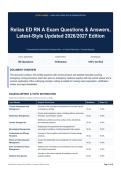
Relias ED RN A Exam Questions & Answers,
Latest-Style Updated 2026/2027 Edition
Comprehensive Examination Question Bank • In-Depth Rationales • Concept Mapping
TOTAL QUESTIONS EXAM TOPICS RATIONALES
100 Questions 10 Modules 100% Verified
DOCUMENT OVERVIEW
This document contains 100 verified questions with correct answers and detailed rationales covering
emergency nursing scenarios. Each item pairs an emergency medicine question with the correct answer and a
concise explanation of the underlying principle, making it suitable for nursing exam preparation, certification
review, and rapid remediation.
EXAM BLUEPRINT & TOPIC DISTRIBUTION
Systematic breakdown of subject domains and exam coverage.
Topic Module Scope & Core Focus Questions Share (%)
Trauma Assessment and Focuses on the evaluation and treatment of traumatic injuries
Management in emergency settings. 10 Qs 10.0%
Covers acute respiratory issues, including asthma, pulmonary
Respiratory Emergencies embolism, and inhalation injuries. 10 Qs 10.0%
Addresses conditions such as cardiac arrest, arrhythmias,
Cardiac Emergencies and treatment protocols. 10 Qs 10.0%
Emphasizes the assessment and management of
Neurological Emergencies neurological conditions, including traumatic brain injuries. 10 Qs 10.0%
Anaphylaxis and Allergic Focuses on the recognition and treatment of severe allergic
Reactions reactions. 10 Qs 10.0%
Shock and Hemodynamic Covers the identification and management of various shock
Management states. 10 Qs 10.0%
Burn and Chemical Injury Addresses the immediate care and treatment of burn injuries
Management and chemical exposures. 10 Qs 10.0%
Focuses on the unique aspects of emergency care for
Pediatric Emergencies pediatric patients. 10 Qs 10.0%
Confidential • Student Study Edition • Practice & Review Guide Page 1 of 49
,STUDENT STUDY & MASTERY EDITION PRACTICE & REVIEW GUIDE
Medication Administration and Covers correct medication administration practices and
Safety protocols in emergencies. 10 Qs 10.0%
Focuses on the management of patients with poisoning or
Poisoning and Toxicology overdose scenarios. 10 Qs 10.0%
Total Exam Coverage 10 Integrated Topic Modules 100 Qs 100.0%
Confidential • Student Study Edition • Practice & Review Guide Page 2 of 49
,STUDENT STUDY & MASTERY EDITION PRACTICE & REVIEW GUIDE
TOPIC 1: TRAUMA ASSESSMENT AND MANAGEMENT
10 Questions • 10.0% of Exam • Focuses on the evaluation and treatment of traumatic injuries in emergency settings.
QUESTION 1
While conducting a triage assessment, a patient presents with a penetrating trauma
wound to the chest. What is the most appropriate initial action to take?
[A] Administer oxygen and transport to the operating room immediately
[B] Check the patient's airway, breathing, and circulation (ABCs) and prepare for potential thoracotomy
[C] Apply a tourniquet to the wound and transport to the operating room
[D] Call for a trauma alert and prepare the patient for X-ray
Correct Answer: Option B.
Rationale: In a penetrating trauma wound to the chest, checking the patient's airway, breathing, and circulation (ABCs) is
the most appropriate initial action to take.
QUESTION 2
A patient has been involved in a motor vehicle collision and presents to the emergency
department with a potential spinal injury. What is the most appropriate initial action to
take?
[A] Apply a spinal board and transport the patient to the radiology department for a CT scan
[B] Conduct a thorough neurological examination and check for motor and sensory deficits
[C] Administer pain medication and transport the patient to the operating room for potential surgery
[D] Order a chest X-ray and start IV fluids
Correct Answer: Option B.
Rationale: In a patient with a potential spinal injury, the most appropriate initial action to take is to conduct a thorough
neurological examination and check for motor and sensory deficits.
Confidential • Student Study Edition • Practice & Review Guide Page 3 of 49
, STUDENT STUDY & MASTERY EDITION PRACTICE & REVIEW GUIDE
QUESTION 3
A traumatic injury patient is triaged and requires immediate attention. What is the most
appropriate method to use in prioritizing this patient's care?
[A] The patient's medical history is reviewed.
[B] The patient's vital signs are assessed.
[C] The patient's Glasgow Coma Scale (GCS) score is calculated.
[D] The patient is evaluated based on the severity of their injuries.
Correct Answer: The patient's Glasgow Coma Scale (GCS) score is calculated.
Rationale: The GCS score provides a quick and reliable assessment of a patient's neurological status after a traumatic
injury.
QUESTION 4
A patient with a severe burn injury requires immediate assessment and treatment. What
is the first priority in managing this patient's care?
[A] The patient's airway is secured.
[B] The patient's circulation is assessed.
[C] The patient's respiratory status is evaluated.
[D] The patient's temperature is taken.
Correct Answer: The patient's airway is secured.
Rationale: Securing the patient's airway is the first priority in managing a burn injury patient.
QUESTION 5
A patient with a traumatic injury requires immediate assessment and treatment. What is
the primary principle to apply in prioritizing this patient's care?
[A] The patient's medical history is reviewed.
[B] The patient's vital signs are assessed.
[C] The patient's injuries are evaluated based on their severity.
[D] The patient is evaluated based on their age.
Correct Answer: The patient's injuries are evaluated based on their severity.
Rationale: In a traumatic injury, the severity of the patient's injuries is used to prioritize their care.
Confidential • Student Study Edition • Practice & Review Guide Page 4 of 49
Relias ED RN A Exam Questions & Answers,
Latest-Style Updated 2026/2027 Edition
Comprehensive Examination Question Bank • In-Depth Rationales • Concept Mapping
TOTAL QUESTIONS EXAM TOPICS RATIONALES
100 Questions 10 Modules 100% Verified
DOCUMENT OVERVIEW
This document contains 100 verified questions with correct answers and detailed rationales covering
emergency nursing scenarios. Each item pairs an emergency medicine question with the correct answer and a
concise explanation of the underlying principle, making it suitable for nursing exam preparation, certification
review, and rapid remediation.
EXAM BLUEPRINT & TOPIC DISTRIBUTION
Systematic breakdown of subject domains and exam coverage.
Topic Module Scope & Core Focus Questions Share (%)
Trauma Assessment and Focuses on the evaluation and treatment of traumatic injuries
Management in emergency settings. 10 Qs 10.0%
Covers acute respiratory issues, including asthma, pulmonary
Respiratory Emergencies embolism, and inhalation injuries. 10 Qs 10.0%
Addresses conditions such as cardiac arrest, arrhythmias,
Cardiac Emergencies and treatment protocols. 10 Qs 10.0%
Emphasizes the assessment and management of
Neurological Emergencies neurological conditions, including traumatic brain injuries. 10 Qs 10.0%
Anaphylaxis and Allergic Focuses on the recognition and treatment of severe allergic
Reactions reactions. 10 Qs 10.0%
Shock and Hemodynamic Covers the identification and management of various shock
Management states. 10 Qs 10.0%
Burn and Chemical Injury Addresses the immediate care and treatment of burn injuries
Management and chemical exposures. 10 Qs 10.0%
Focuses on the unique aspects of emergency care for
Pediatric Emergencies pediatric patients. 10 Qs 10.0%
Confidential • Student Study Edition • Practice & Review Guide Page 1 of 49
,STUDENT STUDY & MASTERY EDITION PRACTICE & REVIEW GUIDE
Medication Administration and Covers correct medication administration practices and
Safety protocols in emergencies. 10 Qs 10.0%
Focuses on the management of patients with poisoning or
Poisoning and Toxicology overdose scenarios. 10 Qs 10.0%
Total Exam Coverage 10 Integrated Topic Modules 100 Qs 100.0%
Confidential • Student Study Edition • Practice & Review Guide Page 2 of 49
,STUDENT STUDY & MASTERY EDITION PRACTICE & REVIEW GUIDE
TOPIC 1: TRAUMA ASSESSMENT AND MANAGEMENT
10 Questions • 10.0% of Exam • Focuses on the evaluation and treatment of traumatic injuries in emergency settings.
QUESTION 1
While conducting a triage assessment, a patient presents with a penetrating trauma
wound to the chest. What is the most appropriate initial action to take?
[A] Administer oxygen and transport to the operating room immediately
[B] Check the patient's airway, breathing, and circulation (ABCs) and prepare for potential thoracotomy
[C] Apply a tourniquet to the wound and transport to the operating room
[D] Call for a trauma alert and prepare the patient for X-ray
Correct Answer: Option B.
Rationale: In a penetrating trauma wound to the chest, checking the patient's airway, breathing, and circulation (ABCs) is
the most appropriate initial action to take.
QUESTION 2
A patient has been involved in a motor vehicle collision and presents to the emergency
department with a potential spinal injury. What is the most appropriate initial action to
take?
[A] Apply a spinal board and transport the patient to the radiology department for a CT scan
[B] Conduct a thorough neurological examination and check for motor and sensory deficits
[C] Administer pain medication and transport the patient to the operating room for potential surgery
[D] Order a chest X-ray and start IV fluids
Correct Answer: Option B.
Rationale: In a patient with a potential spinal injury, the most appropriate initial action to take is to conduct a thorough
neurological examination and check for motor and sensory deficits.
Confidential • Student Study Edition • Practice & Review Guide Page 3 of 49
, STUDENT STUDY & MASTERY EDITION PRACTICE & REVIEW GUIDE
QUESTION 3
A traumatic injury patient is triaged and requires immediate attention. What is the most
appropriate method to use in prioritizing this patient's care?
[A] The patient's medical history is reviewed.
[B] The patient's vital signs are assessed.
[C] The patient's Glasgow Coma Scale (GCS) score is calculated.
[D] The patient is evaluated based on the severity of their injuries.
Correct Answer: The patient's Glasgow Coma Scale (GCS) score is calculated.
Rationale: The GCS score provides a quick and reliable assessment of a patient's neurological status after a traumatic
injury.
QUESTION 4
A patient with a severe burn injury requires immediate assessment and treatment. What
is the first priority in managing this patient's care?
[A] The patient's airway is secured.
[B] The patient's circulation is assessed.
[C] The patient's respiratory status is evaluated.
[D] The patient's temperature is taken.
Correct Answer: The patient's airway is secured.
Rationale: Securing the patient's airway is the first priority in managing a burn injury patient.
QUESTION 5
A patient with a traumatic injury requires immediate assessment and treatment. What is
the primary principle to apply in prioritizing this patient's care?
[A] The patient's medical history is reviewed.
[B] The patient's vital signs are assessed.
[C] The patient's injuries are evaluated based on their severity.
[D] The patient is evaluated based on their age.
Correct Answer: The patient's injuries are evaluated based on their severity.
Rationale: In a traumatic injury, the severity of the patient's injuries is used to prioritize their care.
Confidential • Student Study Edition • Practice & Review Guide Page 4 of 49