[STUDY GUIDE] • HIGH-YIELD PRACTICE & REVIEW EDITION
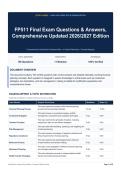
FP511 Final Exam Questions & Answers,
Comprehensive Updated 2026/2027 Edition
Comprehensive Examination Question Bank • In-Depth Rationales • Concept Mapping
TOTAL QUESTIONS EXAM TOPICS RATIONALES
100 Questions 11 Modules 100% Verified
DOCUMENT OVERVIEW
This document contains 100 verified questions with correct answers and detailed rationales covering financial
planning concepts. Each question is designed to assess knowledge in critical areas such as investment
strategies, tax implications, and risk management, making it suitable for certification preparation and
comprehensive review.
EXAM BLUEPRINT & TOPIC DISTRIBUTION
Systematic breakdown of subject domains and exam coverage.
Topic Module Scope & Core Focus Questions Share (%)
This topic explores the phases of the financial planning
Financial Planning Process process and the associated activities. 10 Qs 10.0%
This topic focuses on investment analysis, portfolio
Investment Strategies management, and performance evaluation techniques. 9 Qs 9.0%
This topic examines the principles of taxation, including
Taxation Principles marginal tax rates and tax-efficient strategies. 9 Qs 9.0%
This topic deals with identifying, assessing, and mitigating risk
Risk Management in financial planning. 9 Qs 9.0%
This topic assesses knowledge of regulatory standards and
Regulatory Compliance ethical requirements in financial planning. 9 Qs 9.0%
This topic explores how psychological factors influence
Behavioral Finance investor behavior and decision-making. 9 Qs 9.0%
This topic covers strategies for effective retirement planning
Retirement Planning and managing retirement income. 9 Qs 9.0%
This topic addresses planning for intergenerational wealth
Wealth Transfer Strategies transfer and estate planning principles. 9 Qs 9.0%
Confidential • Student Study Edition • Practice & Review Guide Page 1 of 52
,STUDENT STUDY & MASTERY EDITION PRACTICE & REVIEW GUIDE
This topic examines insurance products and the principles of
Insurance and Risk Transfer risk transfer. 9 Qs 9.0%
This topic focuses on ethical practices and communication
Client Relationship Management strategies in client relationships. 9 Qs 9.0%
This topic explores the use of Monte Carlo simulation in
Monte Carlo Simulation financial modeling and risk assessment. 9 Qs 9.0%
Total Exam Coverage 11 Integrated Topic Modules 100 Qs 100.0%
Confidential • Student Study Edition • Practice & Review Guide Page 2 of 52
,STUDENT STUDY & MASTERY EDITION PRACTICE & REVIEW GUIDE
TOPIC 1: FINANCIAL PLANNING PROCESS
10 Questions • 10.0% of Exam • This topic explores the phases of the financial planning process and the associated activities.
QUESTION 1
Which of the following activities is performed during the "Analysis and Evaluation"
phase of the financial planning process?
[A] Developing specific investment recommendations for the client
[B] Collecting the client's current financial statements and tax returns
[C] Calculating cash-flow gaps, risk exposure, and retirement adequacy
[D] Monitoring the implementation of the approved financial plan
Correct Answer: Calculating cash-flow gaps, risk exposure, and retirement adequacy.
Rationale: The analysis and evaluation phase focuses on interpreting gathered data, which includes cash-flow analysis, risk
assessment, and retirement adequacy calculations. Recommendation development, data collection, and monitoring occur in
other phases.
QUESTION 2
Which of the following best describes the purpose of the "Implementation" phase in the
financial planning process?
[A] To verify that the client's stated objectives are realistic and measurable
[B] To execute the agreed-upon strategies, such as opening accounts and purchasing assets
[C] To perform a comprehensive risk tolerance questionnaire
[D] To conduct a post-implementation performance audit
Correct Answer: To execute the agreed-upon strategies, such as opening accounts and purchasing assets.
Rationale: Implementation translates recommendations into actionable steps-opening accounts, executing trades, and
establishing insurance policies. The other options pertain to earlier or later phases.
Confidential • Student Study Edition • Practice & Review Guide Page 3 of 52
, STUDENT STUDY & MASTERY EDITION PRACTICE & REVIEW GUIDE
QUESTION 3
When conducting a comprehensive financial plan, a planner applies the "net worth"
metric. Which of the following formulas correctly calculates net worth?
[A] Total assets ÷ Total liabilities
[B] Total assets - Total liabilities
[C] Total liabilities - Total assets
[D] Total assets + Total liabilities
Correct Answer: Total assets - Total liabilities.
Rationale: Net worth is defined as the difference between total assets and total liabilities. The other formulas do not
represent net worth.
QUESTION 4
During the "Data Gathering" stage, a planner asks a client to provide all of the following
EXCEPT:
[A] Recent pay stubs and salary history
[B] Copies of current insurance policies
[C] A list of preferred vacation destinations for the next five years
[D] Recent federal and state tax returns
Correct Answer: A list of preferred vacation destinations for the next five years.
Rationale: While lifestyle goals are relevant, a specific list of vacation destinations is not essential data for financial
analysis; the other documents are required for a comprehensive financial picture.
Confidential • Student Study Edition • Practice & Review Guide Page 4 of 52
FP511 Final Exam Questions & Answers,
Comprehensive Updated 2026/2027 Edition
Comprehensive Examination Question Bank • In-Depth Rationales • Concept Mapping
TOTAL QUESTIONS EXAM TOPICS RATIONALES
100 Questions 11 Modules 100% Verified
DOCUMENT OVERVIEW
This document contains 100 verified questions with correct answers and detailed rationales covering financial
planning concepts. Each question is designed to assess knowledge in critical areas such as investment
strategies, tax implications, and risk management, making it suitable for certification preparation and
comprehensive review.
EXAM BLUEPRINT & TOPIC DISTRIBUTION
Systematic breakdown of subject domains and exam coverage.
Topic Module Scope & Core Focus Questions Share (%)
This topic explores the phases of the financial planning
Financial Planning Process process and the associated activities. 10 Qs 10.0%
This topic focuses on investment analysis, portfolio
Investment Strategies management, and performance evaluation techniques. 9 Qs 9.0%
This topic examines the principles of taxation, including
Taxation Principles marginal tax rates and tax-efficient strategies. 9 Qs 9.0%
This topic deals with identifying, assessing, and mitigating risk
Risk Management in financial planning. 9 Qs 9.0%
This topic assesses knowledge of regulatory standards and
Regulatory Compliance ethical requirements in financial planning. 9 Qs 9.0%
This topic explores how psychological factors influence
Behavioral Finance investor behavior and decision-making. 9 Qs 9.0%
This topic covers strategies for effective retirement planning
Retirement Planning and managing retirement income. 9 Qs 9.0%
This topic addresses planning for intergenerational wealth
Wealth Transfer Strategies transfer and estate planning principles. 9 Qs 9.0%
Confidential • Student Study Edition • Practice & Review Guide Page 1 of 52
,STUDENT STUDY & MASTERY EDITION PRACTICE & REVIEW GUIDE
This topic examines insurance products and the principles of
Insurance and Risk Transfer risk transfer. 9 Qs 9.0%
This topic focuses on ethical practices and communication
Client Relationship Management strategies in client relationships. 9 Qs 9.0%
This topic explores the use of Monte Carlo simulation in
Monte Carlo Simulation financial modeling and risk assessment. 9 Qs 9.0%
Total Exam Coverage 11 Integrated Topic Modules 100 Qs 100.0%
Confidential • Student Study Edition • Practice & Review Guide Page 2 of 52
,STUDENT STUDY & MASTERY EDITION PRACTICE & REVIEW GUIDE
TOPIC 1: FINANCIAL PLANNING PROCESS
10 Questions • 10.0% of Exam • This topic explores the phases of the financial planning process and the associated activities.
QUESTION 1
Which of the following activities is performed during the "Analysis and Evaluation"
phase of the financial planning process?
[A] Developing specific investment recommendations for the client
[B] Collecting the client's current financial statements and tax returns
[C] Calculating cash-flow gaps, risk exposure, and retirement adequacy
[D] Monitoring the implementation of the approved financial plan
Correct Answer: Calculating cash-flow gaps, risk exposure, and retirement adequacy.
Rationale: The analysis and evaluation phase focuses on interpreting gathered data, which includes cash-flow analysis, risk
assessment, and retirement adequacy calculations. Recommendation development, data collection, and monitoring occur in
other phases.
QUESTION 2
Which of the following best describes the purpose of the "Implementation" phase in the
financial planning process?
[A] To verify that the client's stated objectives are realistic and measurable
[B] To execute the agreed-upon strategies, such as opening accounts and purchasing assets
[C] To perform a comprehensive risk tolerance questionnaire
[D] To conduct a post-implementation performance audit
Correct Answer: To execute the agreed-upon strategies, such as opening accounts and purchasing assets.
Rationale: Implementation translates recommendations into actionable steps-opening accounts, executing trades, and
establishing insurance policies. The other options pertain to earlier or later phases.
Confidential • Student Study Edition • Practice & Review Guide Page 3 of 52
, STUDENT STUDY & MASTERY EDITION PRACTICE & REVIEW GUIDE
QUESTION 3
When conducting a comprehensive financial plan, a planner applies the "net worth"
metric. Which of the following formulas correctly calculates net worth?
[A] Total assets ÷ Total liabilities
[B] Total assets - Total liabilities
[C] Total liabilities - Total assets
[D] Total assets + Total liabilities
Correct Answer: Total assets - Total liabilities.
Rationale: Net worth is defined as the difference between total assets and total liabilities. The other formulas do not
represent net worth.
QUESTION 4
During the "Data Gathering" stage, a planner asks a client to provide all of the following
EXCEPT:
[A] Recent pay stubs and salary history
[B] Copies of current insurance policies
[C] A list of preferred vacation destinations for the next five years
[D] Recent federal and state tax returns
Correct Answer: A list of preferred vacation destinations for the next five years.
Rationale: While lifestyle goals are relevant, a specific list of vacation destinations is not essential data for financial
analysis; the other documents are required for a comprehensive financial picture.
Confidential • Student Study Edition • Practice & Review Guide Page 4 of 52