
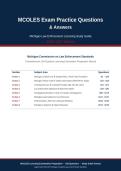
MCOLES Exam Practice Questions
& Answers
Michigan Law Enforcement Licensing Study Guide
Edition
Michigan Commission on Law Enforcement Standards
Comprehensive 150-Question Licensing Examination Preparation Manual
Section Subject Area Questions
Section 1 Michigan Criminal Law & Statutes (MCL, Penal Code, Procedure) Q1 - Q30
Section 2 Michigan Vehicle Code & Traffic Enforcement (OWI/OWVI, Stops) Q31 - Q50
Section 3 Constitutional Law & Criminal Procedure (4th, 5th, 6th, 14th) Q51 - Q75
Section 4 Law Enforcement Operations & Patrol Procedures Q76 - Q95
Section 5 Investigations (Evidence, Chain of Custody, Interrogations) Q96 - Q110
Section 6 Michigan Legal Updates & Court Decisions Q111 - Q125
Section 7 Professionalism, Ethics & Community Relations Q126 - Q140
Section 8 Emergency Response & Special Situations Q141 - Q150
MCOLES Licensing Examination Preparation - 150 Questions - Study Guide Format
Aligned with 2026-2027 Michigan Compiled Laws and MCOLES Standards
,MCOLES Exam Practice Questions & Answers | Michigan Law Enforcement Licensing Study Guide 2026/2027 Edition 2026-2027
MCOLES Exam Practice Questions &
Answers
Michigan Law Enforcement Licensing Study Guide
Edition
This study guide presents 150 practice questions aligned with the 2026-2027 Michigan Commission on Law Enforcement
Standards (MCOLES) Licensing Examination. Questions are organized into eight content domains: Michigan Criminal Law
and Statutes; Vehicle Code and Traffic Enforcement; Constitutional Law and Criminal Procedure; Patrol Procedures and
Operations; Investigations; Michigan Legal Updates and Court Decisions; Professionalism, Ethics, and Community Relations;
and Emergency Response and Special Situations. Each question is multiple choice with one correct answer; rationales include
citations to the Michigan Compiled Laws (MCL), Michigan case law, and federal constitutional authority. Approximately
75% of questions are scenario-based; the remaining 25% test direct recall of statutes, definitions, and case law. The
2026/2027 edition incorporates recent amendments to MCL 750 (Penal Code), MCL 257 (Vehicle Code), and MCL 333
(Public Health Code), as well as MCOLES use-of-force, de-escalation, and duty-to-intervene policy updates.
Section 1
Section 1: Michigan Criminal Law and Statutes (MCL, Penal Code, Criminal
Procedure, & Elements of Offenses)
Questions: Q1 - Q30 | Focus: Michigan criminal law (MCL 750, 752, 257, 333) - Elements of crimes, classifications, and
penalties
Q1: Under MCL 750.411, a person who breaks and enters a building with intent to commit larceny or any
felony therein is guilty of which offense?
A. Breaking and Entering a building, a misdemeanor
B. Breaking and Entering with intent to commit larceny or a felony therein, a felony punishable by up to 10
years [CORRECT]
C. Home invasion in the first degree under MCL 750.110a(2)
D. Trespassing under MCL 750.552
Correct Answer: B
Rationale: MCL 750.411 makes it a felony to break and enter a building with intent to commit larceny or any felony therein,
punishable by imprisonment for not more than 10 years. Choice A is wrong because the offense is a felony, not a misdemeanor.
Choice C is incorrect because first-degree home invasion under MCL 750.110a(2) requires the dwelling be a 'dwelling' and that
a person was present at the time. Choice D, MCL 750.552 (trespassing), lacks the element of breaking and entering with intent
to commit a felony inside.
Q2: An officer responds to a retail store where a suspect concealed merchandise valued at $35 and exited
past the point of sale. Under MCL 750.356d, what offense and degree applies?
A. First-degree retail fraud because the merchandise value exceeds $25
B. Third-degree retail fraud, a misdemeanor [CORRECT]
MCOLES Licensing Examination Preparation Page 2
, C. Second-degree retail fraud, a felony
D. Larceny from a person under MCL 750.357
Correct Answer: B
Rationale: MCL 750.356d(3) classifies retail fraud as third-degree (a misdemeanor) when the value of money, property, or
other thing of value involved is $200 or less but more than $1.00, or where the offender returns undamaged property within
48 hours. Because the merchandise here was $35, this is retail fraud third degree. Choice A is wrong because first-degree
retail fraud under MCL 750.356d(1) requires value exceeding $1,000. Choice C requires value exceeding $200 but not
$1,000 (second-degree). Choice D is inapplicable because larceny from a person (MCL 750.357) requires taking property
directly from a person, not from a store.
Q3: A suspect strikes another person with a beer bottle during a bar fight, causing a cut requiring six
stitches. Under MCL 750.81(2), what is the most appropriate charge?
A. Aggravated assault under MCL 750.81a because a dangerous weapon was used [CORRECT]
B. Assault and battery under MCL 750.81, a misdemeanor
C. Assault with intent to do great bodily harm less than murder under MCL 750.84
D. Malicious wounding under MCL 750.50
Correct Answer: A
Rationale: MCL 750.81a defines aggravated assault as an assault and battery where the offender uses a dangerous weapon or
the victim suffers serious injury requiring immediate medical treatment. The beer bottle qualifies as a dangerous weapon, and
stitches constitute serious injury requiring immediate medical treatment. Choice B (simple A&B; under MCL 750.81) would
apply only if no weapon and no serious injury occurred. Choice C (MCL 750.84, assault with intent to do great bodily harm
less than murder) requires specific intent to commit great bodily harm, a 10-year felony — too high for this fact pattern.
Choice D references an obsolete common-law offense not codified as charged.
Q4: Under MCL 750.110a, which element is NOT required to prove first-degree home invasion?
A. The defendant broke and entered a dwelling
B. The defendant entered without permission
C. A person was present at the time of the invasion [CORRECT]
D. The defendant intended to commit a felony, larceny, or assault therein
Correct Answer: C
Rationale: MCL 750.110a(2) (first-degree home invasion) does NOT require that a person be present. The presence element
applies to first-degree home invasion under MCL 750.110a(2)(c) only when a person is present. The four statutory grounds
are: (a) the dwelling is a 'dwelling' as defined; (b) at any time while the home invader is entering, present, or leaving, another
person is present or expected to be present, OR (c) the home invader is armed with a dangerous weapon, OR (d) the home
invader uses force or threatens force. Wait — MCL 750.110a(2) lists three scenarios that elevate home invasion to first
degree: (1) a person is present, (2) the invader is armed, or (3) the invader uses force. The core elements (breaking and
entering a dwelling with intent) are required for any degree; only one of the three elevating factors must be present. Choice C
is therefore misleading — it is one elevating factor, not the only one. The exam tests that mere breaking and entering a
dwelling with intent, without an elevating factor, is second-degree (MCL 750.110a(3)).
Q5: Under MCL 750.316, what is the maximum penalty for first-degree murder in Michigan?
A. Life imprisonment with the possibility of parole after 20 years
B. Mandatory life imprisonment without parole [CORRECT]
C. Life imprisonment or any term of years, at the court's discretion
D. 40 years to life
Correct Answer: B
, Rationale: MCL 750.316(1) provides that a person who commits first-degree murder 'shall be punished by imprisonment for
life without parole.' Michigan has no death penalty. Choice A is wrong — first-degree murder carries no parole eligibility.
Choice C describes second-degree murder (MCL 750.317), which permits life or any term of years. Choice D is incorrect;
there is no 40-year minimum under Michigan law.
Q6: Which of the following is NOT one of the elements required to prove CSC first degree under MCL
750.549(1)?
A. Sexual penetration
B. Victim is under 13 years of age, OR a listed aggravating circumstance applies
C. Use of force or coercion causing injury
D. The actor knew or had reason to know the victim was mentally incapable [CORRECT]
Correct Answer: D
Rationale: MCL 750.549(1) (first-degree Criminal Sexual Conduct) requires sexual penetration AND one of the following
circumstances: (a) victim is under 13; (b) victim is 13-15 and the actor is a member of the same household, related by blood,
in a position of authority, or a teacher/substitute teacher; (c) personal injury to the victim and force or coercion is used; (d)
personal injury and the actor is armed with a weapon; or (e) personal injury and the actor is aided by others. Knowledge of
mental incapacity is an element of CSC third degree (MCL 750.551) — not first degree. Choice D describes third-degree
CSC circumstances.
Q7: A suspect takes a vehicle owned by another person without consent and drives it 30 miles, intending
to return it the next day. Under MCL 750.414, what is the proper charge?
A. Larceny of a motor vehicle under MCL 750.413
B. Unlawful driving away of a motor vehicle, a 5-year felony
C. Joyriding under MCL 750.414, a 2-year misdemeanor [CORRECT]
D. Receiving and concealing stolen property under MCL 750.535
Correct Answer: C
Rationale: MCL 750.414 specifically addresses the situation where a person takes a motor vehicle without consent and
without intent to steal but with intent to use — this is the so-called 'joyriding' statute, a misdemeanor punishable by up to 2
years. Choice A (MCL 750.413, larceny of a motor vehicle) requires intent to permanently deprive. Choice B is incorrect
because 'unlawful driving away' is not a separate Michigan statute; MCL 750.413 is the larceny of an automobile statute.
Choice D requires the actor knew or had reason to know the property was stolen.
Q8: Under MCL 750.535e, a person who receives, conceals, or disposes of stolen property valued at
$1,500 commits:
A. Receiving and concealing stolen property over $1,000 but less than $20,000, a 5-year felony
[CORRECT]
B. Receiving and concealing stolen property over $20,000, a 10-year felony
C. Petty larceny, a misdemeanor
D. Receiving and concealing stolen property less than $200, a 1-year misdemeanor
Correct Answer: A
Rationale: MCL 750.535e(2) makes receiving and concealing stolen property with a value of $1,000 or more but less than
$20,000 a felony punishable by up to 5 years and/or a $10,000 fine, or 3x the value. Choice B applies only when value is
$20,000 or more (10-year felony). Choice C (petty larceny) is the wrong offense classification and the value threshold is
incorrect. Choice D applies to property under $200 (a 93-day misdemeanor under MCL 750.535e(4) as enhanced).
& Answers
Michigan Law Enforcement Licensing Study Guide
Edition
Michigan Commission on Law Enforcement Standards
Comprehensive 150-Question Licensing Examination Preparation Manual
Section Subject Area Questions
Section 1 Michigan Criminal Law & Statutes (MCL, Penal Code, Procedure) Q1 - Q30
Section 2 Michigan Vehicle Code & Traffic Enforcement (OWI/OWVI, Stops) Q31 - Q50
Section 3 Constitutional Law & Criminal Procedure (4th, 5th, 6th, 14th) Q51 - Q75
Section 4 Law Enforcement Operations & Patrol Procedures Q76 - Q95
Section 5 Investigations (Evidence, Chain of Custody, Interrogations) Q96 - Q110
Section 6 Michigan Legal Updates & Court Decisions Q111 - Q125
Section 7 Professionalism, Ethics & Community Relations Q126 - Q140
Section 8 Emergency Response & Special Situations Q141 - Q150
MCOLES Licensing Examination Preparation - 150 Questions - Study Guide Format
Aligned with 2026-2027 Michigan Compiled Laws and MCOLES Standards
,MCOLES Exam Practice Questions & Answers | Michigan Law Enforcement Licensing Study Guide 2026/2027 Edition 2026-2027
MCOLES Exam Practice Questions &
Answers
Michigan Law Enforcement Licensing Study Guide
Edition
This study guide presents 150 practice questions aligned with the 2026-2027 Michigan Commission on Law Enforcement
Standards (MCOLES) Licensing Examination. Questions are organized into eight content domains: Michigan Criminal Law
and Statutes; Vehicle Code and Traffic Enforcement; Constitutional Law and Criminal Procedure; Patrol Procedures and
Operations; Investigations; Michigan Legal Updates and Court Decisions; Professionalism, Ethics, and Community Relations;
and Emergency Response and Special Situations. Each question is multiple choice with one correct answer; rationales include
citations to the Michigan Compiled Laws (MCL), Michigan case law, and federal constitutional authority. Approximately
75% of questions are scenario-based; the remaining 25% test direct recall of statutes, definitions, and case law. The
2026/2027 edition incorporates recent amendments to MCL 750 (Penal Code), MCL 257 (Vehicle Code), and MCL 333
(Public Health Code), as well as MCOLES use-of-force, de-escalation, and duty-to-intervene policy updates.
Section 1
Section 1: Michigan Criminal Law and Statutes (MCL, Penal Code, Criminal
Procedure, & Elements of Offenses)
Questions: Q1 - Q30 | Focus: Michigan criminal law (MCL 750, 752, 257, 333) - Elements of crimes, classifications, and
penalties
Q1: Under MCL 750.411, a person who breaks and enters a building with intent to commit larceny or any
felony therein is guilty of which offense?
A. Breaking and Entering a building, a misdemeanor
B. Breaking and Entering with intent to commit larceny or a felony therein, a felony punishable by up to 10
years [CORRECT]
C. Home invasion in the first degree under MCL 750.110a(2)
D. Trespassing under MCL 750.552
Correct Answer: B
Rationale: MCL 750.411 makes it a felony to break and enter a building with intent to commit larceny or any felony therein,
punishable by imprisonment for not more than 10 years. Choice A is wrong because the offense is a felony, not a misdemeanor.
Choice C is incorrect because first-degree home invasion under MCL 750.110a(2) requires the dwelling be a 'dwelling' and that
a person was present at the time. Choice D, MCL 750.552 (trespassing), lacks the element of breaking and entering with intent
to commit a felony inside.
Q2: An officer responds to a retail store where a suspect concealed merchandise valued at $35 and exited
past the point of sale. Under MCL 750.356d, what offense and degree applies?
A. First-degree retail fraud because the merchandise value exceeds $25
B. Third-degree retail fraud, a misdemeanor [CORRECT]
MCOLES Licensing Examination Preparation Page 2
, C. Second-degree retail fraud, a felony
D. Larceny from a person under MCL 750.357
Correct Answer: B
Rationale: MCL 750.356d(3) classifies retail fraud as third-degree (a misdemeanor) when the value of money, property, or
other thing of value involved is $200 or less but more than $1.00, or where the offender returns undamaged property within
48 hours. Because the merchandise here was $35, this is retail fraud third degree. Choice A is wrong because first-degree
retail fraud under MCL 750.356d(1) requires value exceeding $1,000. Choice C requires value exceeding $200 but not
$1,000 (second-degree). Choice D is inapplicable because larceny from a person (MCL 750.357) requires taking property
directly from a person, not from a store.
Q3: A suspect strikes another person with a beer bottle during a bar fight, causing a cut requiring six
stitches. Under MCL 750.81(2), what is the most appropriate charge?
A. Aggravated assault under MCL 750.81a because a dangerous weapon was used [CORRECT]
B. Assault and battery under MCL 750.81, a misdemeanor
C. Assault with intent to do great bodily harm less than murder under MCL 750.84
D. Malicious wounding under MCL 750.50
Correct Answer: A
Rationale: MCL 750.81a defines aggravated assault as an assault and battery where the offender uses a dangerous weapon or
the victim suffers serious injury requiring immediate medical treatment. The beer bottle qualifies as a dangerous weapon, and
stitches constitute serious injury requiring immediate medical treatment. Choice B (simple A&B; under MCL 750.81) would
apply only if no weapon and no serious injury occurred. Choice C (MCL 750.84, assault with intent to do great bodily harm
less than murder) requires specific intent to commit great bodily harm, a 10-year felony — too high for this fact pattern.
Choice D references an obsolete common-law offense not codified as charged.
Q4: Under MCL 750.110a, which element is NOT required to prove first-degree home invasion?
A. The defendant broke and entered a dwelling
B. The defendant entered without permission
C. A person was present at the time of the invasion [CORRECT]
D. The defendant intended to commit a felony, larceny, or assault therein
Correct Answer: C
Rationale: MCL 750.110a(2) (first-degree home invasion) does NOT require that a person be present. The presence element
applies to first-degree home invasion under MCL 750.110a(2)(c) only when a person is present. The four statutory grounds
are: (a) the dwelling is a 'dwelling' as defined; (b) at any time while the home invader is entering, present, or leaving, another
person is present or expected to be present, OR (c) the home invader is armed with a dangerous weapon, OR (d) the home
invader uses force or threatens force. Wait — MCL 750.110a(2) lists three scenarios that elevate home invasion to first
degree: (1) a person is present, (2) the invader is armed, or (3) the invader uses force. The core elements (breaking and
entering a dwelling with intent) are required for any degree; only one of the three elevating factors must be present. Choice C
is therefore misleading — it is one elevating factor, not the only one. The exam tests that mere breaking and entering a
dwelling with intent, without an elevating factor, is second-degree (MCL 750.110a(3)).
Q5: Under MCL 750.316, what is the maximum penalty for first-degree murder in Michigan?
A. Life imprisonment with the possibility of parole after 20 years
B. Mandatory life imprisonment without parole [CORRECT]
C. Life imprisonment or any term of years, at the court's discretion
D. 40 years to life
Correct Answer: B
, Rationale: MCL 750.316(1) provides that a person who commits first-degree murder 'shall be punished by imprisonment for
life without parole.' Michigan has no death penalty. Choice A is wrong — first-degree murder carries no parole eligibility.
Choice C describes second-degree murder (MCL 750.317), which permits life or any term of years. Choice D is incorrect;
there is no 40-year minimum under Michigan law.
Q6: Which of the following is NOT one of the elements required to prove CSC first degree under MCL
750.549(1)?
A. Sexual penetration
B. Victim is under 13 years of age, OR a listed aggravating circumstance applies
C. Use of force or coercion causing injury
D. The actor knew or had reason to know the victim was mentally incapable [CORRECT]
Correct Answer: D
Rationale: MCL 750.549(1) (first-degree Criminal Sexual Conduct) requires sexual penetration AND one of the following
circumstances: (a) victim is under 13; (b) victim is 13-15 and the actor is a member of the same household, related by blood,
in a position of authority, or a teacher/substitute teacher; (c) personal injury to the victim and force or coercion is used; (d)
personal injury and the actor is armed with a weapon; or (e) personal injury and the actor is aided by others. Knowledge of
mental incapacity is an element of CSC third degree (MCL 750.551) — not first degree. Choice D describes third-degree
CSC circumstances.
Q7: A suspect takes a vehicle owned by another person without consent and drives it 30 miles, intending
to return it the next day. Under MCL 750.414, what is the proper charge?
A. Larceny of a motor vehicle under MCL 750.413
B. Unlawful driving away of a motor vehicle, a 5-year felony
C. Joyriding under MCL 750.414, a 2-year misdemeanor [CORRECT]
D. Receiving and concealing stolen property under MCL 750.535
Correct Answer: C
Rationale: MCL 750.414 specifically addresses the situation where a person takes a motor vehicle without consent and
without intent to steal but with intent to use — this is the so-called 'joyriding' statute, a misdemeanor punishable by up to 2
years. Choice A (MCL 750.413, larceny of a motor vehicle) requires intent to permanently deprive. Choice B is incorrect
because 'unlawful driving away' is not a separate Michigan statute; MCL 750.413 is the larceny of an automobile statute.
Choice D requires the actor knew or had reason to know the property was stolen.
Q8: Under MCL 750.535e, a person who receives, conceals, or disposes of stolen property valued at
$1,500 commits:
A. Receiving and concealing stolen property over $1,000 but less than $20,000, a 5-year felony
[CORRECT]
B. Receiving and concealing stolen property over $20,000, a 10-year felony
C. Petty larceny, a misdemeanor
D. Receiving and concealing stolen property less than $200, a 1-year misdemeanor
Correct Answer: A
Rationale: MCL 750.535e(2) makes receiving and concealing stolen property with a value of $1,000 or more but less than
$20,000 a felony punishable by up to 5 years and/or a $10,000 fine, or 3x the value. Choice B applies only when value is
$20,000 or more (10-year felony). Choice C (petty larceny) is the wrong offense classification and the value threshold is
incorrect. Choice D applies to property under $200 (a 93-day misdemeanor under MCL 750.535e(4) as enhanced).


