
PTA Exam NPTE (Musculoskeletal) | UPDATED Questions with
100% Verified Answers
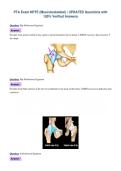
Question: Hip illiofemoral ligament
Answer:
Extends from anterior inferior iliac spine to intertrochanteric line of femur. LIMITS excessive hip extension Y
fan shape
Question: Hip Pubofemoral ligament
Answer:
Extends from Pubic portion of the rim of acetabulum to the neck of the femur. LIMITS excessive abduction and
extension
Question: Ischiofemoral ligament
Answer:
,extends from the iscial wall of the acetabulum to the neck of the femur Limits EXT and IR and reinforces the
articular capsule
Question: Acetabular labrum
Answer:
Fibrocatilaginous rim attatched to the margin of the acetabulum
Question: ATP-PC system
Answer:
High intensity short duration exercise such as sprinting 100 meters. Phosphocreatine decomposes and releases a
large amount of energy. Provides energy up to 15 seconds
Question: Anaerobic glycolysis
Answer:
High intensity short duration activities such as sprinting 400-800 meters. Stored glycogen is split into glucose
and through glycolysis split agian into pyruvic acid to form ATP 30-40 seconds of muscle contraction
Question: Aerobic Metabolism
Answer:
, Low intensity long duration exercise such as running a marathon. Oxygen yield the most ATP but requires
complex chemical reactions through oxidation of food.
Question: Synarthroses joint (fibrous) joint classification
Answer:
Fibrous joints composed of bones united by fibrous tissue and are non synovial. movement is minimal
Question: Suture (synarthroses)
Answer:
Union of 2 bones by a ligament or membrane (ex sagittal suture of skull)
Question: Gomphosis (synarthroses)
Answer:
2 bony surfaces connect such as a peg in the whole ex (tooth in a socket)
Question: Syndesmosis (joint classification)
Answer:
Bone connected to bone by a dense fibrous membrane or cord
Question: Amphiarthrosis (cartiliginous joint)
Answer:
Cartiliginous joints have cartilage or fibrocartilage that connects one bone to another. slightly moveable joints
Question: Shoulder flexion
Answer:
Anterior delt, Coracobrachialis, pec major, biceps brachii
Question: Shoulder extension
Answer:
lattisimus dorsi, posterior delt, teres major
Question: Shoulder abduction
Answer:
Middle deltoid, supraspinatus
Question: Shoulder external rotation
100% Verified Answers
Question: Hip illiofemoral ligament
Answer:
Extends from anterior inferior iliac spine to intertrochanteric line of femur. LIMITS excessive hip extension Y
fan shape
Question: Hip Pubofemoral ligament
Answer:
Extends from Pubic portion of the rim of acetabulum to the neck of the femur. LIMITS excessive abduction and
extension
Question: Ischiofemoral ligament
Answer:
,extends from the iscial wall of the acetabulum to the neck of the femur Limits EXT and IR and reinforces the
articular capsule
Question: Acetabular labrum
Answer:
Fibrocatilaginous rim attatched to the margin of the acetabulum
Question: ATP-PC system
Answer:
High intensity short duration exercise such as sprinting 100 meters. Phosphocreatine decomposes and releases a
large amount of energy. Provides energy up to 15 seconds
Question: Anaerobic glycolysis
Answer:
High intensity short duration activities such as sprinting 400-800 meters. Stored glycogen is split into glucose
and through glycolysis split agian into pyruvic acid to form ATP 30-40 seconds of muscle contraction
Question: Aerobic Metabolism
Answer:
, Low intensity long duration exercise such as running a marathon. Oxygen yield the most ATP but requires
complex chemical reactions through oxidation of food.
Question: Synarthroses joint (fibrous) joint classification
Answer:
Fibrous joints composed of bones united by fibrous tissue and are non synovial. movement is minimal
Question: Suture (synarthroses)
Answer:
Union of 2 bones by a ligament or membrane (ex sagittal suture of skull)
Question: Gomphosis (synarthroses)
Answer:
2 bony surfaces connect such as a peg in the whole ex (tooth in a socket)
Question: Syndesmosis (joint classification)
Answer:
Bone connected to bone by a dense fibrous membrane or cord
Question: Amphiarthrosis (cartiliginous joint)
Answer:
Cartiliginous joints have cartilage or fibrocartilage that connects one bone to another. slightly moveable joints
Question: Shoulder flexion
Answer:
Anterior delt, Coracobrachialis, pec major, biceps brachii
Question: Shoulder extension
Answer:
lattisimus dorsi, posterior delt, teres major
Question: Shoulder abduction
Answer:
Middle deltoid, supraspinatus
Question: Shoulder external rotation


