
IOP 3702 Assignment 1
Unique number: 607325
Question 1
When developing the appropriate performance criteria, there are often challenges that
occur.
Firstly, it is very hard to measure job performance, because jobs are multifaceted. All
jobs need different levels of performance and different skills thus there can never be
one perfect job criteria which can be used universally.
There is also never a clear criterion, this means that professionals have to be very
creative, imaginative and original when it comes to designing a suitable criterion.
Another challenge is time. Time can easily obscure finding an applicable criterion,
this is because short-term and long-term criteria are not similar.
Thus, some of the challenges that arise during criteria development include difficulty
designing a criterion that is appropriate, applicable to the certain job it is analyzing,
and also time (Leary, 2018).
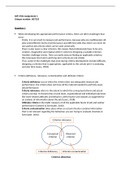
Criteria deficiency, relevance, contamination and ultimate criteria:
Criteria deficiency occurs when the criteria does not adequately measure job
performance, the criteria does not have all the material needed to perfectly asses
job performance.
Criteria relevance refers to the extent to which the conceptual criteria and actual
criteria overlap. It characterizes crucial team, organizational and individual outcomes
like work-related attitudes and behavior, performance and outputs as suggested by
an analysis of information about the job (Leary, 2018).
Ultimate criteria is the idyllic measure of all the applicable facets of job and worker
performance (Coetzee & Schreuder, 2010).
Criteria contamination takes place when an actual criterion contains information
that is not relevant regarding the behaviour you are trying to evaluate (Coetzee &
Schreuder, 2010).
Criterion relevance
Conceptual Observed
criterion criterion
Criterion deficiency Criterion contamination
Criterion distortion
Unique number: 607325
Question 1
When developing the appropriate performance criteria, there are often challenges that
occur.
Firstly, it is very hard to measure job performance, because jobs are multifaceted. All
jobs need different levels of performance and different skills thus there can never be
one perfect job criteria which can be used universally.
There is also never a clear criterion, this means that professionals have to be very
creative, imaginative and original when it comes to designing a suitable criterion.
Another challenge is time. Time can easily obscure finding an applicable criterion,
this is because short-term and long-term criteria are not similar.
Thus, some of the challenges that arise during criteria development include difficulty
designing a criterion that is appropriate, applicable to the certain job it is analyzing,
and also time (Leary, 2018).
Criteria deficiency, relevance, contamination and ultimate criteria:
Criteria deficiency occurs when the criteria does not adequately measure job
performance, the criteria does not have all the material needed to perfectly asses
job performance.
Criteria relevance refers to the extent to which the conceptual criteria and actual
criteria overlap. It characterizes crucial team, organizational and individual outcomes
like work-related attitudes and behavior, performance and outputs as suggested by
an analysis of information about the job (Leary, 2018).
Ultimate criteria is the idyllic measure of all the applicable facets of job and worker
performance (Coetzee & Schreuder, 2010).
Criteria contamination takes place when an actual criterion contains information
that is not relevant regarding the behaviour you are trying to evaluate (Coetzee &
Schreuder, 2010).
Criterion relevance
Conceptual Observed
criterion criterion
Criterion deficiency Criterion contamination
Criterion distortion


