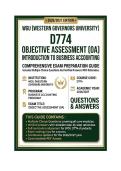
,WGU D774 OA Introduction to Business Accounting 2026/2027
Questions And Answers
Q1. What is the primary purpose of accounting in a business?
A) Identify, record, analyze, and communicate financial information for
decision-making
B) Guarantee profitability
C) Determine product prices automatically
D) Eliminate financial risk
Correct Answer: A) Identify, record, analyze, and communicate financial
information for decision-making
Rationale: Accounting converts business transactions and economic events
into useful information for managers and external stakeholders.
Q2. Which description best characterizes financial accounting?
A) It focuses only on future budgets.
B) It is used exclusively by production supervisors.
C) It does not follow standardized reporting principles.
D) It primarily provides financial information to external users.
Correct Answer: D) It primarily provides financial information to external
users.
Rationale: Financial accounting produces standardized reports for investors,
lenders, regulators, and other external users.
Q3. Which situation is an example of managerial accounting?
A) A department manager analyzes product costs before deciding whether to
discontinue a product line.
B) An investor reviews a company's annual report.
C) A bank examines audited financial statements before lending money.
D) A regulator reviews a public filing.
Correct Answer: A) A department manager analyzes product costs before
deciding whether to discontinue a product line.
Rationale: Managerial accounting provides internal information for planning,
controlling, and operational decision-making.
Q4. Which statement best distinguishes managerial accounting from
financial accounting?
, A) Managerial reports can be tailored to internal decision needs rather than
being limited to standardized external reporting formats.
B) Managerial accounting is intended primarily for shareholders.
C) Managerial accounting reports only historical information.
D) Managerial accounting excludes nonfinancial information.
Correct Answer: A) Managerial reports can be tailored to internal decision
needs rather than being limited to standardized external reporting formats.
Rationale: Internal managers can request detailed reports organized by
product, department, project, or decision.
Q5. Which user is an external user of accounting information?
A) Production supervisor
B) Commercial lender
C) Marketing manager
D) Operations director
Correct Answer: B) Commercial lender
Rationale: A lender is outside the company and uses financial information
to assess repayment risk.
Q6. Which user primarily relies on managerial accounting
information?
A) Securities regulator
B) Regional operations manager
C) Bond investor
D) External auditor
Correct Answer: B) Regional operations manager
Rationale: Operations managers need internal accounting information to
plan activities, control costs, and evaluate performance.
Q7. What is the fundamental accounting equation?
A) Assets = Liabilities + Owner's Equity
B) Assets + Expenses = Revenue
C) Cash = Liabilities − Equity
D) Revenue = Assets + Liabilities
Correct Answer: A) Assets = Liabilities + Owner's Equity
Questions And Answers
Q1. What is the primary purpose of accounting in a business?
A) Identify, record, analyze, and communicate financial information for
decision-making
B) Guarantee profitability
C) Determine product prices automatically
D) Eliminate financial risk
Correct Answer: A) Identify, record, analyze, and communicate financial
information for decision-making
Rationale: Accounting converts business transactions and economic events
into useful information for managers and external stakeholders.
Q2. Which description best characterizes financial accounting?
A) It focuses only on future budgets.
B) It is used exclusively by production supervisors.
C) It does not follow standardized reporting principles.
D) It primarily provides financial information to external users.
Correct Answer: D) It primarily provides financial information to external
users.
Rationale: Financial accounting produces standardized reports for investors,
lenders, regulators, and other external users.
Q3. Which situation is an example of managerial accounting?
A) A department manager analyzes product costs before deciding whether to
discontinue a product line.
B) An investor reviews a company's annual report.
C) A bank examines audited financial statements before lending money.
D) A regulator reviews a public filing.
Correct Answer: A) A department manager analyzes product costs before
deciding whether to discontinue a product line.
Rationale: Managerial accounting provides internal information for planning,
controlling, and operational decision-making.
Q4. Which statement best distinguishes managerial accounting from
financial accounting?
, A) Managerial reports can be tailored to internal decision needs rather than
being limited to standardized external reporting formats.
B) Managerial accounting is intended primarily for shareholders.
C) Managerial accounting reports only historical information.
D) Managerial accounting excludes nonfinancial information.
Correct Answer: A) Managerial reports can be tailored to internal decision
needs rather than being limited to standardized external reporting formats.
Rationale: Internal managers can request detailed reports organized by
product, department, project, or decision.
Q5. Which user is an external user of accounting information?
A) Production supervisor
B) Commercial lender
C) Marketing manager
D) Operations director
Correct Answer: B) Commercial lender
Rationale: A lender is outside the company and uses financial information
to assess repayment risk.
Q6. Which user primarily relies on managerial accounting
information?
A) Securities regulator
B) Regional operations manager
C) Bond investor
D) External auditor
Correct Answer: B) Regional operations manager
Rationale: Operations managers need internal accounting information to
plan activities, control costs, and evaluate performance.
Q7. What is the fundamental accounting equation?
A) Assets = Liabilities + Owner's Equity
B) Assets + Expenses = Revenue
C) Cash = Liabilities − Equity
D) Revenue = Assets + Liabilities
Correct Answer: A) Assets = Liabilities + Owner's Equity