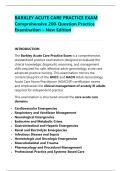
BARKLEY ACUTE CARE PRACTICE EXAM
Comprehensive 200-Question Practice
Examination – New Edition
INTRODUCTION
The Barkley Acute Care Practice Exam is a comprehensive,
standardized practice examination designed to evaluate the
clinical knowledge, diagnostic reasoning, and management
skills required for safe, effective adult-gerontology acute care
advanced practice nursing. This examination mirrors the
content blueprint of the ANCC and AACN Adult-Gerontology
Acute Care Nurse Practitioner (AGACNP) certification exams
and emphasizes the clinical management of acutely ill adults
required for independent practice.
This examination is structured around the core acute care
domains:
• Cardiovascular Emergencies
• Respiratory and Ventilator Management
• Neurological Emergencies
• Endocrine and Metabolic Crises
• Gastrointestinal and Hepatic Emergencies
• Renal and Electrolyte Emergencies
• Infectious Disease and Sepsis
• Hematologic and Oncologic Emergencies
• Musculoskeletal and Trauma
• Pharmacology and Procedural Management
• Professional Practice and Systems-Based Care
, Each of the 200 questions is presented in a clinical scenario-
based format, requiring the acute care NP to apply the
diagnostic reasoning process (Subjective Data, Objective Data,
Assessment/Differential Diagnosis, Plan/Management) and
evidence-based critical care guidelines.
Answer Format:
• Correct answers and detailed explanations are presented in
italics.
• Rationales and clinical reasoning are presented in bold.
This examination is intended for AGACNP students preparing
for certification, practicing acute care NPs seeking continuing
education, and educators developing comprehensive
assessment tools.
TABLE OF CONTENTS
Section Content Area Question Ran
I Cardiovascular Emergencies 1–30
II Respiratory and Ventilator Management 31–60
III Neurological Emergencies 61–85
IV Endocrine and Metabolic Crises 86–110
V Gastrointestinal and Hepatic Emergencies 111–130
VI Renal and Electrolyte Emergencies 131–150
,Section Content Area Question Ran
VII Infectious Disease and Sepsis 151–170
VIII Hematologic and Oncologic Emergencies 171–185
IX Musculoskeletal and Trauma 186–195
X Professional Practice and Systems-Based Care 196–200
Answer Key & Rationales 1–200
SECTION I: CARDIOVASCULAR EMERGENCIES (Questions 1–
30)
Question 1
A 58-year-old male presents with crushing substernal chest
pain radiating to the left arm and jaw, diaphoresis, and nausea.
His ECG shows ST elevation in leads II, III, and aVF. Which
coronary artery is most likely occluded?
A. Left anterior descending artery
B. Left circumflex artery
C. Right coronary artery
D. Left main coronary artery
Answer: C
ST elevation in leads II, III, and aVF indicates an inferior wall
myocardial infarction, which is most commonly caused by
occlusion of the right coronary artery (RCA).
, Rationale: The LAD (A) supplies the anterior wall (leads V1–
V4). The circumflex (B) supplies the lateral wall (leads I,
aVL, V5–V6). The left main (D) supplies a large territory and
would cause widespread changes. The RCA (C) supplies the
inferior wall .
Question 2
A 62-year-old female presents with acute onset of severe
dyspnea, orthopnea, and pink frothy sputum. Her blood
pressure is 180/100 mmHg, heart rate 120 bpm, and oxygen
saturation 82% on room air. Which medication is most
appropriate initially?
A. IV furosemide
B. IV metoprolol
C. IV diltiazem
D. Oral lisinopril
Answer: A
This patient is presenting with acute decompensated heart failure
and pulmonary edema with adequate blood pressure. IV
furosemide is the first-line medication to reduce preload and
relieve pulmonary congestion .
Rationale: IV metoprolol (B) and IV diltiazem (C) are rate-
control agents that may worsen heart failure acutely. Oral
lisinopril (D) is not appropriate for acute management. IV
furosemide (A) is the priority .
Comprehensive 200-Question Practice
Examination – New Edition
INTRODUCTION
The Barkley Acute Care Practice Exam is a comprehensive,
standardized practice examination designed to evaluate the
clinical knowledge, diagnostic reasoning, and management
skills required for safe, effective adult-gerontology acute care
advanced practice nursing. This examination mirrors the
content blueprint of the ANCC and AACN Adult-Gerontology
Acute Care Nurse Practitioner (AGACNP) certification exams
and emphasizes the clinical management of acutely ill adults
required for independent practice.
This examination is structured around the core acute care
domains:
• Cardiovascular Emergencies
• Respiratory and Ventilator Management
• Neurological Emergencies
• Endocrine and Metabolic Crises
• Gastrointestinal and Hepatic Emergencies
• Renal and Electrolyte Emergencies
• Infectious Disease and Sepsis
• Hematologic and Oncologic Emergencies
• Musculoskeletal and Trauma
• Pharmacology and Procedural Management
• Professional Practice and Systems-Based Care
, Each of the 200 questions is presented in a clinical scenario-
based format, requiring the acute care NP to apply the
diagnostic reasoning process (Subjective Data, Objective Data,
Assessment/Differential Diagnosis, Plan/Management) and
evidence-based critical care guidelines.
Answer Format:
• Correct answers and detailed explanations are presented in
italics.
• Rationales and clinical reasoning are presented in bold.
This examination is intended for AGACNP students preparing
for certification, practicing acute care NPs seeking continuing
education, and educators developing comprehensive
assessment tools.
TABLE OF CONTENTS
Section Content Area Question Ran
I Cardiovascular Emergencies 1–30
II Respiratory and Ventilator Management 31–60
III Neurological Emergencies 61–85
IV Endocrine and Metabolic Crises 86–110
V Gastrointestinal and Hepatic Emergencies 111–130
VI Renal and Electrolyte Emergencies 131–150
,Section Content Area Question Ran
VII Infectious Disease and Sepsis 151–170
VIII Hematologic and Oncologic Emergencies 171–185
IX Musculoskeletal and Trauma 186–195
X Professional Practice and Systems-Based Care 196–200
Answer Key & Rationales 1–200
SECTION I: CARDIOVASCULAR EMERGENCIES (Questions 1–
30)
Question 1
A 58-year-old male presents with crushing substernal chest
pain radiating to the left arm and jaw, diaphoresis, and nausea.
His ECG shows ST elevation in leads II, III, and aVF. Which
coronary artery is most likely occluded?
A. Left anterior descending artery
B. Left circumflex artery
C. Right coronary artery
D. Left main coronary artery
Answer: C
ST elevation in leads II, III, and aVF indicates an inferior wall
myocardial infarction, which is most commonly caused by
occlusion of the right coronary artery (RCA).
, Rationale: The LAD (A) supplies the anterior wall (leads V1–
V4). The circumflex (B) supplies the lateral wall (leads I,
aVL, V5–V6). The left main (D) supplies a large territory and
would cause widespread changes. The RCA (C) supplies the
inferior wall .
Question 2
A 62-year-old female presents with acute onset of severe
dyspnea, orthopnea, and pink frothy sputum. Her blood
pressure is 180/100 mmHg, heart rate 120 bpm, and oxygen
saturation 82% on room air. Which medication is most
appropriate initially?
A. IV furosemide
B. IV metoprolol
C. IV diltiazem
D. Oral lisinopril
Answer: A
This patient is presenting with acute decompensated heart failure
and pulmonary edema with adequate blood pressure. IV
furosemide is the first-line medication to reduce preload and
relieve pulmonary congestion .
Rationale: IV metoprolol (B) and IV diltiazem (C) are rate-
control agents that may worsen heart failure acutely. Oral
lisinopril (D) is not appropriate for acute management. IV
furosemide (A) is the priority .