

Written by students who passed Immediately available after payment Read online or as PDF Wrong document? Swap it for free 4.6 TrustPilot
logo-home
Document preview thumbnail
Preview 2 out of 13 pages
Exam (elaborations)

PSYC 351 Final Chapter 11 2026/2027 – 60+ Q&A | Aggression, Social Learning, Serotonin, Culture of Honor & Self-Control

Document preview thumbnail
Preview 2 out of 13 pages

This PSYC 351 Final Chapter 11 2026/2027 study guide is a focused 13-page exam-preparation resource containing more than 60 identifiable questions, answers, definitions, theories, research concepts, and applied scenarios centered on the psychology of aggression and violence. Core topics include proactive and reactive aggression, cultural and gender differences in aggression, culture of honor, machismo, personality and aggression, evolutionary explanations, serotonin and testosterone, executive functioning, reinforcement, punishment, Social Learning Theory, Bandura’s Bobo Doll study, frustration-aggression, catharsis, provocation, hostile attribution bias, rumination, alcohol, heat, weapons, and self-control. The guide begins by distinguishing major forms and cultural dimensions of aggression. Aggression is defined in the document as behavior intended to harm another individual, while proactive or instrumental aggression is used to achieve a desired goal and reactive aggression occurs in response to perceived threat or provocation. Cultural concepts include culture of honor, where reputation and status are defended through aggression, and machismo, described as an emphasis on masculinity and dominance linked to aggression. The material also differentiates instrumental aggression from relational aggression and discusses cross-cultural variation in violence, bullying, and nonviolent social norms. The personality, biological, and evolutionary sections connect aggression with low agreeableness, low openness, high neuroticism, the Dark Triad of narcissism, Machiavellianism, and psychopathy, low self-control, and Type A personality characteristics. Evolutionary explanations presented in the guide associate male aggression with achieving and maintaining status and female aggression with protection of offspring. Biological material covers heritability, testosterone, cortisol, serotonin, executive functioning, the prefrontal cortex (PFC), amygdala hijack, traumatic brain injury, and chronic traumatic encephalopathy (CTE). The source specifically identifies serotonin as a neurotransmitter that restrains impulsive aggression and associates lower serotonin levels with greater aggression. A substantial section examines learning and behavioral explanations of aggression. Positive reinforcement is described as increasing aggression when it produces desired outcomes, whereas negative reinforcement strengthens aggression when it removes an unpleasant situation. The document reviews punishment and corporal punishment, noting an association between physical punishment and later antisocial behavior. Social Learning Theory explains behavior through observation and reinforcement, and Bandura’s Bobo Doll study is used to illustrate how children may imitate aggressive behavior demonstrated by adult models. The guide also provides high-yield coverage of the frustration-aggression hypothesis, displacement, and catharsis. Frustration is presented as creating a motive for aggression, while displacement involves redirecting aggression toward a substitute target. Catharsis is defined as releasing aggressive emotions or tension, but the source states that catharsis can increase rather than reduce aggression and identifies responses incompatible with aggression as a more effective approach. Environmental influences include heat, provocation, social rejection, feeling disrespected, weapons, and aggressive cues. The final sections focus on cognition, emotional arousal, and self-regulation. Students review automatic associations, hostile attribution bias, higher-order cognition, thinking about consequences, moral principles, rumination, and alcohol-related disinhibition. The source describes hostile attribution bias as interpreting others’ behavior as hostile and rumination as repeatedly thinking about anger-provoking experiences. It also explains that intense emotional arousal can reduce higher-order thinking and self-control, while alcohol can impair inhibition and increase aggression risk. Applied

Content preview

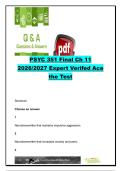
PSYC 351 Final Ch 11
2026/2027 Expert Verifed Ace
the Test


Serotonin

Choose an answer

1

Neurotransmitter that restrains impulsive aggression.

2

Neurotransmitter that increases anxiety and panic.

3

, Hormone responsible for the fight-or-flight response.

4

Chemical messenger that enhances memory formation.

ANS 1

Negative Reinforcement of Aggression

Choose an answer

1

Aggression removes unpleasant situations.

2

Punishment reduces aggression only if immediate, strong, consistent,

and fair.

3

Aggression increases because it produces desired outcomes.

4

Nonaggressive responses reduce aggression more effectively than

catharsis.

ANS 1

Cultural emphasis on masculinity and dominance linked to aggression.
Document information

Uploaded on
September 17, 2026
Number of pages
13
Written in
2026/2027
Type
Exam (elaborations)
Contains
Questions & answers
$18.99

Wrong document? Swap it for free Within 14 days of purchase and before downloading, you can choose a different document. You can simply spend the amount again.
Written by students who passed
Immediately available after payment
Read online or as PDF

Seller avatar
Reputation scores are based on the amount of documents a seller has sold for a fee and the reviews they have received for those documents. There are three levels: Bronze, Silver and Gold. The better the reputation, the more your can rely on the quality of the sellers work.
NinjaNerd
3.4
(78)
Sold
419
Followers
6
Items
15918
Last sold
1 day ago


Why students choose Stuvia

Created by fellow students, verified by reviews

Quality you can trust: written by students who passed their tests and reviewed by others who've used these notes.

Didn't get what you expected? Choose another document

No worries! You can instantly pick a different document that better fits what you're looking for.

Pay as you like, start learning right away

No subscription, no commitments. Pay the way you're used to via credit card and download your PDF document instantly.

Student with book image

“Bought, downloaded, and aced it. It really can be that simple.”

Alisha Student

Working on your references?

Create accurate citations in APA, MLA and Harvard with our free citation generator.

Working on your references?

Frequently asked questions

