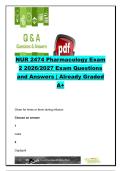
This NUR 2474 Pharmacology Exam 2 2026/2027 study resource contains 53 identifiable questions and answer/review items across 12 pages, covering high-yield pharmacology concepts involving hypertension, cardiovascular medications, dysrhythmias, heart failure, anticoagulants, hematologic drugs, lipid-lowering therapy, gastrointestinal medications, respiratory pharmacology, and medication safety. The document combines multiple-choice questions with concise question-and-answer review statements, making it useful for rapid recall of drug indications, mechanisms, adverse effects, laboratory monitoring, contraindications, interactions, and nursing assessments.
A major section focuses on hypertension and cardiovascular pharmacology. The material reviews primary hypertension, blood-pressure goals, hypertensive emergencies, thiazide and loop diuretics, calcium-channel blockers, aldosterone antagonists, ACE inhibitors, ARBs, beta blockers, and combination antihypertensive therapy. Specific medications include furosemide (Lasix), hydrochlorothiazide, spironolactone, captopril, lisinopril, losartan, propranolol, metoprolol, verapamil, nitroprusside, and nitroglycerin. Students review potassium monitoring, renal function and GFR, orthostatic hypotension, ACE-inhibitor-associated cough and angioedema, pregnancy-related medication concerns, bronchospasm risk with propranolol, and nursing assessment of heart rate and blood pressure before cardiac medication administration.
The heart failure and dysrhythmia material emphasizes digoxin, amiodarone, beta blockers, IV magnesium, and related monitoring. The guide provides a digoxin therapeutic range of 0.5–0.8, discusses renal function in relation to digoxin toxicity, identifies Digifab/Fab antibody fragments for severe digoxin overdose, and notes that verapamil can elevate digoxin levels. Amiodarone is presented as a potassium-channel blocker used for atrial fibrillation/flutter, with grapefruit identified as an interaction to avoid. The resource also reviews IV magnesium for torsades de pointes, appropriate pulse assessment, and metoprolol therapy targeting the heart-rate range specified by the document.
Another important section covers anticoagulants, antiplatelets, bleeding precautions, and hematologic pharmacology. Students review aspirin and platelet aggregation, heparin with aPTT monitoring and protamine sulfate, warfarin with INR monitoring and vitamin K, rivaroxaban bleeding precautions, and clopidogrel (Plavix) with signs suggestive of gastrointestinal bleeding. Hematologic medications include epoetin alfa for increasing red blood cell production, factor VIII for hemophilia A, filgrastim for increasing neutrophil counts, and iron/ferrous sulfate therapy. The material also highlights avoiding NSAIDs in patients with hemophilia and reinforces recognition of medication-associated bleeding.
The document further reviews lipid, gastrointestinal, and supportive pharmacology. Cholestyramine administration, statin-associated muscle symptoms and CK monitoring, lactulose and intestinal ammonia excretion, magnesium hydroxide precautions in end-stage renal disease, stimulant laxative effects, and scopolamine-associated dry mouth are included. Respiratory medication content includes theophylline therapeutic-level information and its interaction with ciprofloxacin. Diphenhydramine (Benadryl) is also identified in the study material for hives or fever occurring during an infusion.
Medication-safety concepts are integrated throughout the guide. Students review I&O assessment with furosemide, potassium monitoring with diuretics, renal-function assessment, bleeding precautions during anticoagulant therapy, slow positional changes for orthostatic hypotension, cardiovascular assessment before cardiac medications, and sublingual nitroglycerin actions during an anginal episode. This combination of drug facts and practical nursing considerations makes the document particularly relevant for examination questions that require connecting pharmacology knowledge with bedside assessment and patient education.
The uploaded source identifies itself as NUR 2474 Pharmacology Exam 2 2026/2027, but it does not identify a university, assigned textbook, journal, author, or textbook edition. For accuracy, no institution or external reference should be attributed to the document without additional evidence. Some statements in the document are condensed exam notes, so they should be studied according to the terminology and expectations of the NUR 2474 course rather than interpreted as standalone clinical prescribing guidance.
Relevant students: This resource is particularly relevant for NUR 2474 students, professional nursing students, RN students, ADN and BSN students, nursing pharmacology students, medical-surgical nursing students, and learners preparing for Pharmacology Exam 2. It is especially useful for students reviewing cardiovascular medications, hypertension, heart failure, dysrhythmias, anticoagulation, hematology medications, medication toxicity, laboratory monitoring, adverse effects, drug interactions, gastrointestinal pharmacology, and nursing patient education.
Keywords: NUR 2474 Pharmacology Exam 2, NUR 2474 Exam 2, NUR , NUR , pharmacology exam questions and answers, nursing pharmacology study guide, hypertension pharmacology, antihypertensive medications, cardiac medications nursing, ACE inhibitors nursing, lisinopril side effects, captopril nursing, losartan nursing, beta blockers nursing, metoprolol nursing, calcium channel blockers, verapamil nursing, loop diuretics, furosemide nursing, hydrochlorothiazide nursing, spironolactone nursing, potassium monitoring, GFR nursing, digoxin levels, digoxin toxicity, Digifab antidote, amiodarone nursing, torsades de pointes magnesium, nitroprusside nursing, nitroglycerin nursing, anticoagulants nursing, heparin aPTT, protamine sulfate, warfarin INR, vitamin K warfarin, rivaroxaban nursing, Plavix bleeding, aspirin antiplatelet, epoetin alfa nursing, factor VIII hemophilia, filgrastim nursing, iron anemia nursing, statins muscle pain, cholestyramine nursing, lactulose nursing, theophylline therapeutic level, nursing medication safety, RN pharmacology exam
Inhaltsvorschau
NUR 2474 Pharmacology Exam
2 2026/2027 Exam Questions
and Answers | Already Graded
A+
Given for hives or fever during infusion
Choose an answer
1
Lasix
2
Captopril
, 3
Albuterol
4
Benadryl
ANS 4
Avoid in hypertension due to vasoconstriction effects
Falsches Dokument? Kostenlos tauschen
Innerhalb von 14 Tagen nach dem Kauf und vor dem Herunterladen kannst du ein anderes Dokument wählen. Du kannst den Betrag einfach neu ausgeben.
Geschrieben von Student*innen, die bestanden haben
Sofort verfügbar nach Zahlung
Online lesen oder als PDF
Bewertungen des Ansehens basieren auf der Anzahl der Dokumente, die ein Verkäufer gegen eine Gebühr verkauft hat, und den Bewertungen, die er für diese Dokumente erhalten hat. Es gibt drei Stufen: Bronze, Silber und Gold. Je besser das Ansehen eines Verkäufers ist, desto mehr kannst du dich auf die Qualität der Arbeiten verlassen.