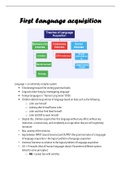
First language acquisition
Language = an extremely complex system
• Time/energy/research for writing grammar books
• Linguists make living by investigating language
• Foreign languages in “Human Lang Series” DVDs
• Children determine grammar of language based on data such as the following:
o John saw himself.
o Looking after himself bores John.
o John said that Fred liked himself.
o John told Bill to wash himself.
• Despite this, children acquire their first language without any effort, without any
instruction, unconsciously, and completely at an age when they are still cognitively
immature.
• Also: poverty of the stimulus
• Gap between INPUT (sound streams) and OUTPUT (the grammar/rules of a language)
of language acquisition= the logical problem of language acquisition
• Universal Grammar as solution to the logical problem of language acquisition
• UG = Principles (that all human languages obey)+Parameters (different options
linked to some principles)
o UG = power box with switches
, o Principles = switches welded into position
o (child gets these properties of the lang “for free”, foreknown)
o Parameters = switches, need flicking to 1/other position
o (Every position of every switch linked to number of properties; child notices 1
of these properties, flicks switch to correct position + gets all other properties
linked to this position “for free”)
o Child has some knowledge of Language X prior to exposure (principles and
parameters of UG)
o Child is exposed to Language X
o Child uses UG to decode the input and determine “rules” of Language X.
o Thus, language not learned sentence-by-sentence or construction-by-
construction
The Innateness Theory
• Every human being is born with the ability (biologically programmed) to learn the
language to which s/he is exposed to (quickly, easily, automatically, unconsciously
and completely)
• This ability is part of our biological endowment, involves a module of the mind
• This hypothesis accounts for all of the otherwise surprising facts of first language
acquisition
Alternative theories of first language acquisition
1. Imitation theory
2. Reinforcement theory
3. Analogy theory
4. Theory of structured input
Imitation theory
• Children listen to what is said around them and imitate that word labels and
formulaic utterances are learnt in this manner, but children are not good verbal
imitators
Reinforcement theory
Parents offer:
• positive reinforcement for grammatically correct sentences
• negative reinforcement for ungrammatical sentences
Language = an extremely complex system
• Time/energy/research for writing grammar books
• Linguists make living by investigating language
• Foreign languages in “Human Lang Series” DVDs
• Children determine grammar of language based on data such as the following:
o John saw himself.
o Looking after himself bores John.
o John said that Fred liked himself.
o John told Bill to wash himself.
• Despite this, children acquire their first language without any effort, without any
instruction, unconsciously, and completely at an age when they are still cognitively
immature.
• Also: poverty of the stimulus
• Gap between INPUT (sound streams) and OUTPUT (the grammar/rules of a language)
of language acquisition= the logical problem of language acquisition
• Universal Grammar as solution to the logical problem of language acquisition
• UG = Principles (that all human languages obey)+Parameters (different options
linked to some principles)
o UG = power box with switches
, o Principles = switches welded into position
o (child gets these properties of the lang “for free”, foreknown)
o Parameters = switches, need flicking to 1/other position
o (Every position of every switch linked to number of properties; child notices 1
of these properties, flicks switch to correct position + gets all other properties
linked to this position “for free”)
o Child has some knowledge of Language X prior to exposure (principles and
parameters of UG)
o Child is exposed to Language X
o Child uses UG to decode the input and determine “rules” of Language X.
o Thus, language not learned sentence-by-sentence or construction-by-
construction
The Innateness Theory
• Every human being is born with the ability (biologically programmed) to learn the
language to which s/he is exposed to (quickly, easily, automatically, unconsciously
and completely)
• This ability is part of our biological endowment, involves a module of the mind
• This hypothesis accounts for all of the otherwise surprising facts of first language
acquisition
Alternative theories of first language acquisition
1. Imitation theory
2. Reinforcement theory
3. Analogy theory
4. Theory of structured input
Imitation theory
• Children listen to what is said around them and imitate that word labels and
formulaic utterances are learnt in this manner, but children are not good verbal
imitators
Reinforcement theory
Parents offer:
• positive reinforcement for grammatically correct sentences
• negative reinforcement for ungrammatical sentences