
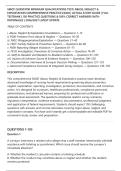
SMQT (SURVEYOR MINIMUM QUALIFICATIONS TEST) ABUSE, NEGLECT &
EXPLOITATION COMPREHENSIVE PRACTICE EXAM | ACTUAL STUDY GUIDE | FULL
TESTBANK | 150 PRACTICE QUESTIONS & 100% CORRECT ANSWERS WITH
RATIONALES | 2026/2027 LATEST UPDATE
TABLE OF CONTENTS
i. Abuse, Neglect & Exploitation Foundations — Questions 1–15
ii. F600: Freedom From Abuse & Neglect — Questions 16–30
iii. F602: Misappropriation/Exploitation — Questions 31–45
iv. F607: Facility Policies & Prevention Systems — Questions 46–60
v. F609: Reporting Alleged Violations — Questions 61–75
vi. F610: Investigation, Prevention & Corrective Action — Questions 76–90
vii. Staff-to-Resident and Resident-to-Resident Incidents — Questions 91–105
viii. Injuries of Unknown Source & Evidence Analysis — Questions 106–120
ix. Documentation, Interviews & Surveyor Decision-Making — Questions 121–135
x. Advanced Compliance Scenarios & Integrated Survey Analysis — Questions 136–150
DESCRIPTION
This comprehensive SMQT Abuse, Neglect & Exploitation practice exam develops
advanced knowledge of nursing-home requirements governing abuse prevention,
neglect, exploitation, reporting, investigation, protection, documentation, and corrective
action. It is designed for surveyors, healthcare professionals, compliance personnel,
administrators, and advanced learners preparing for professional certification or
graduate-level assessment. The questions emphasize realistic survey scenarios,
regulatory interpretation, evidence evaluation, documentation, professional judgment,
and application of federal requirements. Students should expect 150 challenging
questions with answers and concise rationales covering major abuse, neglect, and
exploitation concepts. Purchase and instantly get a downloadable and editable PDF for
convenient study, review, and preparation.
QUESTIONS 1–150
Question 1
A surveyor interviews a resident who alleges that a staff member intentionally withheld
assistance with toileting as punishment. Which issue should receive the surveyor's
immediate attention?
A. Whether the resident's care plan contains a toileting schedule
B. Whether the conduct may constitute abuse or neglect and whether the resident
remains protected
,C. Whether the staff member has previously received counseling
D. Whether the resident has filed a grievance
🔴 Correct Answer: B. Whether the conduct may constitute abuse or neglect and
whether the resident remains protected.
🔵 Explanation: Allegations suggesting abuse or neglect require prompt investigation and
protection of the resident. The surveyor should establish what occurred, assess risk, and
determine whether required facility actions were taken.
Question 2
Which circumstance most clearly represents neglect rather than an isolated clinical
error?
A. A single documentation omission immediately corrected
B. Failure of required systems and processes to provide necessary care resulting in
unmet resident needs
C. A resident declining a recommended service
D. A physician changing a treatment order
🔴 Correct Answer: B. Failure of required systems and processes to provide necessary
care resulting in unmet resident needs.
🔵 Explanation: Neglect can involve failure to provide required structures and processes
needed to meet resident needs, including deficiencies involving staffing, supplies, services,
training, supervision, or oversight.
Question 3
A resident reports that a caregiver repeatedly calls her degrading names when
providing personal care. No physical injury occurred. What is the most appropriate
surveyor conclusion?
A. No abuse occurred because there was no physical injury
B. The allegation is irrelevant unless another resident witnessed it
C. The conduct may constitute mental or verbal abuse and requires investigation
D. The matter is solely an employee-relations issue
🔴 Correct Answer: C. The conduct may constitute mental or verbal abuse and
requires investigation.
🔵 Explanation: Abuse is not limited to physical injury. Conduct producing or having the
likelihood of causing mental anguish or other prohibited harm requires investigation.
Question 4
Which evidence would generally provide the strongest basis for determining whether an
allegation of abuse occurred?
,A. A facility policy alone
B. A staff member's reputation
C. Corroborated observations, interviews, records, and other relevant evidence
D. The administrator's conclusion
🔴 Correct Answer: C. Corroborated observations, interviews, records, and other
relevant evidence.
🔵 Explanation: Survey conclusions should be based on evidence gathered through
appropriate investigative methods rather than reputation or unsupported conclusions.
Question 5
A facility immediately removes an accused employee from resident contact after
receiving an abuse allegation. What does this action establish?
A. That abuse has been proven
B. That the facility has taken a protective measure while facts are investigated
C. That no further investigation is required
D. That the allegation must be false
🔴 Correct Answer: B. That the facility has taken a protective measure while facts are
investigated.
🔵 Explanation: Protective measures do not establish whether an allegation is
substantiated. The facility must still investigate and take appropriate action based on
findings.
Question 6
A surveyor learns that an allegation was reported internally but no evidence shows that
the resident was protected while the investigation was pending. Which concern is most
significant?
A. Failure to conduct an annual resident meeting
B. Failure to prevent further potential abuse during the investigation
C. Failure to revise the facility newsletter
D. Failure to complete dietary documentation
🔴 Correct Answer: B. Failure to prevent further potential abuse during the
investigation.
🔵 Explanation: Facilities must protect residents from additional potential abuse, neglect,
exploitation, or mistreatment while an allegation is being investigated.
Question 7
Which statement best distinguishes an allegation from a substantiated finding?
, A. An allegation automatically establishes noncompliance
B. A substantiated finding requires evidence supporting the alleged violation
C. A substantiated finding requires a criminal conviction
D. An allegation can never support a citation
🔴 Correct Answer: B. A substantiated finding requires evidence supporting the
alleged violation.
🔵 Explanation: An allegation triggers investigation. A citation requires evidence
establishing noncompliance under the applicable requirement; a criminal conviction is not
generally necessary for a regulatory finding.
Question 8
A resident with cognitive impairment reports that another resident struck him. What
should the surveyor do first?
A. Dismiss the statement because of cognitive impairment
B. Investigate the allegation and assess immediate safety
C. Automatically cite staff abuse
D. Require hospitalization
🔴 Correct Answer: B. Investigate the allegation and assess immediate safety.
🔵 Explanation: Cognitive impairment does not eliminate the resident's report as
evidence. The surveyor should assess immediate risk and investigate the circumstances.
Question 9
Which facility response most strongly demonstrates an effective abuse-prevention
system?
A. Investigating only incidents that cause hospitalization
B. Maintaining policies but providing no staff education
C. Combining screening, training, supervision, reporting, investigation, protection, and
corrective action
D. Relying entirely on resident complaints
🔴 Correct Answer: C. Combining screening, training, supervision, reporting,
investigation, protection, and corrective action.
🔵 Explanation: Effective prevention is systemic. Policies alone are insufficient without
implementation, competency, monitoring, and corrective processes.
Question 10
A staff member witnesses another employee roughly handling a resident but does not
report it because the resident appears unharmed. What is the principal concern?
EXPLOITATION COMPREHENSIVE PRACTICE EXAM | ACTUAL STUDY GUIDE | FULL
TESTBANK | 150 PRACTICE QUESTIONS & 100% CORRECT ANSWERS WITH
RATIONALES | 2026/2027 LATEST UPDATE
TABLE OF CONTENTS
i. Abuse, Neglect & Exploitation Foundations — Questions 1–15
ii. F600: Freedom From Abuse & Neglect — Questions 16–30
iii. F602: Misappropriation/Exploitation — Questions 31–45
iv. F607: Facility Policies & Prevention Systems — Questions 46–60
v. F609: Reporting Alleged Violations — Questions 61–75
vi. F610: Investigation, Prevention & Corrective Action — Questions 76–90
vii. Staff-to-Resident and Resident-to-Resident Incidents — Questions 91–105
viii. Injuries of Unknown Source & Evidence Analysis — Questions 106–120
ix. Documentation, Interviews & Surveyor Decision-Making — Questions 121–135
x. Advanced Compliance Scenarios & Integrated Survey Analysis — Questions 136–150
DESCRIPTION
This comprehensive SMQT Abuse, Neglect & Exploitation practice exam develops
advanced knowledge of nursing-home requirements governing abuse prevention,
neglect, exploitation, reporting, investigation, protection, documentation, and corrective
action. It is designed for surveyors, healthcare professionals, compliance personnel,
administrators, and advanced learners preparing for professional certification or
graduate-level assessment. The questions emphasize realistic survey scenarios,
regulatory interpretation, evidence evaluation, documentation, professional judgment,
and application of federal requirements. Students should expect 150 challenging
questions with answers and concise rationales covering major abuse, neglect, and
exploitation concepts. Purchase and instantly get a downloadable and editable PDF for
convenient study, review, and preparation.
QUESTIONS 1–150
Question 1
A surveyor interviews a resident who alleges that a staff member intentionally withheld
assistance with toileting as punishment. Which issue should receive the surveyor's
immediate attention?
A. Whether the resident's care plan contains a toileting schedule
B. Whether the conduct may constitute abuse or neglect and whether the resident
remains protected
,C. Whether the staff member has previously received counseling
D. Whether the resident has filed a grievance
🔴 Correct Answer: B. Whether the conduct may constitute abuse or neglect and
whether the resident remains protected.
🔵 Explanation: Allegations suggesting abuse or neglect require prompt investigation and
protection of the resident. The surveyor should establish what occurred, assess risk, and
determine whether required facility actions were taken.
Question 2
Which circumstance most clearly represents neglect rather than an isolated clinical
error?
A. A single documentation omission immediately corrected
B. Failure of required systems and processes to provide necessary care resulting in
unmet resident needs
C. A resident declining a recommended service
D. A physician changing a treatment order
🔴 Correct Answer: B. Failure of required systems and processes to provide necessary
care resulting in unmet resident needs.
🔵 Explanation: Neglect can involve failure to provide required structures and processes
needed to meet resident needs, including deficiencies involving staffing, supplies, services,
training, supervision, or oversight.
Question 3
A resident reports that a caregiver repeatedly calls her degrading names when
providing personal care. No physical injury occurred. What is the most appropriate
surveyor conclusion?
A. No abuse occurred because there was no physical injury
B. The allegation is irrelevant unless another resident witnessed it
C. The conduct may constitute mental or verbal abuse and requires investigation
D. The matter is solely an employee-relations issue
🔴 Correct Answer: C. The conduct may constitute mental or verbal abuse and
requires investigation.
🔵 Explanation: Abuse is not limited to physical injury. Conduct producing or having the
likelihood of causing mental anguish or other prohibited harm requires investigation.
Question 4
Which evidence would generally provide the strongest basis for determining whether an
allegation of abuse occurred?
,A. A facility policy alone
B. A staff member's reputation
C. Corroborated observations, interviews, records, and other relevant evidence
D. The administrator's conclusion
🔴 Correct Answer: C. Corroborated observations, interviews, records, and other
relevant evidence.
🔵 Explanation: Survey conclusions should be based on evidence gathered through
appropriate investigative methods rather than reputation or unsupported conclusions.
Question 5
A facility immediately removes an accused employee from resident contact after
receiving an abuse allegation. What does this action establish?
A. That abuse has been proven
B. That the facility has taken a protective measure while facts are investigated
C. That no further investigation is required
D. That the allegation must be false
🔴 Correct Answer: B. That the facility has taken a protective measure while facts are
investigated.
🔵 Explanation: Protective measures do not establish whether an allegation is
substantiated. The facility must still investigate and take appropriate action based on
findings.
Question 6
A surveyor learns that an allegation was reported internally but no evidence shows that
the resident was protected while the investigation was pending. Which concern is most
significant?
A. Failure to conduct an annual resident meeting
B. Failure to prevent further potential abuse during the investigation
C. Failure to revise the facility newsletter
D. Failure to complete dietary documentation
🔴 Correct Answer: B. Failure to prevent further potential abuse during the
investigation.
🔵 Explanation: Facilities must protect residents from additional potential abuse, neglect,
exploitation, or mistreatment while an allegation is being investigated.
Question 7
Which statement best distinguishes an allegation from a substantiated finding?
, A. An allegation automatically establishes noncompliance
B. A substantiated finding requires evidence supporting the alleged violation
C. A substantiated finding requires a criminal conviction
D. An allegation can never support a citation
🔴 Correct Answer: B. A substantiated finding requires evidence supporting the
alleged violation.
🔵 Explanation: An allegation triggers investigation. A citation requires evidence
establishing noncompliance under the applicable requirement; a criminal conviction is not
generally necessary for a regulatory finding.
Question 8
A resident with cognitive impairment reports that another resident struck him. What
should the surveyor do first?
A. Dismiss the statement because of cognitive impairment
B. Investigate the allegation and assess immediate safety
C. Automatically cite staff abuse
D. Require hospitalization
🔴 Correct Answer: B. Investigate the allegation and assess immediate safety.
🔵 Explanation: Cognitive impairment does not eliminate the resident's report as
evidence. The surveyor should assess immediate risk and investigate the circumstances.
Question 9
Which facility response most strongly demonstrates an effective abuse-prevention
system?
A. Investigating only incidents that cause hospitalization
B. Maintaining policies but providing no staff education
C. Combining screening, training, supervision, reporting, investigation, protection, and
corrective action
D. Relying entirely on resident complaints
🔴 Correct Answer: C. Combining screening, training, supervision, reporting,
investigation, protection, and corrective action.
🔵 Explanation: Effective prevention is systemic. Policies alone are insufficient without
implementation, competency, monitoring, and corrective processes.
Question 10
A staff member witnesses another employee roughly handling a resident but does not
report it because the resident appears unharmed. What is the principal concern?


