[STUDY GUIDE] • HIGH-YIELD PRACTICE & REVIEW EDITION
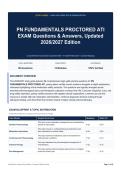
PN FUNDAMENTALS PROCTORED ATI
EXAM Questions & Answers, Updated
2026/2027 Edition
Comprehensive Examination Question Bank • In-Depth Rationales • Concept Mapping
TOTAL QUESTIONS EXAM TOPICS RATIONALES
86 Questions 12 Modules 100% Verified
DOCUMENT OVERVIEW
This 2026/2027 study guide delivers 86 comprehensive high-yield practice questions for PN
FUNDAMENTALS PROCTORED ATI, pairing latest verified correct solutions alongside in-depth explanatory
rationales highlighting critical medication safety protocols. The questions are logically arranged across
essential pharmacological topics and therapeutic subtopics covering Year-Old, Consume Grapefruit Juice, and
drug safety standards, pairing verified answers with targeted clinical explanations. Learners can use this
resource to master high-risk medication administration, reinforce diagnostic decision-making through
self-paced testing, and direct their final revision toward complex clinical pharmacotherapy.
EXAM BLUEPRINT & TOPIC DISTRIBUTION
Systematic breakdown of subject domains and exam coverage.
Topic Module Scope & Core Focus Questions Share (%)
This topic covers medication management and considerations
Geriatric Pharmacology specific to older adults. 8 Qs 9.3%
This topic focuses on understanding drug interactions and
Medication Interactions their implications for patient safety. 8 Qs 9.3%
This topic examines medications used in the treatment of
Cardiovascular Pharmacology cardiovascular conditions. 7 Qs 8.1%
This topic addresses the pharmacological management of
Antiviral Therapy viral infections. 7 Qs 8.1%
This topic explores pharmacological approaches to managing
Pain Management acute and chronic pain. 7 Qs 8.1%
Confidential • Student Study Edition • Practice & Review Guide Page 1 of 45
,STUDENT STUDY & MASTERY EDITION PRACTICE & REVIEW GUIDE
This topic discusses the use of antibiotics for prevention in
Antibiotic Prophylaxis various clinical scenarios. 7 Qs 8.1%
This topic focuses on pharmacological interventions for
Diabetes Management diabetes care. 7 Qs 8.1%
This topic covers medications used in the management of
Respiratory Pharmacology respiratory conditions. 7 Qs 8.1%
This topic examines the role of nutrition-related medications
Nutritional Pharmacology and their interactions. 7 Qs 8.1%
This topic addresses the pharmacological management of
Oncology Pharmacology cancer and its symptoms. 7 Qs 8.1%
This topic focuses on medications used in the treatment of
Psychiatric Pharmacology psychiatric disorders. 7 Qs 8.1%
Preoperative and Postoperative This topic discusses pharmacological considerations in
Care surgical settings. 7 Qs 8.1%
Total Exam Coverage 12 Integrated Topic Modules 86 Qs 100.0%
Confidential • Student Study Edition • Practice & Review Guide Page 2 of 45
,STUDENT STUDY & MASTERY EDITION PRACTICE & REVIEW GUIDE
TOPIC 1: GERIATRIC PHARMACOLOGY
8 Questions • 9.3% of Exam • This topic covers medication management and considerations specific to older adults.
QUESTION 1
A 74-year-old male with a history of chronic obstructive pulmonary disease (COPD),
hypertension, and stage 3 chronic kidney disease is admitted for exacerbation of
dyspnea. He is receiving nebulized albuterol, oral furosemide 40 mg daily, and lisinopril
10 mg daily. Laboratory values reveal: BUN 48 mg/dL (normal 7-20), creatinine 2.2
mg/dL (normal 0.6-1.3), serum potassium 5.2 mEq/L (normal 3.5-5.0), and arterial blood
gas pH 7.32. Which nursing intervention should be prioritized to prevent a
life-threatening complication?
[A] Increase the furosemide dose to promote diuresis.
[B] Hold the lisinopril and monitor potassium closely.
[C] Administer a nebulized ipratropium bromide to improve bronchodilation.
[D] Provide supplemental oxygen to maintain SpO2 above 95%.
Correct Answer: Hold the lisinopril and monitor potassium closely.
Rationale: Elevated potassium and impaired renal function increase the risk of hyperkalemia; ACE inhibitors like lisinopril
can exacerbate this, so holding the drug and monitoring potassium is the immediate priority.
QUESTION 2
A 58-year-old female with type 2 diabetes mellitus, peripheral neuropathy, and a recent
below-knee amputation presents for postoperative wound assessment. The wound
shows a pale, non-granulating base, minimal drainage, and a temperature of 98.4 °F.
Which action best promotes optimal wound healing in this client?
[A] Apply a moist gauze dressing and change it every 24 hours.
[B] Increase the frequency of turning to every two hours.
[C] Administer a high-dose vitamin C supplement.
[D] Encourage the client to perform passive range-of-motion exercises of the residual limb.
Correct Answer: Apply a moist gauze dressing and change it every 24 hours.
Rationale: Moist wound environments facilitate cellular migration and granulation tissue formation; regular moist gauze
changes support optimal healing in diabetic foot wounds.
Confidential • Student Study Edition • Practice & Review Guide Page 3 of 45
, STUDENT STUDY & MASTERY EDITION PRACTICE & REVIEW GUIDE
QUESTION 3
A nurse is conducting a discharge teaching session for a client with newly diagnosed
heart failure who will be using a home weight scale daily. Which instruction best
reinforces accurate self-monitoring?
[A] Weigh yourself first thing in the morning after using the bathroom, before breakfast.
[B] Record your weight after each meal to track fluid shifts.
[C] Weigh yourself before bedtime to capture daily fluid accumulation.
[D] Use the scale after a vigorous exercise session to assess dehydration.
Correct Answer: Weigh yourself first thing in the morning after using the bathroom, before breakfast.
Rationale: Morning weights after voiding provide the most consistent baseline, minimizing variations due to food or activity,
and facilitating early detection of fluid retention.
QUESTION 4
A 50-year-old client with hypertension and hyperlipidemia is prescribed an
angiotensin-II receptor blocker (ARB). The client asks whether it is safe to consume
grapefruit juice daily. Which response is most accurate?
[A] Grapefruit juice can increase ARB levels, so avoid it.
[B] Grapefruit juice has no known interaction with ARBs.
[C] Limit grapefruit juice to less than 8 ounces per day.
[D] Only consume grapefruit juice on days when the ARB is not taken.
Correct Answer: Grapefruit juice has no known interaction with ARBs.
Rationale: Unlike some calcium channel blockers, ARBs are not significantly metabolized by CYP3A4, making grapefruit
juice consumption generally safe.
Confidential • Student Study Edition • Practice & Review Guide Page 4 of 45
PN FUNDAMENTALS PROCTORED ATI
EXAM Questions & Answers, Updated
2026/2027 Edition
Comprehensive Examination Question Bank • In-Depth Rationales • Concept Mapping
TOTAL QUESTIONS EXAM TOPICS RATIONALES
86 Questions 12 Modules 100% Verified
DOCUMENT OVERVIEW
This 2026/2027 study guide delivers 86 comprehensive high-yield practice questions for PN
FUNDAMENTALS PROCTORED ATI, pairing latest verified correct solutions alongside in-depth explanatory
rationales highlighting critical medication safety protocols. The questions are logically arranged across
essential pharmacological topics and therapeutic subtopics covering Year-Old, Consume Grapefruit Juice, and
drug safety standards, pairing verified answers with targeted clinical explanations. Learners can use this
resource to master high-risk medication administration, reinforce diagnostic decision-making through
self-paced testing, and direct their final revision toward complex clinical pharmacotherapy.
EXAM BLUEPRINT & TOPIC DISTRIBUTION
Systematic breakdown of subject domains and exam coverage.
Topic Module Scope & Core Focus Questions Share (%)
This topic covers medication management and considerations
Geriatric Pharmacology specific to older adults. 8 Qs 9.3%
This topic focuses on understanding drug interactions and
Medication Interactions their implications for patient safety. 8 Qs 9.3%
This topic examines medications used in the treatment of
Cardiovascular Pharmacology cardiovascular conditions. 7 Qs 8.1%
This topic addresses the pharmacological management of
Antiviral Therapy viral infections. 7 Qs 8.1%
This topic explores pharmacological approaches to managing
Pain Management acute and chronic pain. 7 Qs 8.1%
Confidential • Student Study Edition • Practice & Review Guide Page 1 of 45
,STUDENT STUDY & MASTERY EDITION PRACTICE & REVIEW GUIDE
This topic discusses the use of antibiotics for prevention in
Antibiotic Prophylaxis various clinical scenarios. 7 Qs 8.1%
This topic focuses on pharmacological interventions for
Diabetes Management diabetes care. 7 Qs 8.1%
This topic covers medications used in the management of
Respiratory Pharmacology respiratory conditions. 7 Qs 8.1%
This topic examines the role of nutrition-related medications
Nutritional Pharmacology and their interactions. 7 Qs 8.1%
This topic addresses the pharmacological management of
Oncology Pharmacology cancer and its symptoms. 7 Qs 8.1%
This topic focuses on medications used in the treatment of
Psychiatric Pharmacology psychiatric disorders. 7 Qs 8.1%
Preoperative and Postoperative This topic discusses pharmacological considerations in
Care surgical settings. 7 Qs 8.1%
Total Exam Coverage 12 Integrated Topic Modules 86 Qs 100.0%
Confidential • Student Study Edition • Practice & Review Guide Page 2 of 45
,STUDENT STUDY & MASTERY EDITION PRACTICE & REVIEW GUIDE
TOPIC 1: GERIATRIC PHARMACOLOGY
8 Questions • 9.3% of Exam • This topic covers medication management and considerations specific to older adults.
QUESTION 1
A 74-year-old male with a history of chronic obstructive pulmonary disease (COPD),
hypertension, and stage 3 chronic kidney disease is admitted for exacerbation of
dyspnea. He is receiving nebulized albuterol, oral furosemide 40 mg daily, and lisinopril
10 mg daily. Laboratory values reveal: BUN 48 mg/dL (normal 7-20), creatinine 2.2
mg/dL (normal 0.6-1.3), serum potassium 5.2 mEq/L (normal 3.5-5.0), and arterial blood
gas pH 7.32. Which nursing intervention should be prioritized to prevent a
life-threatening complication?
[A] Increase the furosemide dose to promote diuresis.
[B] Hold the lisinopril and monitor potassium closely.
[C] Administer a nebulized ipratropium bromide to improve bronchodilation.
[D] Provide supplemental oxygen to maintain SpO2 above 95%.
Correct Answer: Hold the lisinopril and monitor potassium closely.
Rationale: Elevated potassium and impaired renal function increase the risk of hyperkalemia; ACE inhibitors like lisinopril
can exacerbate this, so holding the drug and monitoring potassium is the immediate priority.
QUESTION 2
A 58-year-old female with type 2 diabetes mellitus, peripheral neuropathy, and a recent
below-knee amputation presents for postoperative wound assessment. The wound
shows a pale, non-granulating base, minimal drainage, and a temperature of 98.4 °F.
Which action best promotes optimal wound healing in this client?
[A] Apply a moist gauze dressing and change it every 24 hours.
[B] Increase the frequency of turning to every two hours.
[C] Administer a high-dose vitamin C supplement.
[D] Encourage the client to perform passive range-of-motion exercises of the residual limb.
Correct Answer: Apply a moist gauze dressing and change it every 24 hours.
Rationale: Moist wound environments facilitate cellular migration and granulation tissue formation; regular moist gauze
changes support optimal healing in diabetic foot wounds.
Confidential • Student Study Edition • Practice & Review Guide Page 3 of 45
, STUDENT STUDY & MASTERY EDITION PRACTICE & REVIEW GUIDE
QUESTION 3
A nurse is conducting a discharge teaching session for a client with newly diagnosed
heart failure who will be using a home weight scale daily. Which instruction best
reinforces accurate self-monitoring?
[A] Weigh yourself first thing in the morning after using the bathroom, before breakfast.
[B] Record your weight after each meal to track fluid shifts.
[C] Weigh yourself before bedtime to capture daily fluid accumulation.
[D] Use the scale after a vigorous exercise session to assess dehydration.
Correct Answer: Weigh yourself first thing in the morning after using the bathroom, before breakfast.
Rationale: Morning weights after voiding provide the most consistent baseline, minimizing variations due to food or activity,
and facilitating early detection of fluid retention.
QUESTION 4
A 50-year-old client with hypertension and hyperlipidemia is prescribed an
angiotensin-II receptor blocker (ARB). The client asks whether it is safe to consume
grapefruit juice daily. Which response is most accurate?
[A] Grapefruit juice can increase ARB levels, so avoid it.
[B] Grapefruit juice has no known interaction with ARBs.
[C] Limit grapefruit juice to less than 8 ounces per day.
[D] Only consume grapefruit juice on days when the ARB is not taken.
Correct Answer: Grapefruit juice has no known interaction with ARBs.
Rationale: Unlike some calcium channel blockers, ARBs are not significantly metabolized by CYP3A4, making grapefruit
juice consumption generally safe.
Confidential • Student Study Edition • Practice & Review Guide Page 4 of 45