
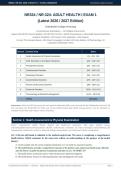
NR324 / NR-324: ADULT HEALTH I — EXAM 1 (2026/2027) Chamberlain College of Nursing
NR324 / NR-324: ADULT HEALTH I EXAM 1
(Latest Edition)
Chamberlain College of Nursing
Comprehensive Examination — 120 Multiple-Choice Items
Aligned with NR 324 Course Syllabus • NCLEX-RN Test Plan • QSEN Competencies • Adult Health Nursing Standards
Cognitive Distribution: 20% Recall • 50% Application • 30% Analysis
Format: 75% Scenario-Based • 25% Direct Knowledge | Includes 20 Priority-Setting, 15 Pharmacology, 10
Laboratory-Interpretation Items
Section Content Area Items
1 Health Assessment & Physical Examination Q1 – Q15 (15)
2 Fluid, Electrolyte, & Acid-Base Imbalances Q16 – Q30 (15)
3 Perioperative Nursing Q31 – Q42 (12)
4 Cardiovascular Disorders Q43 – Q60 (18)
5 Respiratory Disorders Q61 – Q75 (15)
6 Gastrointestinal Disorders Q76 – Q87 (12)
7 Renal & Genitourinary Disorders Q88 – Q99 (12)
8 Endocrine Disorders Q100 – Q111 (12)
9 Pharmacology & Medication Management Q112 – Q120 (9)
TOTAL 120 Items
Instructions: Select the ONE best answer for each question. Rationales follow every item and cite the Chamberlain University NR
324 curriculum, the NCLEX-RN Test Plan, and current evidence-based adult health nursing practice. Use the rationales to
remediate missed items and reinforce clinical reasoning.
Section 1: Health Assessment & Physical Examination
Focus: comprehensive health history, focused and head-to-toe assessment, vital signs, general survey,
inspection/palpation/percussion/auscultation, HEENT, cardiovascular, respiratory, GI, renal, neurological, musculoskeletal, and
integumentary examinations, normal vs. abnormal findings, documentation, age-related and cultural considerations.
Q1: A 68-year-old female is admitted to the medical-surgical unit. The nurse is completing a comprehensive
health history. Which statement by the nurse best reflects an understanding of the purpose of the health
history?
A. I need to gather only the current complaint information so I can finish my assessment quickly.
B. The health history provides a comprehensive picture of the patient's past and present health status, lifestyle,
and risk factors to guide the physical examination and plan of care. *[CORRECT]*
C. The health history is primarily used to verify the physician's admission diagnosis.
D. The health history focuses on collecting laboratory data and diagnostic test results.
Comprehensive Examination — 120 Items Aligned with NCLEX-RN Test Plan & QSEN Competencies Page 1
,NR324 / NR-324: ADULT HEALTH I — EXAM 1 (2026/2027) Chamberlain College of Nursing
Correct Answer: B
Rationale: The health history is the foundation of nursing assessment and provides a holistic picture of the patient's past
and present health, lifestyle, family history, psychosocial factors, and risk factors that guide both the physical exam and the
plan of care (Chamberlain NR 324 Module 1; Jarvis, 2026). Option A is incomplete and shortcuts safety. Option C reflects a
medical-model focus rather than nursing. Option D confuses the history with diagnostic data, which is adjunctive rather
than primary.
Q2: The nurse is preparing to perform a head-to-toe assessment on an 82-year-old male resident of a long-term
care facility. Which age-related change should the nurse anticipate that may affect assessment findings?
A. Increased tactile sensitivity and hyperactive deep tendon reflexes
B. Decreased lung elasticity and increased chest wall stiffness leading to decreased breath sounds at the bases
*[CORRECT]*
C. Thickening of the tympanic membrane causing hyperacusis
D. Increased peripheral nerve conduction velocity resulting in brisker reflexes
Correct Answer: B
Rationale: Older adults experience decreased lung elasticity, stiffening of the chest wall, and reduced vital capacity, which
can produce diminished basilar breath sounds and increased residual volume (Jarvis, 2026; Tabloski, 2024). Options A and
D are incorrect because tactile sensitivity and nerve conduction decline with age, producing decreased—not
increased—reflexes. Option C is incorrect; the tympanic membrane stiffens, causing presbycusis (hearing loss), not
hyperacusis.
Q3: While performing a cardiovascular assessment on a 55-year-old African American male with a history of
hypertension, the nurse auscultates an S3 heart sound at the apex. Which interpretation by the nurse is most
accurate?
A. An S3 is a normal age-related finding in adults older than 50.
B. An S3 in an adult over 35 often indicates increased ventricular filling pressure and may signal heart failure or
volume overload. *[CORRECT]*
C. An S3 is best heard at the second right intercostal space and indicates aortic stenosis.
D. An S3 is a benign finding that requires no further evaluation.
Correct Answer: B
Rationale: An S3 (ventricular gallop) in an adult over age 35 is generally pathologic and reflects rapid ventricular filling
due to volume overload or decreased compliance, commonly seen in heart failure (AHA, 2025; Chamberlain NR 324
Module 4). It is best heard at the apex with the bell. Option A is incorrect—S3 is abnormal in adults. Option C confuses S3
with a murmur of aortic stenosis. Option D dismisses a potentially serious sign requiring further evaluation.
Q4: The nurse is performing a focused respiratory assessment on a 72-year-old patient with COPD. Which
finding requires immediate follow-up?
A. Barrel chest with increased anteroposterior diameter
B. Pursed-lip breathing with prolonged expiratory phase
C. Asymmetric chest expansion with absent breath sounds on the right side *[CORRECT]*
D. Use of accessory muscles with activity
Correct Answer: C
Rationale: Asymmetric chest expansion with absent breath sounds is an acute, potentially life-threatening finding
suggesting pneumothorax, pleural effusion, atelectasis, or mainstem bronchus obstruction and requires immediate provider
notification (AARC, 2025; QSEN Safety). Options A, B, and D are expected chronic findings in COPD and do not indicate
an acute emergency. Prioritization requires distinguishing expected disease manifestations from acute deterioration.
Comprehensive Examination — 120 Items Aligned with NCLEX-RN Test Plan & QSEN Competencies Page 2
,NR324 / NR-324: ADULT HEALTH I — EXAM 1 (2026/2027) Chamberlain College of Nursing
Q5: A nurse is assessing the abdomen of a 45-year-old female admitted with right lower quadrant pain. In
which sequence should the nurse perform the abdominal assessment?
A. Percussion, palpation, inspection, auscultation
B. Auscultation, inspection, percussion, palpation
C. Inspection, auscultation, percussion, palpation *[CORRECT]*
D. Inspection, palpation, percussion, auscultation
Correct Answer: C
Rationale: The correct sequence for abdominal assessment is inspection, auscultation, percussion, then palpation.
Auscultation is performed before percussion and palpation because manipulating the abdomen can alter bowel sounds and
produce false findings (Jarvis, 2026; Chamberlain NR 324 Module 1). Any other sequence compromises the validity of the
assessment and is considered a fundamental nursing error.
Q6: A nurse is taking vital signs on a 60-year-old patient. The patient's blood pressure is 162/96 mmHg in the
right arm and 148/88 mmHg in the left arm. Which action should the nurse take first?
A. Document the right arm reading as the official blood pressure and proceed with care.
B. Notify the provider of a significant inter-arm BP difference greater than 10 mmHg systolic. *[CORRECT]*
C. Recheck both arms in 30 minutes and record the average.
D. Administer the patient's scheduled antihypertensive immediately.
Correct Answer: B
Rationale: An inter-arm systolic BP difference greater than 10 mmHg is associated with peripheral arterial disease,
subclavian stenosis, and increased cardiovascular risk and warrants provider notification and further evaluation (AHA,
2025). Option A dismisses the abnormal finding. Option C delays needed follow-up. Option D is premature without provider
notification and assessment of the underlying cause.
Q7: During a neurological assessment, the nurse tests pupillary response on a 58-year-old postoperative patient.
The nurse documents that the pupils are equal, round, and reactive to light and accommodation. Which cranial
nerves are being assessed?
A. Cranial nerves II and III *[CORRECT]*
B. Cranial nerves III, IV, and VI
C. Cranial nerves II and IV
D. Cranial nerves V and VII
Correct Answer: A
Rationale: Pupillary response tests cranial nerve II (optic, afferent limb of the light reflex) and cranial nerve III
(oculomotor, efferent limb controlling pupillary constriction and accommodation) (Hickey, 2025; Chamberlain NR 324
Module 1). CN IV and VI control extraocular movements but not pupillary constriction. CN V and VII are facial sensation
and movement, respectively.
Q8: A 50-year-old male presents to the emergency department with new onset of confusion. The nurse is
assessing level of consciousness using the Glasgow Coma Scale. The patient opens eyes to painful stimulus,
makes incomprehensible sounds, and exhibits abnormal flexion (decorticate) to pain. What is the patient's GCS
score?
A. GCS 6
B. GCS 7 *[CORRECT]*
C. GCS 8
D. GCS 9
Correct Answer: B
Comprehensive Examination — 120 Items Aligned with NCLEX-RN Test Plan & QSEN Competencies Page 3
, NR324 / NR-324: ADULT HEALTH I — EXAM 1 (2026/2027) Chamberlain College of Nursing
Rationale: GCS scoring: Eye opening to pain = 2, Verbal incomprehensible sounds = 2, Motor abnormal flexion
(decorticate) = 3. Total = 2+2+3 = 7, indicating severe neurological impairment (Teasdale, 2024; Brain Trauma
Foundation, 2025). A GCS of 8 or less typically indicates coma and the need for airway protection. The other calculations
are mathematically incorrect based on the described responses.
Q9: Which of the following findings during a skin assessment of a 70-year-old patient should be reported to the
provider immediately as a potential sign of malignancy?
A. A 0.5 cm round, tan, well-circumscribed seborrheic keratosis on the back
B. An asymmetric, irregularly bordered, dark brown-black mole 8 mm in diameter on the upper back that has
changed color over the past month *[CORRECT]*
C. A 1 cm cherry angioma on the trunk
D. Multiple senile lentigines (liver spots) on the dorsum of the hands
Correct Answer: B
Rationale: The ABCDE rule of melanoma detection identifies Asymmetry, Border irregularity, Color variation, Diameter
greater than 6 mm, and Evolution (change) as warning signs (ACS, 2025). The described mole meets all five criteria and
requires immediate referral. Seborrheic keratoses, cherry angiomas, and senile lentigines are benign age-related findings
that do not require urgent evaluation.
Q10: The nurse is assessing an older adult patient's functional status using the Katz Index of Independence in
Activities of Daily Living. The patient requires assistance with bathing and dressing but is independent in
feeding, toileting, transferring, and continence. What is the patient's Katz score and interpretation?
A. Score of 6 — fully independent
B. Score of 4 — moderate impairment *[CORRECT]*
C. Score of 2 — severe functional impairment
D. Score of 0 — totally dependent
Correct Answer: B
Rationale: The Katz Index scores six ADLs (bathing, dressing, toileting, transferring, continence, feeding), each worth 1
point if independent. The patient is independent in 4 ADLs = score of 4, indicating moderate functional impairment that
warrants further assessment and possible supportive services (Katz, 2024; Chamberlain NR 324 Module 1). Score of 6
requires independence in all; scores of 2 and 0 reflect much greater dependence.
Q11: A nurse is performing a focused musculoskeletal assessment on a 65-year-old female with suspected
osteoporosis. Which finding would be most consistent with a compression fracture of the thoracic spine?
A. Symmetric 4+ deep tendon reflexes in all extremities
B. Loss of height of 2 inches over 5 years and exaggerated thoracic kyphosis *[CORRECT]*
C. Equal muscle bulk and tone in upper and lower extremities
D. Full range of motion in all spinal segments without pain
Correct Answer: B
Rationale: Loss of height (often greater than 1.5 inches) and an exaggerated thoracic kyphosis (dowager's hump) are
classic signs of osteoporotic compression fractures of the thoracic spine (NOF, 2024; Chamberlain NR 324 Module 1).
Options A, C, and D describe normal findings inconsistent with vertebral compression fractures. The kyphosis results from
anterior wedging of compressed vertebral bodies.
Q12: A 35-year-old female patient is admitted with acute abdominal pain rated 8/10. The nurse performs a pain
assessment using the COLDSPA mnemonic. Which element addresses the 'O' in COLDSPA?
A. Onset — when the pain began *[CORRECT]*
B. Origin — the anatomic source of the pain
C. Other symptoms — associated findings such as nausea or fever
Comprehensive Examination — 120 Items Aligned with NCLEX-RN Test Plan & QSEN Competencies Page 4
NR324 / NR-324: ADULT HEALTH I EXAM 1
(Latest Edition)
Chamberlain College of Nursing
Comprehensive Examination — 120 Multiple-Choice Items
Aligned with NR 324 Course Syllabus • NCLEX-RN Test Plan • QSEN Competencies • Adult Health Nursing Standards
Cognitive Distribution: 20% Recall • 50% Application • 30% Analysis
Format: 75% Scenario-Based • 25% Direct Knowledge | Includes 20 Priority-Setting, 15 Pharmacology, 10
Laboratory-Interpretation Items
Section Content Area Items
1 Health Assessment & Physical Examination Q1 – Q15 (15)
2 Fluid, Electrolyte, & Acid-Base Imbalances Q16 – Q30 (15)
3 Perioperative Nursing Q31 – Q42 (12)
4 Cardiovascular Disorders Q43 – Q60 (18)
5 Respiratory Disorders Q61 – Q75 (15)
6 Gastrointestinal Disorders Q76 – Q87 (12)
7 Renal & Genitourinary Disorders Q88 – Q99 (12)
8 Endocrine Disorders Q100 – Q111 (12)
9 Pharmacology & Medication Management Q112 – Q120 (9)
TOTAL 120 Items
Instructions: Select the ONE best answer for each question. Rationales follow every item and cite the Chamberlain University NR
324 curriculum, the NCLEX-RN Test Plan, and current evidence-based adult health nursing practice. Use the rationales to
remediate missed items and reinforce clinical reasoning.
Section 1: Health Assessment & Physical Examination
Focus: comprehensive health history, focused and head-to-toe assessment, vital signs, general survey,
inspection/palpation/percussion/auscultation, HEENT, cardiovascular, respiratory, GI, renal, neurological, musculoskeletal, and
integumentary examinations, normal vs. abnormal findings, documentation, age-related and cultural considerations.
Q1: A 68-year-old female is admitted to the medical-surgical unit. The nurse is completing a comprehensive
health history. Which statement by the nurse best reflects an understanding of the purpose of the health
history?
A. I need to gather only the current complaint information so I can finish my assessment quickly.
B. The health history provides a comprehensive picture of the patient's past and present health status, lifestyle,
and risk factors to guide the physical examination and plan of care. *[CORRECT]*
C. The health history is primarily used to verify the physician's admission diagnosis.
D. The health history focuses on collecting laboratory data and diagnostic test results.
Comprehensive Examination — 120 Items Aligned with NCLEX-RN Test Plan & QSEN Competencies Page 1
,NR324 / NR-324: ADULT HEALTH I — EXAM 1 (2026/2027) Chamberlain College of Nursing
Correct Answer: B
Rationale: The health history is the foundation of nursing assessment and provides a holistic picture of the patient's past
and present health, lifestyle, family history, psychosocial factors, and risk factors that guide both the physical exam and the
plan of care (Chamberlain NR 324 Module 1; Jarvis, 2026). Option A is incomplete and shortcuts safety. Option C reflects a
medical-model focus rather than nursing. Option D confuses the history with diagnostic data, which is adjunctive rather
than primary.
Q2: The nurse is preparing to perform a head-to-toe assessment on an 82-year-old male resident of a long-term
care facility. Which age-related change should the nurse anticipate that may affect assessment findings?
A. Increased tactile sensitivity and hyperactive deep tendon reflexes
B. Decreased lung elasticity and increased chest wall stiffness leading to decreased breath sounds at the bases
*[CORRECT]*
C. Thickening of the tympanic membrane causing hyperacusis
D. Increased peripheral nerve conduction velocity resulting in brisker reflexes
Correct Answer: B
Rationale: Older adults experience decreased lung elasticity, stiffening of the chest wall, and reduced vital capacity, which
can produce diminished basilar breath sounds and increased residual volume (Jarvis, 2026; Tabloski, 2024). Options A and
D are incorrect because tactile sensitivity and nerve conduction decline with age, producing decreased—not
increased—reflexes. Option C is incorrect; the tympanic membrane stiffens, causing presbycusis (hearing loss), not
hyperacusis.
Q3: While performing a cardiovascular assessment on a 55-year-old African American male with a history of
hypertension, the nurse auscultates an S3 heart sound at the apex. Which interpretation by the nurse is most
accurate?
A. An S3 is a normal age-related finding in adults older than 50.
B. An S3 in an adult over 35 often indicates increased ventricular filling pressure and may signal heart failure or
volume overload. *[CORRECT]*
C. An S3 is best heard at the second right intercostal space and indicates aortic stenosis.
D. An S3 is a benign finding that requires no further evaluation.
Correct Answer: B
Rationale: An S3 (ventricular gallop) in an adult over age 35 is generally pathologic and reflects rapid ventricular filling
due to volume overload or decreased compliance, commonly seen in heart failure (AHA, 2025; Chamberlain NR 324
Module 4). It is best heard at the apex with the bell. Option A is incorrect—S3 is abnormal in adults. Option C confuses S3
with a murmur of aortic stenosis. Option D dismisses a potentially serious sign requiring further evaluation.
Q4: The nurse is performing a focused respiratory assessment on a 72-year-old patient with COPD. Which
finding requires immediate follow-up?
A. Barrel chest with increased anteroposterior diameter
B. Pursed-lip breathing with prolonged expiratory phase
C. Asymmetric chest expansion with absent breath sounds on the right side *[CORRECT]*
D. Use of accessory muscles with activity
Correct Answer: C
Rationale: Asymmetric chest expansion with absent breath sounds is an acute, potentially life-threatening finding
suggesting pneumothorax, pleural effusion, atelectasis, or mainstem bronchus obstruction and requires immediate provider
notification (AARC, 2025; QSEN Safety). Options A, B, and D are expected chronic findings in COPD and do not indicate
an acute emergency. Prioritization requires distinguishing expected disease manifestations from acute deterioration.
Comprehensive Examination — 120 Items Aligned with NCLEX-RN Test Plan & QSEN Competencies Page 2
,NR324 / NR-324: ADULT HEALTH I — EXAM 1 (2026/2027) Chamberlain College of Nursing
Q5: A nurse is assessing the abdomen of a 45-year-old female admitted with right lower quadrant pain. In
which sequence should the nurse perform the abdominal assessment?
A. Percussion, palpation, inspection, auscultation
B. Auscultation, inspection, percussion, palpation
C. Inspection, auscultation, percussion, palpation *[CORRECT]*
D. Inspection, palpation, percussion, auscultation
Correct Answer: C
Rationale: The correct sequence for abdominal assessment is inspection, auscultation, percussion, then palpation.
Auscultation is performed before percussion and palpation because manipulating the abdomen can alter bowel sounds and
produce false findings (Jarvis, 2026; Chamberlain NR 324 Module 1). Any other sequence compromises the validity of the
assessment and is considered a fundamental nursing error.
Q6: A nurse is taking vital signs on a 60-year-old patient. The patient's blood pressure is 162/96 mmHg in the
right arm and 148/88 mmHg in the left arm. Which action should the nurse take first?
A. Document the right arm reading as the official blood pressure and proceed with care.
B. Notify the provider of a significant inter-arm BP difference greater than 10 mmHg systolic. *[CORRECT]*
C. Recheck both arms in 30 minutes and record the average.
D. Administer the patient's scheduled antihypertensive immediately.
Correct Answer: B
Rationale: An inter-arm systolic BP difference greater than 10 mmHg is associated with peripheral arterial disease,
subclavian stenosis, and increased cardiovascular risk and warrants provider notification and further evaluation (AHA,
2025). Option A dismisses the abnormal finding. Option C delays needed follow-up. Option D is premature without provider
notification and assessment of the underlying cause.
Q7: During a neurological assessment, the nurse tests pupillary response on a 58-year-old postoperative patient.
The nurse documents that the pupils are equal, round, and reactive to light and accommodation. Which cranial
nerves are being assessed?
A. Cranial nerves II and III *[CORRECT]*
B. Cranial nerves III, IV, and VI
C. Cranial nerves II and IV
D. Cranial nerves V and VII
Correct Answer: A
Rationale: Pupillary response tests cranial nerve II (optic, afferent limb of the light reflex) and cranial nerve III
(oculomotor, efferent limb controlling pupillary constriction and accommodation) (Hickey, 2025; Chamberlain NR 324
Module 1). CN IV and VI control extraocular movements but not pupillary constriction. CN V and VII are facial sensation
and movement, respectively.
Q8: A 50-year-old male presents to the emergency department with new onset of confusion. The nurse is
assessing level of consciousness using the Glasgow Coma Scale. The patient opens eyes to painful stimulus,
makes incomprehensible sounds, and exhibits abnormal flexion (decorticate) to pain. What is the patient's GCS
score?
A. GCS 6
B. GCS 7 *[CORRECT]*
C. GCS 8
D. GCS 9
Correct Answer: B
Comprehensive Examination — 120 Items Aligned with NCLEX-RN Test Plan & QSEN Competencies Page 3
, NR324 / NR-324: ADULT HEALTH I — EXAM 1 (2026/2027) Chamberlain College of Nursing
Rationale: GCS scoring: Eye opening to pain = 2, Verbal incomprehensible sounds = 2, Motor abnormal flexion
(decorticate) = 3. Total = 2+2+3 = 7, indicating severe neurological impairment (Teasdale, 2024; Brain Trauma
Foundation, 2025). A GCS of 8 or less typically indicates coma and the need for airway protection. The other calculations
are mathematically incorrect based on the described responses.
Q9: Which of the following findings during a skin assessment of a 70-year-old patient should be reported to the
provider immediately as a potential sign of malignancy?
A. A 0.5 cm round, tan, well-circumscribed seborrheic keratosis on the back
B. An asymmetric, irregularly bordered, dark brown-black mole 8 mm in diameter on the upper back that has
changed color over the past month *[CORRECT]*
C. A 1 cm cherry angioma on the trunk
D. Multiple senile lentigines (liver spots) on the dorsum of the hands
Correct Answer: B
Rationale: The ABCDE rule of melanoma detection identifies Asymmetry, Border irregularity, Color variation, Diameter
greater than 6 mm, and Evolution (change) as warning signs (ACS, 2025). The described mole meets all five criteria and
requires immediate referral. Seborrheic keratoses, cherry angiomas, and senile lentigines are benign age-related findings
that do not require urgent evaluation.
Q10: The nurse is assessing an older adult patient's functional status using the Katz Index of Independence in
Activities of Daily Living. The patient requires assistance with bathing and dressing but is independent in
feeding, toileting, transferring, and continence. What is the patient's Katz score and interpretation?
A. Score of 6 — fully independent
B. Score of 4 — moderate impairment *[CORRECT]*
C. Score of 2 — severe functional impairment
D. Score of 0 — totally dependent
Correct Answer: B
Rationale: The Katz Index scores six ADLs (bathing, dressing, toileting, transferring, continence, feeding), each worth 1
point if independent. The patient is independent in 4 ADLs = score of 4, indicating moderate functional impairment that
warrants further assessment and possible supportive services (Katz, 2024; Chamberlain NR 324 Module 1). Score of 6
requires independence in all; scores of 2 and 0 reflect much greater dependence.
Q11: A nurse is performing a focused musculoskeletal assessment on a 65-year-old female with suspected
osteoporosis. Which finding would be most consistent with a compression fracture of the thoracic spine?
A. Symmetric 4+ deep tendon reflexes in all extremities
B. Loss of height of 2 inches over 5 years and exaggerated thoracic kyphosis *[CORRECT]*
C. Equal muscle bulk and tone in upper and lower extremities
D. Full range of motion in all spinal segments without pain
Correct Answer: B
Rationale: Loss of height (often greater than 1.5 inches) and an exaggerated thoracic kyphosis (dowager's hump) are
classic signs of osteoporotic compression fractures of the thoracic spine (NOF, 2024; Chamberlain NR 324 Module 1).
Options A, C, and D describe normal findings inconsistent with vertebral compression fractures. The kyphosis results from
anterior wedging of compressed vertebral bodies.
Q12: A 35-year-old female patient is admitted with acute abdominal pain rated 8/10. The nurse performs a pain
assessment using the COLDSPA mnemonic. Which element addresses the 'O' in COLDSPA?
A. Onset — when the pain began *[CORRECT]*
B. Origin — the anatomic source of the pain
C. Other symptoms — associated findings such as nausea or fever
Comprehensive Examination — 120 Items Aligned with NCLEX-RN Test Plan & QSEN Competencies Page 4


