
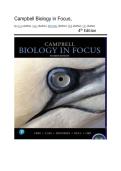
Campbell Biology in Focus,
by Urry (Author), Cain (Author), Minorsky (Author), Hull (Author), Orr (Author)
4th Edition
,TABLE OF CONTENTS
1. Introduction: Evolution and the Foundations of Biology
UNIT 1: CHEMISTRY AND CELLS
2. The Chemical Context of Life
3. Carbon and the Molecular Diversity of Life
4. A Tour of the Cell
5. Membrane Transport and Cell Signaling
6. An Introduction to Metabolism
7. Cellular Respiration and Fermentation
8. Photosynthesis
9. The Cell Cycle
UNIT 2: GENETICS
10. Meiosis and Sexual Life Cycles
11. Mendel and the Gene Idea
12. The Chromosomal Basis of Inheritance
13. The Molecular Basis of Inheritance
14. Gene Expression: From Gene to Protein
15. Regulation of Gene Expression
16. Development, Stem Cells, and Cancer
17. Viruses
18. Genomes and Their Evolution
UNIT 3: EVOLUTION
19. Descent with Modification
20. Phylogeny
21. The Evolution of Populations
22. The Origin of Species
23. Broad Patterns of Evolution
UNIT 4: THE EVOLUTIONARY HISTORY OF LIFE
, 24. Early Life and the Diversification of Prokaryotes
25. The Origin and Diversification of Eukaryotes
26. The Colonization of Land
27. The Rise of Animal Diversity
UNIT 5: PLANT FORM AND FUNCTION
28. Vascular Plant Structure and Growth
29. Resource Acquisition, Nutrition, and Transport in Vascular Plants
30. Reproduction and Domestication of Flowering Plants
31. Plant Responses to Internal and External Signals
UNIT 6: ANIMAL FORM AND FUNCTION
32. The Internal Environment of Animals: Organization and Regulation
33. Animal Nutrition
34. Circulation and Gas Exchange
35. The Immune System
36. Reproduction and Development
37. Neurons, Synapses, and Signaling
38. Nervous and Sensory Systems
39. Motor Mechanisms and Behavior
UNIT 7: ECOLOGY
40. Population Ecology and the Distribution of Organisms
41. Ecological Communities
42. Ecosystems and Energy
43. Conservation Biology and Global Change
, TEST BANK
Campbell Biology in Focus, 4th Edition (Urry, 2020)
Chapters 1–43
CHAPTER 1: INTRODUCTION: EVOLUTION AND THE FOUNDATIONS OF
BIOLOGY
Multiple Choice Questions
1.1 Which of the following is the smallest unit that can evolve?
A) A single organism
B) A population
C) A species
D) An ecosystem
E) A cell
Answer: B
Explanation: Evolution occurs at the population level through changes in allele frequencies over
generations. Individual organisms do not evolve; populations do.
Bloom's Level: Knowledge/Comprehension
Section: 1.2 Evolution, the Core Theme of Biology
1.2 Which of the following is NOT one of the properties associated with life?
A) Evolutionary adaptation
B) Energy processing
C) Response to the environment
D) Maintaining a constant internal temperature
E) Reproduction
Answer: D
Explanation: Maintaining a constant internal temperature (thermoregulation) is not a universal
property of life. Many organisms are ectotherms. The properties of life include order, reproduction,
growth and development, energy processing, response to the environment, regulation (homeostasis),
and evolutionary adaptation.
Bloom's Level: Knowledge/Comprehension
Section: 1.1 The Study of Life
by Urry (Author), Cain (Author), Minorsky (Author), Hull (Author), Orr (Author)
4th Edition
,TABLE OF CONTENTS
1. Introduction: Evolution and the Foundations of Biology
UNIT 1: CHEMISTRY AND CELLS
2. The Chemical Context of Life
3. Carbon and the Molecular Diversity of Life
4. A Tour of the Cell
5. Membrane Transport and Cell Signaling
6. An Introduction to Metabolism
7. Cellular Respiration and Fermentation
8. Photosynthesis
9. The Cell Cycle
UNIT 2: GENETICS
10. Meiosis and Sexual Life Cycles
11. Mendel and the Gene Idea
12. The Chromosomal Basis of Inheritance
13. The Molecular Basis of Inheritance
14. Gene Expression: From Gene to Protein
15. Regulation of Gene Expression
16. Development, Stem Cells, and Cancer
17. Viruses
18. Genomes and Their Evolution
UNIT 3: EVOLUTION
19. Descent with Modification
20. Phylogeny
21. The Evolution of Populations
22. The Origin of Species
23. Broad Patterns of Evolution
UNIT 4: THE EVOLUTIONARY HISTORY OF LIFE
, 24. Early Life and the Diversification of Prokaryotes
25. The Origin and Diversification of Eukaryotes
26. The Colonization of Land
27. The Rise of Animal Diversity
UNIT 5: PLANT FORM AND FUNCTION
28. Vascular Plant Structure and Growth
29. Resource Acquisition, Nutrition, and Transport in Vascular Plants
30. Reproduction and Domestication of Flowering Plants
31. Plant Responses to Internal and External Signals
UNIT 6: ANIMAL FORM AND FUNCTION
32. The Internal Environment of Animals: Organization and Regulation
33. Animal Nutrition
34. Circulation and Gas Exchange
35. The Immune System
36. Reproduction and Development
37. Neurons, Synapses, and Signaling
38. Nervous and Sensory Systems
39. Motor Mechanisms and Behavior
UNIT 7: ECOLOGY
40. Population Ecology and the Distribution of Organisms
41. Ecological Communities
42. Ecosystems and Energy
43. Conservation Biology and Global Change
, TEST BANK
Campbell Biology in Focus, 4th Edition (Urry, 2020)
Chapters 1–43
CHAPTER 1: INTRODUCTION: EVOLUTION AND THE FOUNDATIONS OF
BIOLOGY
Multiple Choice Questions
1.1 Which of the following is the smallest unit that can evolve?
A) A single organism
B) A population
C) A species
D) An ecosystem
E) A cell
Answer: B
Explanation: Evolution occurs at the population level through changes in allele frequencies over
generations. Individual organisms do not evolve; populations do.
Bloom's Level: Knowledge/Comprehension
Section: 1.2 Evolution, the Core Theme of Biology
1.2 Which of the following is NOT one of the properties associated with life?
A) Evolutionary adaptation
B) Energy processing
C) Response to the environment
D) Maintaining a constant internal temperature
E) Reproduction
Answer: D
Explanation: Maintaining a constant internal temperature (thermoregulation) is not a universal
property of life. Many organisms are ectotherms. The properties of life include order, reproduction,
growth and development, energy processing, response to the environment, regulation (homeostasis),
and evolutionary adaptation.
Bloom's Level: Knowledge/Comprehension
Section: 1.1 The Study of Life



