
NUR 2214 / NUR2214: Nursing Care of the Older Adult - Quiz 2 Review (2026/2027) Page 1
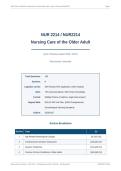
NUR 2214 / NUR2214
Nursing Care of the Older Adult
Quiz 2 Review (Latest )
Rasmussen University
Total Questions: 100
Sections: 8
Cognitive Levels: 20% Recall | 50% Application | 30% Analysis
Style: 75% Scenario-Based | 25% Direct Knowledge
Format: Multiple Choice (4 options, single best answer)
Aligned With: NCLEX-RN Test Plan, QSEN Competencies,
Gerontological Nursing Standards
Edition: 2026/2027
Section Breakdown
Section Topic Qs
1 Age-Related Physiological Changes Q1-Q15 (15)
2 Comprehensive Geriatric Assessment Q16-Q30 (15)
3 Geriatric Syndromes Q31-Q45 (15)
4 Common Chronic Conditions in Older Adults Q46-Q60 (15)
Rasmussen University - NUR 2214 - Comprehensive Quiz 2 Review - 100 Questions 2026/2027 Edition
,NUR 2214 / NUR2214: Nursing Care of the Older Adult - Quiz 2 Review (2026/2027) Page 2
5 Geriatric Pharmacology & Polypharmacy Q61-Q72 (12)
6 Psychosocial & Mental Health Issues Q73-Q84 (12)
7 Palliative & End-of-Life Care Q85-Q92 (8)
8 Healthcare Policy, Ethics, & Care Coordination Q93-Q100 (8)
Aligned with NUR 2214 Rasmussen Course Syllabus, NCLEX-RN Test Plan, QSEN Competencies, AACN Essentials, and
Gerontological Nursing Standards.
Rasmussen University - NUR 2214 - Comprehensive Quiz 2 Review - 100 Questions 2026/2027 Edition
,NUR 2214 / NUR2214: Nursing Care of the Older Adult - Quiz 2 Review (2026/2027) Page 3
Examination Overview & Instructions
This comprehensive 100-question review examination is designed to assess mastery of core gerontological
nursing concepts aligned with the Rasmussen University NUR 2214 Nursing Care of the Older Adult course
syllabus. The examination integrates the NCLEX-RN Test Plan, QSEN Competencies, AACN Essentials, and
current Gerontological Nursing Standards to prepare students for safe, evidence-based care of older adults
across diverse settings.
Cognitive levels are distributed as follows: approximately 20% of items assess recall of essential knowledge,
50% assess application of concepts to clinical situations, and 30% assess analysis including clinical reasoning,
comprehensive assessment, and complex care management. Approximately 75% of items are scenario-based,
presenting realistic patient presentations and clinical situations, while 25% assess direct knowledge recall.
Each question includes four options (A-D) with one best answer and a detailed rationale linking the item to NUR
2214 curriculum content and evidence-based gerontological practice.
Topics span age-related physiological changes, comprehensive geriatric assessment, geriatric syndromes,
common chronic conditions, pharmacology and polypharmacy, psychosocial and mental health issues,
palliative and end-of-life care, and healthcare policy, ethics, and care coordination. The examination
emphasizes the Age-Friendly Health Systems 4Ms framework (What Matters, Medication, Mentation, Mobility),
the AACN Synergy Model, and the nurse's role in promoting function, autonomy, dignity, and quality of life for
older adults.
Section 1: Age-Related Physiological Changes
Q1: An 82-year-old female is prescribed hydrochlorothiazide 25 mg daily for hypertension. Three
days after starting therapy, she reports dizziness when standing from her chair. Which age-related
cardiovascular change most directly contributes to this presentation?
A. Increased baroreceptor sensitivity leading to exaggerated heart rate response
B. Enhanced beta-adrenergic receptor responsiveness increasing cardiac output
C. Increased venous return from improved calf-muscle pump efficiency
D. Decreased arterial elasticity and blunted baroreceptor response causing orthostatic hypotension
*[CORRECT]*
Correct Answer: D
Rationale: Aging reduces arterial compliance and blunts baroreceptor-mediated compensation, predisposing
older adults to orthostatic hypotension, especially with diuretics or vasodilators. Option A is incorrect because
baroreceptor sensitivity declines with age. Option C is wrong because beta-adrenergic responsiveness
decreases. Option D is wrong because the calf-muscle pump weakens with sarcopenia. This aligns with NUR
2214 content on cardiovascular homeostenosis and the AACN Synergy Model's recognition of reduced
physiological reserve.
Rasmussen University - NUR 2214 - Comprehensive Quiz 2 Review - 100 Questions 2026/2027 Edition
, NUR 2214 / NUR2214: Nursing Care of the Older Adult - Quiz 2 Review (2026/2027) Page 4
Q2: A 78-year-old male is recovering from abdominal surgery. Compared to a younger adult, which
respiratory change places him at highest risk for postoperative atelectasis and pneumonia?
A. Increased vital capacity and improved mucociliary clearance
B. Decreased chest wall compliance and blunted cough reflex *[CORRECT]*
C. Increased lung elastic recoil and improved ventilation-perfusion matching
D. Enhanced respiratory muscle strength and increased ciliary action
Correct Answer: B
Rationale: Aging decreases chest wall compliance (costal cartilage calcification) and blunts the cough reflex,
both of which impair secretion clearance and raise postoperative pulmonary risk. Vital capacity actually
decreases, ruling out A. Respiratory muscle strength declines with sarcopenia, ruling out C. Lung elastic recoil
decreases with alveolar enlargement, ruling out D. QSEN Safety competencies support early ambulation and
incentive spirometry in this population.
Q3: A physician orders gentamicin for a 75-year-old patient with a urinary tract infection. Which
renal change of aging most directly increases this patient's risk of nephrotoxicity and ototoxicity?
A. Increased tubular secretion accelerating aminoglycoside elimination
B. Increased glomerular filtration rate (GFR) leading to rapid drug clearance
C. Enhanced renal blood flow providing better drug delivery
D. Decreased GFR and reduced renal blood flow prolonging drug half-life *[CORRECT]*
Correct Answer: D
Rationale: Aging reduces GFR and renal blood flow by approximately 1 mL/min/year after age 40, prolonging
the half-life of renally cleared drugs such as aminoglycosides and requiring renal dose adjustment. Options A, B,
and D describe the opposite of normal aging. NUR 2214 emphasizes that serum creatinine is an unreliable
marker in older adults due to decreased muscle mass; estimated GFR (eGFR) or creatinine clearance
(Cockcroft-Gault) better guides dosing.
Q4: An 80-year-old patient asks why she bruises more easily than she used to. Which age-related
integumentary change best explains this finding?
A. Thinning of the dermis and loss of subcutaneous fat making vessels more vulnerable *[CORRECT]*
B. Increased subcutaneous fat and dermal thickness protecting vessels
C. Increased melanin production thickening the protective skin barrier
D. Enhanced collagen cross-linking increasing skin elasticity
Correct Answer: A
Rationale: Aging causes dermal thinning, loss of subcutaneous fat, and decreased capillary support, resulting in
senile purpura and easy bruising from minor trauma. Options A, C, and D describe changes opposite to normal
aging. The Gerontological Nursing Standards emphasize gentle handling, pressure injury prevention, and patient
education that bruising is expected but should still be evaluated for elder mistreatment when patterned.
Rasmussen University - NUR 2214 - Comprehensive Quiz 2 Review - 100 Questions 2026/2027 Edition
NUR 2214 / NUR2214
Nursing Care of the Older Adult
Quiz 2 Review (Latest )
Rasmussen University
Total Questions: 100
Sections: 8
Cognitive Levels: 20% Recall | 50% Application | 30% Analysis
Style: 75% Scenario-Based | 25% Direct Knowledge
Format: Multiple Choice (4 options, single best answer)
Aligned With: NCLEX-RN Test Plan, QSEN Competencies,
Gerontological Nursing Standards
Edition: 2026/2027
Section Breakdown
Section Topic Qs
1 Age-Related Physiological Changes Q1-Q15 (15)
2 Comprehensive Geriatric Assessment Q16-Q30 (15)
3 Geriatric Syndromes Q31-Q45 (15)
4 Common Chronic Conditions in Older Adults Q46-Q60 (15)
Rasmussen University - NUR 2214 - Comprehensive Quiz 2 Review - 100 Questions 2026/2027 Edition
,NUR 2214 / NUR2214: Nursing Care of the Older Adult - Quiz 2 Review (2026/2027) Page 2
5 Geriatric Pharmacology & Polypharmacy Q61-Q72 (12)
6 Psychosocial & Mental Health Issues Q73-Q84 (12)
7 Palliative & End-of-Life Care Q85-Q92 (8)
8 Healthcare Policy, Ethics, & Care Coordination Q93-Q100 (8)
Aligned with NUR 2214 Rasmussen Course Syllabus, NCLEX-RN Test Plan, QSEN Competencies, AACN Essentials, and
Gerontological Nursing Standards.
Rasmussen University - NUR 2214 - Comprehensive Quiz 2 Review - 100 Questions 2026/2027 Edition
,NUR 2214 / NUR2214: Nursing Care of the Older Adult - Quiz 2 Review (2026/2027) Page 3
Examination Overview & Instructions
This comprehensive 100-question review examination is designed to assess mastery of core gerontological
nursing concepts aligned with the Rasmussen University NUR 2214 Nursing Care of the Older Adult course
syllabus. The examination integrates the NCLEX-RN Test Plan, QSEN Competencies, AACN Essentials, and
current Gerontological Nursing Standards to prepare students for safe, evidence-based care of older adults
across diverse settings.
Cognitive levels are distributed as follows: approximately 20% of items assess recall of essential knowledge,
50% assess application of concepts to clinical situations, and 30% assess analysis including clinical reasoning,
comprehensive assessment, and complex care management. Approximately 75% of items are scenario-based,
presenting realistic patient presentations and clinical situations, while 25% assess direct knowledge recall.
Each question includes four options (A-D) with one best answer and a detailed rationale linking the item to NUR
2214 curriculum content and evidence-based gerontological practice.
Topics span age-related physiological changes, comprehensive geriatric assessment, geriatric syndromes,
common chronic conditions, pharmacology and polypharmacy, psychosocial and mental health issues,
palliative and end-of-life care, and healthcare policy, ethics, and care coordination. The examination
emphasizes the Age-Friendly Health Systems 4Ms framework (What Matters, Medication, Mentation, Mobility),
the AACN Synergy Model, and the nurse's role in promoting function, autonomy, dignity, and quality of life for
older adults.
Section 1: Age-Related Physiological Changes
Q1: An 82-year-old female is prescribed hydrochlorothiazide 25 mg daily for hypertension. Three
days after starting therapy, she reports dizziness when standing from her chair. Which age-related
cardiovascular change most directly contributes to this presentation?
A. Increased baroreceptor sensitivity leading to exaggerated heart rate response
B. Enhanced beta-adrenergic receptor responsiveness increasing cardiac output
C. Increased venous return from improved calf-muscle pump efficiency
D. Decreased arterial elasticity and blunted baroreceptor response causing orthostatic hypotension
*[CORRECT]*
Correct Answer: D
Rationale: Aging reduces arterial compliance and blunts baroreceptor-mediated compensation, predisposing
older adults to orthostatic hypotension, especially with diuretics or vasodilators. Option A is incorrect because
baroreceptor sensitivity declines with age. Option C is wrong because beta-adrenergic responsiveness
decreases. Option D is wrong because the calf-muscle pump weakens with sarcopenia. This aligns with NUR
2214 content on cardiovascular homeostenosis and the AACN Synergy Model's recognition of reduced
physiological reserve.
Rasmussen University - NUR 2214 - Comprehensive Quiz 2 Review - 100 Questions 2026/2027 Edition
, NUR 2214 / NUR2214: Nursing Care of the Older Adult - Quiz 2 Review (2026/2027) Page 4
Q2: A 78-year-old male is recovering from abdominal surgery. Compared to a younger adult, which
respiratory change places him at highest risk for postoperative atelectasis and pneumonia?
A. Increased vital capacity and improved mucociliary clearance
B. Decreased chest wall compliance and blunted cough reflex *[CORRECT]*
C. Increased lung elastic recoil and improved ventilation-perfusion matching
D. Enhanced respiratory muscle strength and increased ciliary action
Correct Answer: B
Rationale: Aging decreases chest wall compliance (costal cartilage calcification) and blunts the cough reflex,
both of which impair secretion clearance and raise postoperative pulmonary risk. Vital capacity actually
decreases, ruling out A. Respiratory muscle strength declines with sarcopenia, ruling out C. Lung elastic recoil
decreases with alveolar enlargement, ruling out D. QSEN Safety competencies support early ambulation and
incentive spirometry in this population.
Q3: A physician orders gentamicin for a 75-year-old patient with a urinary tract infection. Which
renal change of aging most directly increases this patient's risk of nephrotoxicity and ototoxicity?
A. Increased tubular secretion accelerating aminoglycoside elimination
B. Increased glomerular filtration rate (GFR) leading to rapid drug clearance
C. Enhanced renal blood flow providing better drug delivery
D. Decreased GFR and reduced renal blood flow prolonging drug half-life *[CORRECT]*
Correct Answer: D
Rationale: Aging reduces GFR and renal blood flow by approximately 1 mL/min/year after age 40, prolonging
the half-life of renally cleared drugs such as aminoglycosides and requiring renal dose adjustment. Options A, B,
and D describe the opposite of normal aging. NUR 2214 emphasizes that serum creatinine is an unreliable
marker in older adults due to decreased muscle mass; estimated GFR (eGFR) or creatinine clearance
(Cockcroft-Gault) better guides dosing.
Q4: An 80-year-old patient asks why she bruises more easily than she used to. Which age-related
integumentary change best explains this finding?
A. Thinning of the dermis and loss of subcutaneous fat making vessels more vulnerable *[CORRECT]*
B. Increased subcutaneous fat and dermal thickness protecting vessels
C. Increased melanin production thickening the protective skin barrier
D. Enhanced collagen cross-linking increasing skin elasticity
Correct Answer: A
Rationale: Aging causes dermal thinning, loss of subcutaneous fat, and decreased capillary support, resulting in
senile purpura and easy bruising from minor trauma. Options A, C, and D describe changes opposite to normal
aging. The Gerontological Nursing Standards emphasize gentle handling, pressure injury prevention, and patient
education that bruising is expected but should still be evaluated for elder mistreatment when patterned.
Rasmussen University - NUR 2214 - Comprehensive Quiz 2 Review - 100 Questions 2026/2027 Edition


