
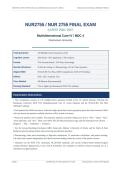
NUR2755 / NUR 2755 Final Exam | Multidimensional Care IV / MDC 4 Rasmussen University | 2026/2027 Edition
NUR2755 / NUR 2755 FINAL EXAM
(LATEST )
Multidimensional Care IV / MDC 4
Rasmussen University
Total Questions: 150 Multiple-Choice Questions (A-D)
Cognitive Levels: 20% Recall / 50% Application / 30% Analysis
Format: 75% Scenario-Based / 25% Direct Knowledge
Special Inclusions: 20 Priority-Setting, 15 Pharmacology, 10 Lab Value Questions
Aligned With: NCLEX-RN Test Plan, QSEN Competencies, NUR 2755 Syllabus
Edition: Academic Year
Time Allotted: 180 Minutes (Recommended)
Passing Standard: 75% or higher (per Rasmussen NUR 2755 syllabus)
Examination Instructions
• This examination consists of 150 multiple-choice questions divided across 10 content domains reflecting the
Rasmussen University NUR 2755 Multidimensional Care IV course blueprint and the NCLEX-RN Test Plan
(2026/2027 edition).
• Each question has ONE best answer. Select the single option that is most appropriate given the clinical scenario. Mark
only one answer per question; multiple selections will be scored as incorrect.
• Read each question stem carefully. Pay particular attention to priority-setting cues such as "first," "initial," "best,"
"most important," and "next." These cues reflect NCLEX-RN prioritization logic and the Nursing Process (Assess →
Diagnose → Plan → Implement → Evaluate).
• Use the Airway-Breathing-Circulation (ABC) framework, Maslow’s Hierarchy of Needs, and the Safety & Risk
Reduction priority-setting models when answering prioritization questions.
• Pharmacology items assess knowledge of high-alert medications, IV medication calculations, and patient teaching.
Lab value items require interpretation and clinical decision-making within the context of the patient scenario.
• rationales cite the NUR 2755 curriculum, NCLEX-RN standards, and current evidence-based medical-surgical
nursing references (Ignatavicius, Lewis, AACN Essentials). Use rationales to reinforce clinical reasoning, not as a
substitute for original analysis.
Page 1 Confidential | For Educational Use Only 150 Questions | NCLEX-RN Aligned
,NUR2755 / NUR 2755 Final Exam | Multidimensional Care IV / MDC 4 Rasmussen University | 2026/2027 Edition
Section 1: Complex Cardiovascular & Hematological Disorders
Q1: A 58-year-old male presents to the ED with crushing substernal chest pain rated 8/10, diaphoresis, and
nausea. The ECG shows ST-segment elevation in leads II, III, and aVF. Vital signs: BP 92/58, HR 110, RR
22, SpO2 94% on room air. Which nursing action is the HIGHEST priority?
A. Administer a nitroglycerin sublingual tablet for chest pain relief.
B. Establish two large-bore IV catheters and prepare for reperfusion therapy. *[CORRECT]*
C. Obtain a 12-lead ECG and compare with prior tracings.
D. Administer 4 L/min oxygen via nasal cannula.
Correct Answer: B
Rationale: The patient is experiencing an inferior wall STEMI with hemodynamic instability, and the priority is
reperfusion (PCI or fibrinolytics) within the door-to-balloon time of 90 minutes. Establishing IV access is the essential
first step so that medications and fluids can be rapidly administered. Nitroglycerin is contraindicated with hypotension
(BP 92/58) and inferior MI (right ventricular involvement), oxygen is reserved for SpO2 < 90% per current AHA
guidelines, and obtaining another ECG delays definitive treatment.
Q2: A patient is admitted with a diagnosis of non-ST elevation MI (NSTEMI). Which troponin pattern is
most consistent with this diagnosis?
A. Troponin I 0.02 ng/mL at baseline, 0.03 ng/mL at 3 hours
B. Troponin I 0.5 ng/mL at baseline, 1.8 ng/mL at 3 hours, 2.4 ng/mL at 6 hours *[CORRECT]*
C. Troponin I 0.04 ng/mL with a normal CK-MB
D. Troponin I 0.01 ng/mL with elevated BNP
Correct Answer: B
Rationale: NSTEMI is characterized by elevated cardiac troponin with a rise-and-fall pattern (or persistent elevation)
without ST-elevation on ECG. A troponin I > 0.04 ng/mL with a serial rise indicates myocardial necrosis. Choice A is
within normal limits, Choice C lacks the rise pattern required for diagnosis, and Choice D reflects a heart failure
marker rather than acute myocardial injury.
Q3: A nurse is caring for four patients on a telemetry unit. Which patient should the nurse assess FIRST?
A. A patient with heart failure whose weight increased by 1 kg over 24 hours *[CORRECT]*
B. A patient with atrial fibrillation and a new order for warfarin
C. A patient with a pacemaker whose heart rate is 48 bpm and pacemaker spikes appear before each QRS
D. A patient post-MI reporting chest pain 2/10 at the incision site
Correct Answer: A
Rationale: A 1 kg weight gain in 24 hours indicates fluid retention of approximately 1 liter, signaling acute
decompensated heart failure and risk of pulmonary edema. This patient requires immediate assessment for hypoxia,
crackles, and oxygenation. The pacemaker patient has appropriate capture (spikes precede QRS), the AF patient needs
routine warfarin teaching, and post-MI incisional pain is expected. Using the ABC and acute-vs-chronic priority
frameworks, the heart failure patient is most unstable.
Page 2 Confidential | For Educational Use Only 150 Questions | NCLEX-RN Aligned
,NUR2755 / NUR 2755 Final Exam | Multidimensional Care IV / MDC 4 Rasmussen University | 2026/2027 Edition
Q4: A patient with acute decompensated heart failure has the following hemodynamic profile: PAOP 28
mmHg (normal 6-12), cardiac index 1.8 L/min/m² (normal 2.5-4.0), SVR 1800 dynes/sec/cm⁵ (elevated).
Which classification of cardiogenic shock does this represent, and what is the priority intervention?
A. Warm and dry; administer IV furosemide only
B. Cold and wet; prepare for inotrope (dobutamine) and diuretic therapy *[CORRECT]*
C. Warm and wet; administer IV nitroglycerin
D. Cold and dry; administer IV fluids only
Correct Answer: B
Rationale: The Forrester/Stevenson classification 'cold and wet' describes hypoperfusion (low CI, elevated SVR) with
congestion (high PAOP). The priority is to improve perfusion with an inotrope (dobutamine or milrinone) while
reducing preload with IV loop diuretics. Furosemide alone will not address the low cardiac output, nitroglycerin may
worsen hypotension, and fluids are contraindicated given the elevated PAOP.
Q5: A patient with new-onset atrial fibrillation for 36 hours is being considered for cardioversion. Which
intervention is essential BEFORE elective cardioversion is performed?
A. Administer IV adenosine 6 mg push
B. Ensure therapeutic anticoagulation for 3 weeks or perform TEE to exclude left atrial thrombus
*[CORRECT]*
C. Obtain a chest X-ray to evaluate cardiac silhouette
D. Administer IV amiodarone 150 mg over 10 minutes
Correct Answer: B
Rationale: For atrial fibrillation lasting > 48 hours (or unknown duration), current ACC/AHA/HRS guidelines require
either 3 weeks of therapeutic anticoagulation prior to cardioversion or a transesophageal echocardiogram (TEE) to
exclude left atrial thrombus, followed by at least 4 weeks of anticoagulation post-cardioversion. Adenosine is used for
SVT, amiodarone may be used for rhythm control but does not address thromboembolic risk, and a chest X-ray is not
relevant to thrombus screening.
Q6: A patient on the telemetry unit suddenly becomes unresponsive. The monitor shows a wide-complex
tachycardia at 180 bpm with no palpable pulse. Which action should the nurse take FIRST?
A. Administer synchronized cardioversion at 100 joules
B. Defibrillate immediately at 200 joules (biphasic) and begin CPR *[CORRECT]*
C. Administer IV amiodarone 150 mg over 10 minutes
D. Administer IV epinephrine 1 mg every 3-5 minutes
Correct Answer: B
Rationale: Pulseless ventricular tachycardia (VT) is a shockable rhythm per ACLS algorithm and requires immediate
defibrillation followed by high-quality CPR. Synchronized cardioversion is reserved for unstable tachyarrhythmias
WITH a pulse. Amiodarone is administered after defibrillation and CPR are underway, and epinephrine is given after
the second shock. The NCLEX-RN prioritizes defibrillation for pulseless VT/VF.
Page 3 Confidential | For Educational Use Only 150 Questions | NCLEX-RN Aligned
, NUR2755 / NUR 2755 Final Exam | Multidimensional Care IV / MDC 4 Rasmussen University | 2026/2027 Edition
Q7: A 72-year-old female with severe aortic stenosis is admitted with exertional chest pain, dyspnea on
exertion, and one episode of syncope. On auscultation, the nurse expects to find:
A. A diastolic decrescendo murmur at the left sternal border
B. A systolic crescendo-decrescendo murmur at the right upper sternal border radiating to the
carotids *[CORRECT]*
C. A holosystolic murmur at the apex radiating to the axilla
D. A mid-systolic click followed by a late systolic murmur
Correct Answer: B
Rationale: Aortic stenosis produces a systolic crescendo-decrescendo murmur best heard at the right upper sternal
border (aortic area) with radiation to the carotids. The classic triad includes angina, syncope, and heart failure
symptoms. Choice A describes aortic regurgitation, Choice C describes mitral regurgitation, and Choice D describes
mitral valve prolapse.
Q8: A patient is 4 hours postoperative after coronary artery bypass grafting (CABG). Chest tube output
was 220 mL in the last hour. The nurse notes the drainage has changed from dark red to bright red with
clots. Which finding would indicate suspected cardiac tamponade and require IMMEDIATE provider
notification?
A. Blood pressure 110/70, HR 88, CVP 8 mmHg
B. Blood pressure 84/60, HR 122, CVP 18 mmHg, muffled heart sounds, JVD *[CORRECT]*
C. Blood pressure 118/76, HR 96, CVP 6 mmHg, clear breath sounds
D. Blood pressure 100/64, HR 108, CVP 10 mmHg, bibasilar crackles
Correct Answer: B
Rationale: Beck's triad (hypotension, elevated CVP/JVD, muffled heart sounds) plus a sudden cessation or change in
chest tube output suggests cardiac tamponade, a life-threatening post-CABG complication. The bright red clotted output
indicates active bleeding. Pulsus paradoxus may also be present. Choice A and C show stable hemodynamics, while
Choice D suggests fluid overload rather than tamponade.
Q9: A patient with a dual-chamber permanent pacemaker is being evaluated for proper function. The
ECG shows a pacemaker spike before each atrial contraction and before each ventricular contraction, with
a corresponding P wave and QRS complex following each spike. This finding indicates:
A. Failure to capture
B. Failure to sense
C. Appropriate capture and sensing in both chambers *[CORRECT]*
D. Pacemaker-mediated tachycardia
Correct Answer: C
Rationale: A pacemaker spike followed by an appropriate cardiac response (P wave after atrial spike, QRS after
ventricular spike) demonstrates appropriate capture. The absence of inappropriate spikes between intrinsic beats
indicates appropriate sensing. Failure to capture would show spikes without subsequent P or QRS, failure to sense
would show spikes occurring at inappropriate times despite intrinsic activity, and pacemaker-mediated tachycardia
would show a rapid paced rhythm.
Page 4 Confidential | For Educational Use Only 150 Questions | NCLEX-RN Aligned
NUR2755 / NUR 2755 FINAL EXAM
(LATEST )
Multidimensional Care IV / MDC 4
Rasmussen University
Total Questions: 150 Multiple-Choice Questions (A-D)
Cognitive Levels: 20% Recall / 50% Application / 30% Analysis
Format: 75% Scenario-Based / 25% Direct Knowledge
Special Inclusions: 20 Priority-Setting, 15 Pharmacology, 10 Lab Value Questions
Aligned With: NCLEX-RN Test Plan, QSEN Competencies, NUR 2755 Syllabus
Edition: Academic Year
Time Allotted: 180 Minutes (Recommended)
Passing Standard: 75% or higher (per Rasmussen NUR 2755 syllabus)
Examination Instructions
• This examination consists of 150 multiple-choice questions divided across 10 content domains reflecting the
Rasmussen University NUR 2755 Multidimensional Care IV course blueprint and the NCLEX-RN Test Plan
(2026/2027 edition).
• Each question has ONE best answer. Select the single option that is most appropriate given the clinical scenario. Mark
only one answer per question; multiple selections will be scored as incorrect.
• Read each question stem carefully. Pay particular attention to priority-setting cues such as "first," "initial," "best,"
"most important," and "next." These cues reflect NCLEX-RN prioritization logic and the Nursing Process (Assess →
Diagnose → Plan → Implement → Evaluate).
• Use the Airway-Breathing-Circulation (ABC) framework, Maslow’s Hierarchy of Needs, and the Safety & Risk
Reduction priority-setting models when answering prioritization questions.
• Pharmacology items assess knowledge of high-alert medications, IV medication calculations, and patient teaching.
Lab value items require interpretation and clinical decision-making within the context of the patient scenario.
• rationales cite the NUR 2755 curriculum, NCLEX-RN standards, and current evidence-based medical-surgical
nursing references (Ignatavicius, Lewis, AACN Essentials). Use rationales to reinforce clinical reasoning, not as a
substitute for original analysis.
Page 1 Confidential | For Educational Use Only 150 Questions | NCLEX-RN Aligned
,NUR2755 / NUR 2755 Final Exam | Multidimensional Care IV / MDC 4 Rasmussen University | 2026/2027 Edition
Section 1: Complex Cardiovascular & Hematological Disorders
Q1: A 58-year-old male presents to the ED with crushing substernal chest pain rated 8/10, diaphoresis, and
nausea. The ECG shows ST-segment elevation in leads II, III, and aVF. Vital signs: BP 92/58, HR 110, RR
22, SpO2 94% on room air. Which nursing action is the HIGHEST priority?
A. Administer a nitroglycerin sublingual tablet for chest pain relief.
B. Establish two large-bore IV catheters and prepare for reperfusion therapy. *[CORRECT]*
C. Obtain a 12-lead ECG and compare with prior tracings.
D. Administer 4 L/min oxygen via nasal cannula.
Correct Answer: B
Rationale: The patient is experiencing an inferior wall STEMI with hemodynamic instability, and the priority is
reperfusion (PCI or fibrinolytics) within the door-to-balloon time of 90 minutes. Establishing IV access is the essential
first step so that medications and fluids can be rapidly administered. Nitroglycerin is contraindicated with hypotension
(BP 92/58) and inferior MI (right ventricular involvement), oxygen is reserved for SpO2 < 90% per current AHA
guidelines, and obtaining another ECG delays definitive treatment.
Q2: A patient is admitted with a diagnosis of non-ST elevation MI (NSTEMI). Which troponin pattern is
most consistent with this diagnosis?
A. Troponin I 0.02 ng/mL at baseline, 0.03 ng/mL at 3 hours
B. Troponin I 0.5 ng/mL at baseline, 1.8 ng/mL at 3 hours, 2.4 ng/mL at 6 hours *[CORRECT]*
C. Troponin I 0.04 ng/mL with a normal CK-MB
D. Troponin I 0.01 ng/mL with elevated BNP
Correct Answer: B
Rationale: NSTEMI is characterized by elevated cardiac troponin with a rise-and-fall pattern (or persistent elevation)
without ST-elevation on ECG. A troponin I > 0.04 ng/mL with a serial rise indicates myocardial necrosis. Choice A is
within normal limits, Choice C lacks the rise pattern required for diagnosis, and Choice D reflects a heart failure
marker rather than acute myocardial injury.
Q3: A nurse is caring for four patients on a telemetry unit. Which patient should the nurse assess FIRST?
A. A patient with heart failure whose weight increased by 1 kg over 24 hours *[CORRECT]*
B. A patient with atrial fibrillation and a new order for warfarin
C. A patient with a pacemaker whose heart rate is 48 bpm and pacemaker spikes appear before each QRS
D. A patient post-MI reporting chest pain 2/10 at the incision site
Correct Answer: A
Rationale: A 1 kg weight gain in 24 hours indicates fluid retention of approximately 1 liter, signaling acute
decompensated heart failure and risk of pulmonary edema. This patient requires immediate assessment for hypoxia,
crackles, and oxygenation. The pacemaker patient has appropriate capture (spikes precede QRS), the AF patient needs
routine warfarin teaching, and post-MI incisional pain is expected. Using the ABC and acute-vs-chronic priority
frameworks, the heart failure patient is most unstable.
Page 2 Confidential | For Educational Use Only 150 Questions | NCLEX-RN Aligned
,NUR2755 / NUR 2755 Final Exam | Multidimensional Care IV / MDC 4 Rasmussen University | 2026/2027 Edition
Q4: A patient with acute decompensated heart failure has the following hemodynamic profile: PAOP 28
mmHg (normal 6-12), cardiac index 1.8 L/min/m² (normal 2.5-4.0), SVR 1800 dynes/sec/cm⁵ (elevated).
Which classification of cardiogenic shock does this represent, and what is the priority intervention?
A. Warm and dry; administer IV furosemide only
B. Cold and wet; prepare for inotrope (dobutamine) and diuretic therapy *[CORRECT]*
C. Warm and wet; administer IV nitroglycerin
D. Cold and dry; administer IV fluids only
Correct Answer: B
Rationale: The Forrester/Stevenson classification 'cold and wet' describes hypoperfusion (low CI, elevated SVR) with
congestion (high PAOP). The priority is to improve perfusion with an inotrope (dobutamine or milrinone) while
reducing preload with IV loop diuretics. Furosemide alone will not address the low cardiac output, nitroglycerin may
worsen hypotension, and fluids are contraindicated given the elevated PAOP.
Q5: A patient with new-onset atrial fibrillation for 36 hours is being considered for cardioversion. Which
intervention is essential BEFORE elective cardioversion is performed?
A. Administer IV adenosine 6 mg push
B. Ensure therapeutic anticoagulation for 3 weeks or perform TEE to exclude left atrial thrombus
*[CORRECT]*
C. Obtain a chest X-ray to evaluate cardiac silhouette
D. Administer IV amiodarone 150 mg over 10 minutes
Correct Answer: B
Rationale: For atrial fibrillation lasting > 48 hours (or unknown duration), current ACC/AHA/HRS guidelines require
either 3 weeks of therapeutic anticoagulation prior to cardioversion or a transesophageal echocardiogram (TEE) to
exclude left atrial thrombus, followed by at least 4 weeks of anticoagulation post-cardioversion. Adenosine is used for
SVT, amiodarone may be used for rhythm control but does not address thromboembolic risk, and a chest X-ray is not
relevant to thrombus screening.
Q6: A patient on the telemetry unit suddenly becomes unresponsive. The monitor shows a wide-complex
tachycardia at 180 bpm with no palpable pulse. Which action should the nurse take FIRST?
A. Administer synchronized cardioversion at 100 joules
B. Defibrillate immediately at 200 joules (biphasic) and begin CPR *[CORRECT]*
C. Administer IV amiodarone 150 mg over 10 minutes
D. Administer IV epinephrine 1 mg every 3-5 minutes
Correct Answer: B
Rationale: Pulseless ventricular tachycardia (VT) is a shockable rhythm per ACLS algorithm and requires immediate
defibrillation followed by high-quality CPR. Synchronized cardioversion is reserved for unstable tachyarrhythmias
WITH a pulse. Amiodarone is administered after defibrillation and CPR are underway, and epinephrine is given after
the second shock. The NCLEX-RN prioritizes defibrillation for pulseless VT/VF.
Page 3 Confidential | For Educational Use Only 150 Questions | NCLEX-RN Aligned
, NUR2755 / NUR 2755 Final Exam | Multidimensional Care IV / MDC 4 Rasmussen University | 2026/2027 Edition
Q7: A 72-year-old female with severe aortic stenosis is admitted with exertional chest pain, dyspnea on
exertion, and one episode of syncope. On auscultation, the nurse expects to find:
A. A diastolic decrescendo murmur at the left sternal border
B. A systolic crescendo-decrescendo murmur at the right upper sternal border radiating to the
carotids *[CORRECT]*
C. A holosystolic murmur at the apex radiating to the axilla
D. A mid-systolic click followed by a late systolic murmur
Correct Answer: B
Rationale: Aortic stenosis produces a systolic crescendo-decrescendo murmur best heard at the right upper sternal
border (aortic area) with radiation to the carotids. The classic triad includes angina, syncope, and heart failure
symptoms. Choice A describes aortic regurgitation, Choice C describes mitral regurgitation, and Choice D describes
mitral valve prolapse.
Q8: A patient is 4 hours postoperative after coronary artery bypass grafting (CABG). Chest tube output
was 220 mL in the last hour. The nurse notes the drainage has changed from dark red to bright red with
clots. Which finding would indicate suspected cardiac tamponade and require IMMEDIATE provider
notification?
A. Blood pressure 110/70, HR 88, CVP 8 mmHg
B. Blood pressure 84/60, HR 122, CVP 18 mmHg, muffled heart sounds, JVD *[CORRECT]*
C. Blood pressure 118/76, HR 96, CVP 6 mmHg, clear breath sounds
D. Blood pressure 100/64, HR 108, CVP 10 mmHg, bibasilar crackles
Correct Answer: B
Rationale: Beck's triad (hypotension, elevated CVP/JVD, muffled heart sounds) plus a sudden cessation or change in
chest tube output suggests cardiac tamponade, a life-threatening post-CABG complication. The bright red clotted output
indicates active bleeding. Pulsus paradoxus may also be present. Choice A and C show stable hemodynamics, while
Choice D suggests fluid overload rather than tamponade.
Q9: A patient with a dual-chamber permanent pacemaker is being evaluated for proper function. The
ECG shows a pacemaker spike before each atrial contraction and before each ventricular contraction, with
a corresponding P wave and QRS complex following each spike. This finding indicates:
A. Failure to capture
B. Failure to sense
C. Appropriate capture and sensing in both chambers *[CORRECT]*
D. Pacemaker-mediated tachycardia
Correct Answer: C
Rationale: A pacemaker spike followed by an appropriate cardiac response (P wave after atrial spike, QRS after
ventricular spike) demonstrates appropriate capture. The absence of inappropriate spikes between intrinsic beats
indicates appropriate sensing. Failure to capture would show spikes without subsequent P or QRS, failure to sense
would show spikes occurring at inappropriate times despite intrinsic activity, and pacemaker-mediated tachycardia
would show a rapid paced rhythm.
Page 4 Confidential | For Educational Use Only 150 Questions | NCLEX-RN Aligned


