
HUD EXAM PREP EXAM WITH CORRECT ACTUAL
QUESTIONS AND CORRECTLY WELL DEFINED
ANSWERS
Play your way to mastery with fun games
Match Blocks Charms NEW
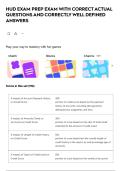
Terms in this set (196)
% Impact of Account Payment History 35%
on Credit Score portion of credit score based on the payment
history of accounts, including late payments,
delinquencies, judgments, and liens
% Impact of Amounts Owed on 30%
Accounts on Credit Score portion of score based on the ratio of total credit
extended to the amount of credit owed
% Impact of Length of Credit History 15%
on Credit Score portion of score based don the overall length of
credit history in the report, as well as average age of
accounts
% Impact of Types of Credit Used on 10%
Credit Score portion of score based on the variety of accounts
,% Impact of New Credit on Credit 10%
Score portion of score based on the number of recent
credit INQUIRIES
1.1.1) All of the following would help a A
counselor develop a realistic
household budget, except:
A. Payment information for a paid-off
car
B. Amount spent on groceries
C. Rent payment information
D. Monthly cable bill
1.1.2) All of the following are reasons C
why it is important for a client to track
income and expenses before
finalizing a budget, except:
A. It helps show clients that they
actually spend less on some
expenses than they think.
B. It helps identify spending habits.
C. It helps show clients that their
spending and expenses are out of
control.
D. It helps define realistic and
attainable goals and timelines.
1.1.3) Which of the following is a C
"want" and not a "need"?
A. Health care premium
B. Car insurance
C. Gym membership
D. Rent
,1.1.4) All of the following are effective A
ways to decrease expenses, except:
A. Cancel insurance policy
B. Cancel cable service
C. Stick to a shopping list
D. Conserve energy in the home
1.1.5) All of the following are effective D
strategies to increase income, except:
A. Work over time
B. Teach yoga
C. Find a second job
D. Factor in an anticipated raise
1.1.6) Rebecca's next appointment is Used to determine budget: A, B, C, D
with Ray, a client who recently started Not used to determine budget: E, F, G, H
a new job and wants to buy a car to
cut down on his commute. Rebecca
reviews documents that Ray brought
to the counseling session and
determines that Ray makes about
$1,900 each month after taxes. He
pays his bills every month and covers
his other expenses, but he never has
any
money left for savings. Identify which
information is used in determining a
budget, and which information is not.
A. Pay Stub
B. Bank Statements
C. Utility Bills
D. Social Security Award Letter
E. Annual Bonus
F. Stock Dividends
G. Employer Reimbursements
H. Credit Score
, 1.1.7) Ray's commute on the bus takes C
over an hour, so he wants to buy a car
as soon as possible, but he has poor
credit and cannot obtain a loan right
now. He thinks he can find a reliable
car for about $2,000 and has about
20% of the total in the bank from his
tax refund. If Ray's goal is to buy a car
within 8 months, what is the minimum
amount he needs to save each
month?
A. $150
B. $175
C. $200
D. $225
1.1.8) Rebecca helps determine that B
with adjustments Ray can set aside
$320 each month to buy
the car. How many months will he
need to save this amount?
A. At least 4
B. At least 5
C. At least 6
D. At least 7
1.2.1) Which section of a credit report C
will contain employer details?
A. Consumer rights
B. Account information
C. Personal information
D. Public records
E. Inquiries
QUESTIONS AND CORRECTLY WELL DEFINED
ANSWERS
Play your way to mastery with fun games
Match Blocks Charms NEW
Terms in this set (196)
% Impact of Account Payment History 35%
on Credit Score portion of credit score based on the payment
history of accounts, including late payments,
delinquencies, judgments, and liens
% Impact of Amounts Owed on 30%
Accounts on Credit Score portion of score based on the ratio of total credit
extended to the amount of credit owed
% Impact of Length of Credit History 15%
on Credit Score portion of score based don the overall length of
credit history in the report, as well as average age of
accounts
% Impact of Types of Credit Used on 10%
Credit Score portion of score based on the variety of accounts
,% Impact of New Credit on Credit 10%
Score portion of score based on the number of recent
credit INQUIRIES
1.1.1) All of the following would help a A
counselor develop a realistic
household budget, except:
A. Payment information for a paid-off
car
B. Amount spent on groceries
C. Rent payment information
D. Monthly cable bill
1.1.2) All of the following are reasons C
why it is important for a client to track
income and expenses before
finalizing a budget, except:
A. It helps show clients that they
actually spend less on some
expenses than they think.
B. It helps identify spending habits.
C. It helps show clients that their
spending and expenses are out of
control.
D. It helps define realistic and
attainable goals and timelines.
1.1.3) Which of the following is a C
"want" and not a "need"?
A. Health care premium
B. Car insurance
C. Gym membership
D. Rent
,1.1.4) All of the following are effective A
ways to decrease expenses, except:
A. Cancel insurance policy
B. Cancel cable service
C. Stick to a shopping list
D. Conserve energy in the home
1.1.5) All of the following are effective D
strategies to increase income, except:
A. Work over time
B. Teach yoga
C. Find a second job
D. Factor in an anticipated raise
1.1.6) Rebecca's next appointment is Used to determine budget: A, B, C, D
with Ray, a client who recently started Not used to determine budget: E, F, G, H
a new job and wants to buy a car to
cut down on his commute. Rebecca
reviews documents that Ray brought
to the counseling session and
determines that Ray makes about
$1,900 each month after taxes. He
pays his bills every month and covers
his other expenses, but he never has
any
money left for savings. Identify which
information is used in determining a
budget, and which information is not.
A. Pay Stub
B. Bank Statements
C. Utility Bills
D. Social Security Award Letter
E. Annual Bonus
F. Stock Dividends
G. Employer Reimbursements
H. Credit Score
, 1.1.7) Ray's commute on the bus takes C
over an hour, so he wants to buy a car
as soon as possible, but he has poor
credit and cannot obtain a loan right
now. He thinks he can find a reliable
car for about $2,000 and has about
20% of the total in the bank from his
tax refund. If Ray's goal is to buy a car
within 8 months, what is the minimum
amount he needs to save each
month?
A. $150
B. $175
C. $200
D. $225
1.1.8) Rebecca helps determine that B
with adjustments Ray can set aside
$320 each month to buy
the car. How many months will he
need to save this amount?
A. At least 4
B. At least 5
C. At least 6
D. At least 7
1.2.1) Which section of a credit report C
will contain employer details?
A. Consumer rights
B. Account information
C. Personal information
D. Public records
E. Inquiries


