
APEA 3P Exam: Key Questions & Verified Answers 2026/2027
| Latest Update | Graded A+
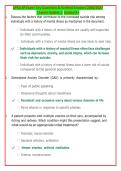
1. Discuss the factors that contribute to the increased suicide risk among
individuals with a history of mental illness as mentioned in the document.
Individuals with a history of mental illness are usually well-supported
by their communities.
Individuals with a history of mental illness are less likely to seek help.
Individuals with a history of mental illness often face challenges
such as depression, anxiety, and social stigma, which can increase
their risk for suicide.
Individuals with a history of mental illness have a lower risk of suicide
compared to the general population.
2. Generalized Anxiety Disorder (GAD) is primarily characterized by:
Fear of public speaking
Obsessive thoughts about cleanliness
Persistent and excessive worry about various domains of life
Panic attacks in response to specific phobias
3. A patient presents with multiple vesicles on their skin, accompanied by
itching and redness. Which condition might this presentation suggest, and
what would be an appropriate initial treatment?
Psoriasis; topical steroids
Bacterial infection; antibiotics
Herpes simplex; antiviral medication
Eczema; moisturizers
,4. What are the key characteristics of hamstring muscles in the human body?
They are located in the lower leg and contribute to dorsiflexion of the
foot.
Hamstring muscles are located in the posterior thigh and are
primarily responsible for knee flexion.
They are found in the abdomen and play a major role in trunk rotation.
Hamstring muscles are located in the upper arm and assist in elbow
flexion.
5. The nurse receives a phone call from a patient who claims she is pregnant.
The patient reports that she has regular menses that occur every 28 days and
last 5 days. The first day of her menses was April 10th. Using Nagele's Rule,
what would the patient's estimated date of delivery (EDD) be?
Jan 17
Nov 13
Jan 10
Dec 3
6. Describe the significance of the ischial tuberosity in relation to sitting.
The ischial tuberosity is involved in the movement of the hip joint.
The ischial tuberosity protects the pelvic organs.
The ischial tuberosity serves as a weight-bearing point when sitting.
The ischial tuberosity aids in the attachment of abdominal muscles.
7. Interpret the significance of pseudohypertrophy in clinical practice.
, k 0Pseudohypertrophy is a term used to describe muscle growth in k0 k0 k0 k0 k0 k0 k0 k0 k0
k0 athletes.
k 0Pseudohypertrophy indicates a pathological condition where k0 k0 k0 k0 k0
k0 muscle appears enlarged but is actually weakened, which can affect
k0 k0 k0 k0 k0 k0 k0 k0 k0
k0 diagnosis and treatment. k0 k0
k 0Pseudohypertrophy is a normal physiological response to exercise k0 k0 k0 k0 k0 k0 k0
k0 and indicates muscle strength.
k0 k0 k0
k 0 Pseudohypertrophy is unrelated to any clinical conditions. k0 k0 k0 k0 k0 k0
8. If a patient presents with distal muscular weakness, which diagnostic test
k0 k0 k0 k0 k0 k0 k0 k0 k0 k0
would be most appropriate to further investigate the underlying cause?
k0 k0 k0 k0 k0 k0 k0 k0 k0 k0
k 0 X-ray imaging k0
k 0 Electromyography (EMG) k0
k 0 Urinalysis
k 0 Complete blood count (CBC) k0 k0 k0
9. The best place to listen to the aortic valve with auscultation is...
k0 k0 k0 k0 k0 k0 k0 k0 k0 k0 k0
k 0 Second intercostal space just right of the sternum
k0 k0 k0 k0 k0 k0 k0
k 0 The aortic valve cannot be heard with auscultation.
k0 k0 k0 k0 k0 k0 k0
k 0 k 0 Left 5th intercostal space, mid clavicular line
k0 k 0 k0 k 0 k 0 k0
k 0 k 0 Right 5th intercostal space, mid clavicular line
k0 k 0 k0 k 0 k 0 k0
10. During a physical examination, a healthcare professional hears
k0 k0 k0 k0 k0 k0 k0
predominantly vesicular breath sounds in a patient. What does this finding
k0 k0 k0 k0 k0 k0 k0 k0 k0 k0 k0
suggestaboutthe patient's lung condition?
k 0 0
k 0
k k0 k0 k0
k 0 The patient may have pneumonia.
k0 k0 k0 k0
k 0 The patient may have a pleural effusion.
k0 k0 k0 k0 k0 k0
, k 0 The patient's lung condition is likely normal.
k0 k0 k0 k0 k0 k0
k 0 The patient may have a bronchial obstruction.
k0 k0 k0 k0 k0 k0
11. What condition does the ankle-brachial index primarily evaluate the risk for?
k0 k0 k0 k0 k0 k0 k0 k 0 k 0 k0
k 0 Deep vein thrombosis
k0 k0
k 0 Pulmonary embolism k0
k 0 k 0 Peripheral artery disease k0 k0
k 0 Heart failure k0
12. What is the primary function of the hamstring muscles?
k0 k0 k0 k0 k0 k0 k0 k0
k 0 To flex the knee and extend the hip.
k0 k0 k0 k0 k0 k0 k0
k 0 To abduct the thigh and flex the ankle.
k0 k0 k0 k0 k0 k0 k0
k 0 To extend the knee and flex the hip.
k0 k0 k0 k0 k0 k0 k0
k 0 To rotate the hip and stabilize the pelvis.
k0 k0 k0 k0 k0 k0 k0
13. In a clinical scenario, if a patient has a fracture in the cervical spine affecting
k0 k0 k0 k0 k0 k0 k0 k0 k0 k0 k0 k0 k0 k0
the transverse foramen, what potential complication should be monitored?
k0 k0 k0 k0 k0 k0 k0 k0 k0
k 0 Compromised blood flow to the brain k0 k0 k0 k0 k0
k 0 Increased spinal cord pressure k0 k0 k0
k 0 Difficulty in breathing k0 k0
k 0 Loss of sensation in the lower limbs
k0 k0 k0 k0 k0 k0
14. What is the function of cranial nerve V?
k0 k0 k0 k0 k0 k0 k0
k 0 Movement of the face, tears, salivation and tastek0 k0 k0 k0 k0 k0 k0
| Latest Update | Graded A+
1. Discuss the factors that contribute to the increased suicide risk among
individuals with a history of mental illness as mentioned in the document.
Individuals with a history of mental illness are usually well-supported
by their communities.
Individuals with a history of mental illness are less likely to seek help.
Individuals with a history of mental illness often face challenges
such as depression, anxiety, and social stigma, which can increase
their risk for suicide.
Individuals with a history of mental illness have a lower risk of suicide
compared to the general population.
2. Generalized Anxiety Disorder (GAD) is primarily characterized by:
Fear of public speaking
Obsessive thoughts about cleanliness
Persistent and excessive worry about various domains of life
Panic attacks in response to specific phobias
3. A patient presents with multiple vesicles on their skin, accompanied by
itching and redness. Which condition might this presentation suggest, and
what would be an appropriate initial treatment?
Psoriasis; topical steroids
Bacterial infection; antibiotics
Herpes simplex; antiviral medication
Eczema; moisturizers
,4. What are the key characteristics of hamstring muscles in the human body?
They are located in the lower leg and contribute to dorsiflexion of the
foot.
Hamstring muscles are located in the posterior thigh and are
primarily responsible for knee flexion.
They are found in the abdomen and play a major role in trunk rotation.
Hamstring muscles are located in the upper arm and assist in elbow
flexion.
5. The nurse receives a phone call from a patient who claims she is pregnant.
The patient reports that she has regular menses that occur every 28 days and
last 5 days. The first day of her menses was April 10th. Using Nagele's Rule,
what would the patient's estimated date of delivery (EDD) be?
Jan 17
Nov 13
Jan 10
Dec 3
6. Describe the significance of the ischial tuberosity in relation to sitting.
The ischial tuberosity is involved in the movement of the hip joint.
The ischial tuberosity protects the pelvic organs.
The ischial tuberosity serves as a weight-bearing point when sitting.
The ischial tuberosity aids in the attachment of abdominal muscles.
7. Interpret the significance of pseudohypertrophy in clinical practice.
, k 0Pseudohypertrophy is a term used to describe muscle growth in k0 k0 k0 k0 k0 k0 k0 k0 k0
k0 athletes.
k 0Pseudohypertrophy indicates a pathological condition where k0 k0 k0 k0 k0
k0 muscle appears enlarged but is actually weakened, which can affect
k0 k0 k0 k0 k0 k0 k0 k0 k0
k0 diagnosis and treatment. k0 k0
k 0Pseudohypertrophy is a normal physiological response to exercise k0 k0 k0 k0 k0 k0 k0
k0 and indicates muscle strength.
k0 k0 k0
k 0 Pseudohypertrophy is unrelated to any clinical conditions. k0 k0 k0 k0 k0 k0
8. If a patient presents with distal muscular weakness, which diagnostic test
k0 k0 k0 k0 k0 k0 k0 k0 k0 k0
would be most appropriate to further investigate the underlying cause?
k0 k0 k0 k0 k0 k0 k0 k0 k0 k0
k 0 X-ray imaging k0
k 0 Electromyography (EMG) k0
k 0 Urinalysis
k 0 Complete blood count (CBC) k0 k0 k0
9. The best place to listen to the aortic valve with auscultation is...
k0 k0 k0 k0 k0 k0 k0 k0 k0 k0 k0
k 0 Second intercostal space just right of the sternum
k0 k0 k0 k0 k0 k0 k0
k 0 The aortic valve cannot be heard with auscultation.
k0 k0 k0 k0 k0 k0 k0
k 0 k 0 Left 5th intercostal space, mid clavicular line
k0 k 0 k0 k 0 k 0 k0
k 0 k 0 Right 5th intercostal space, mid clavicular line
k0 k 0 k0 k 0 k 0 k0
10. During a physical examination, a healthcare professional hears
k0 k0 k0 k0 k0 k0 k0
predominantly vesicular breath sounds in a patient. What does this finding
k0 k0 k0 k0 k0 k0 k0 k0 k0 k0 k0
suggestaboutthe patient's lung condition?
k 0 0
k 0
k k0 k0 k0
k 0 The patient may have pneumonia.
k0 k0 k0 k0
k 0 The patient may have a pleural effusion.
k0 k0 k0 k0 k0 k0
, k 0 The patient's lung condition is likely normal.
k0 k0 k0 k0 k0 k0
k 0 The patient may have a bronchial obstruction.
k0 k0 k0 k0 k0 k0
11. What condition does the ankle-brachial index primarily evaluate the risk for?
k0 k0 k0 k0 k0 k0 k0 k 0 k 0 k0
k 0 Deep vein thrombosis
k0 k0
k 0 Pulmonary embolism k0
k 0 k 0 Peripheral artery disease k0 k0
k 0 Heart failure k0
12. What is the primary function of the hamstring muscles?
k0 k0 k0 k0 k0 k0 k0 k0
k 0 To flex the knee and extend the hip.
k0 k0 k0 k0 k0 k0 k0
k 0 To abduct the thigh and flex the ankle.
k0 k0 k0 k0 k0 k0 k0
k 0 To extend the knee and flex the hip.
k0 k0 k0 k0 k0 k0 k0
k 0 To rotate the hip and stabilize the pelvis.
k0 k0 k0 k0 k0 k0 k0
13. In a clinical scenario, if a patient has a fracture in the cervical spine affecting
k0 k0 k0 k0 k0 k0 k0 k0 k0 k0 k0 k0 k0 k0
the transverse foramen, what potential complication should be monitored?
k0 k0 k0 k0 k0 k0 k0 k0 k0
k 0 Compromised blood flow to the brain k0 k0 k0 k0 k0
k 0 Increased spinal cord pressure k0 k0 k0
k 0 Difficulty in breathing k0 k0
k 0 Loss of sensation in the lower limbs
k0 k0 k0 k0 k0 k0
14. What is the function of cranial nerve V?
k0 k0 k0 k0 k0 k0 k0
k 0 Movement of the face, tears, salivation and tastek0 k0 k0 k0 k0 k0 k0


