

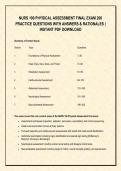
NURS 190 PHYSICAL ASSESSMENT FINAL EXAM 200
PRACTICE QUESTIONS WITH ANSWERS & RATIONALES |
INSTANT PDF DOWNLOAD
Summary of Content Areas:
Section Topic Questions
1 Foundations of Physical Assessment 1–30
2 Head, Eyes, Ears, Nose, and Throat 31–60
3 Respiratory Assessment 61–95
4 Cardiovascular Assessment 96–130
5 Abdominal Assessment 131–160
6 Neurological Assessment 161–185
7 Musculoskeletal Assessment 186–200
This exam covers the core content areas of the NURS 190 Physical Assessment final exam:
Assessment techniques (inspection, palpation, percussion, auscultation) and correct sequencing
Head-to-toe examination across all body systems
Focused respiratory and cardiovascular assessments with breath and heart sound identification
Abdominal examination including organ identification and special sign testing (McBurney's,
Murphy's, Rovsing's, Blumberg's)
Neurological assessment including cranial nerve testing and Glasgow Coma Scale
Musculoskeletal assessment including range of motion, muscle strength grading, and special tests
,Note: The course textbook (typically a physical examination and health assessment text such as Jarvis)
and lecture materials should be used as primary study resources.
SECTION 1: FOUNDATIONS OF PHYSICAL ASSESSMENT (Questions 1–30)
1. A nurse is preparing to perform a physical assessment. Which technique should
the nurse use first for most body systems?
A) Palpation
B) Percussion
C) Auscultation
D) Inspection
Answer: D – Inspection
Rationale: Inspection is always performed first because touching or manipulating an area
can alter findings that would otherwise be observed. The general sequence is inspection,
palpation, percussion, and auscultation.
2. Which assessment technique uses the dorsal surface of the hand?
A) Assessing texture
B) Assessing temperature
,C) Assessing vibration
D) Assessing pulses
Answer: B – Assessing temperature
Rationale: The dorsal (back) surface of the hand is most sensitive to temperature changes.
The fingertips are used for fine discrimination (texture, vibration, pulses).
3. The nurse is preparing to assess a client's abdomen. Which sequence should the
nurse use?
A) Inspection, palpation, percussion, auscultation
B) Inspection, auscultation, percussion, palpation
C) Auscultation, inspection, percussion, palpation
D) Palpation, percussion, auscultation, inspection
Answer: B – Inspection, auscultation, percussion, palpation
Rationale: For the abdomen, auscultation is performed before percussion and palpation
because these techniques can alter bowel sounds. The correct sequence is Inspection,
Auscultation, Percussion, Palpation (IAPP).
4. The nurse is preparing to perform a complete physical assessment. What is the
priority action before beginning the examination?
, A) Gather all necessary equipment
B) Review the client's medical history
C) Establish a therapeutic relationship and explain the procedure
D) Perform hand hygiene and apply PPE
Answer: C – Establish a therapeutic relationship and explain the procedure
Rationale: Before any physical assessment, the nurse must establish trust and explain the
procedure to obtain informed consent and reduce client anxiety. While gathering equipment,
reviewing history, and hand hygiene are important, they occur after establishing therapeutic
communication.
5. Which part of the hand is used for percussion?
A) Dorsal surface
B) Palmar surface
C) Tip of the middle finger
D) Ulnar surface
Answer: C – Tip of the middle finger
Rationale: The tip of the middle finger (plexor) is used to strike the finger of the other hand
(pleximeter) during percussion.
PRACTICE QUESTIONS WITH ANSWERS & RATIONALES |
INSTANT PDF DOWNLOAD
Summary of Content Areas:
Section Topic Questions
1 Foundations of Physical Assessment 1–30
2 Head, Eyes, Ears, Nose, and Throat 31–60
3 Respiratory Assessment 61–95
4 Cardiovascular Assessment 96–130
5 Abdominal Assessment 131–160
6 Neurological Assessment 161–185
7 Musculoskeletal Assessment 186–200
This exam covers the core content areas of the NURS 190 Physical Assessment final exam:
Assessment techniques (inspection, palpation, percussion, auscultation) and correct sequencing
Head-to-toe examination across all body systems
Focused respiratory and cardiovascular assessments with breath and heart sound identification
Abdominal examination including organ identification and special sign testing (McBurney's,
Murphy's, Rovsing's, Blumberg's)
Neurological assessment including cranial nerve testing and Glasgow Coma Scale
Musculoskeletal assessment including range of motion, muscle strength grading, and special tests
,Note: The course textbook (typically a physical examination and health assessment text such as Jarvis)
and lecture materials should be used as primary study resources.
SECTION 1: FOUNDATIONS OF PHYSICAL ASSESSMENT (Questions 1–30)
1. A nurse is preparing to perform a physical assessment. Which technique should
the nurse use first for most body systems?
A) Palpation
B) Percussion
C) Auscultation
D) Inspection
Answer: D – Inspection
Rationale: Inspection is always performed first because touching or manipulating an area
can alter findings that would otherwise be observed. The general sequence is inspection,
palpation, percussion, and auscultation.
2. Which assessment technique uses the dorsal surface of the hand?
A) Assessing texture
B) Assessing temperature
,C) Assessing vibration
D) Assessing pulses
Answer: B – Assessing temperature
Rationale: The dorsal (back) surface of the hand is most sensitive to temperature changes.
The fingertips are used for fine discrimination (texture, vibration, pulses).
3. The nurse is preparing to assess a client's abdomen. Which sequence should the
nurse use?
A) Inspection, palpation, percussion, auscultation
B) Inspection, auscultation, percussion, palpation
C) Auscultation, inspection, percussion, palpation
D) Palpation, percussion, auscultation, inspection
Answer: B – Inspection, auscultation, percussion, palpation
Rationale: For the abdomen, auscultation is performed before percussion and palpation
because these techniques can alter bowel sounds. The correct sequence is Inspection,
Auscultation, Percussion, Palpation (IAPP).
4. The nurse is preparing to perform a complete physical assessment. What is the
priority action before beginning the examination?
, A) Gather all necessary equipment
B) Review the client's medical history
C) Establish a therapeutic relationship and explain the procedure
D) Perform hand hygiene and apply PPE
Answer: C – Establish a therapeutic relationship and explain the procedure
Rationale: Before any physical assessment, the nurse must establish trust and explain the
procedure to obtain informed consent and reduce client anxiety. While gathering equipment,
reviewing history, and hand hygiene are important, they occur after establishing therapeutic
communication.
5. Which part of the hand is used for percussion?
A) Dorsal surface
B) Palmar surface
C) Tip of the middle finger
D) Ulnar surface
Answer: C – Tip of the middle finger
Rationale: The tip of the middle finger (plexor) is used to strike the finger of the other hand
(pleximeter) during percussion.


