
• Wrong document? Swap it for free
  • Written by students who passed
  • Immediately available after payment
  • Read online or as PDF
Sell
Where do you study
Your language
Document preview thumbnail
Preview 4 out of 254 pages
Exam (elaborations)

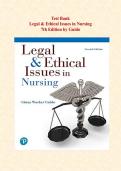
Test Bank for Legal & Ethical Issues in Nursing 7th Edition by Guido – 660 Exam Questions with Answers & Rationales | Instant Download

Document preview thumbnail
Preview 4 out of 254 pages

Prepare for nursing law and ethics exams with confidence using this comprehensive Test Bank for Legal & Ethical Issues in Nursing, 7th Edition by Guido. This up-to-date study resource contains 660 multiple-choice questions covering the full scope of the textbook, with each question including the correct answer and a detailed rationale to reinforce understanding and boost retention. Test Bank for Legal & Ethical Issues in Nursing 7th Edition by Guido Latest Update |A Comprehensive Sample of 660 Multichoice Questions Covering Full Scope of the Text Book| Each Question Includes the Correct Answer with a Detailed Rationale| Guaranteed Pass Table of Contents Part 1: Introduction to the Law and the Judicial Process • Chapter 1: Legal Concepts and the Judicial Process • Chapter 2: Anatomy of a Lawsuit Part 2: Ethics in Nursing Practice • Chapter 3: Introduction to Ethics • Chapter 4: Application of Ethics in Nursing Practice Settings Part 3: Liability Issues • Chapter 5: Standards of Care • Chapter 6: Tort Law • Chapter 7: Nursing Liability: Defenses • Chapter 8: Informed Consent • Chapter 9: Patient Self-Determination • Chapter 10: Documentation and Confidentiality • Chapter 11: Professional Liability Insurance Part 4: Impact of the Law on the Professional Practice of Nursing • Chapter 12: Nurse Practice Acts, Licensure, and the Scope of Practice • Chapter 13: Advanced Nursing Practice Roles • Chapter 14: Corporate Liability Issues and Employment Laws • Chapter 15: Federal Laws: The Americans with Disabilities Act of 1990 and the Civil Rights Act of 1991 • Chapter 16: Nursing Management and the Nurse-Manager • Chapter 17: Delegation, Supervision, and Patient Advocacy Issues Part 5: Impact of the Law on Nursing in Selected Practice Settings • Chapter 18: Nursing in Acute Care Settings • Chapter 19: Nursing in Ambulatory and Managed Care Settings • Chapter 20: Public and Community Health Care • Chapter 21: Nursing in Long-Term Care Settings 1. Which source of law is created by legislative bodies and takes precedence over common law? A. Common law B. Statutory law C. Administrative law D. Case law Correct Answer: B Rationale: Statutory law is enacted by legislative bodies and overrides common law and case law when there is a conflict. Reference: Guido, 2020, Ch. 1. DIF: Knowledge KEY: Legal concepts MSC: NCLEX: Safe, effective care environment NOT: Focus on hierarchy of law. 2. A nurse is served with a summons and complaint. This document initiates which phase of a lawsuit? A. Discovery B. Pleading C. Trial D. Appeal Correct Answer: B Rationale: The pleading phase begins with the plaintiff filing a complaint and the defendant receiving a summons. Reference: Guido, 2020, Ch. 2. DIF: Comprehension KEY: Anatomy of a lawsuit MSC: NCLEX: Safe, effective care environment NOT: Recall litigation process. 3. Which ethical principle obligates a nurse to act in the patient’s best interest? A. Autonomy B. Beneficence C. Justice D. Fidelity Correct Answer: B Rationale: Beneficence requires actions that promote the well-being of others. Reference: Guido, 2020, Ch. 3. DIF: Knowledge KEY: Ethical principles MSC: NCLEX: Safe, effective care environment NOT: Differentiate ethical principles. 4. A nurse uses the ethics of care approach. This approach emphasizes: A. Rules and duties B. Relationships and context C. Consequences only D. Virtue of the nurse Correct Answer: B Rationale: Ethics of care focuses on relational context and responsiveness to others. Reference: Guido, 2020, Ch. 4. DIF: Comprehension KEY: Ethical frameworks MSC: NCLEX: Psychosocial integrity NOT: Compare ethical theories. 5. The standard of care for a nurse is primarily determined by: A. Hospital policy alone B. What a reasonably prudent nurse would do C. Physician orders D. Patient expectations Correct Answer: B Rationale: The legal standard is what a reasonably prudent nurse with similar education and experience would do in similar circumstances. Reference: Guido, 2020, Ch. 5. DIF: Knowledge KEY: Standards of care MSC: NCLEX: Safe, effective care environment NOT: Define standard of care. 6. Which tort involves intentional interference with a person’s right to be free from harmful or offensive contact? A. Negligence B. Battery C. Defamation D. False imprisonment Correct Answer: B Rationale: Battery is intentional harmful or offensive touching without consent. Reference: Guido, 2020, Ch. 6. DIF: Knowledge KEY: Tort law MSC: NCLEX: Safe, effective care environment NOT: Distinguish intentional torts. 7. A nurse is accused of malpractice. Which defense claims the patient knowingly assumed a risk? A. Contributory negligence B. Assumption of risk C. Comparative negligence D. Statute of limitations Correct Answer: B Rationale: Assumption of risk is a defense where the plaintiff voluntarily exposed themselves to a known danger. Reference: Guido, 2020, Ch. 7. DIF: Comprehension KEY: Liability defenses MSC: NCLEX: Safe, effective care environment NOT: Identify malpractice defenses. 8. Informed consent requires that the patient: A. Signs the form without questions B. Receives all information about risks, benefits, and alternatives C. Agrees with the physician’s recommendation D. Has a family member present Correct Answer: B Rationale: Valid informed consent requires disclosure, comprehension, voluntariness, and competence. Reference: Guido, 2020, Ch. 8. DIF: Knowledge KEY: Informed consent MSC: NCLEX: Safe, effective care environment NOT: List elements of informed consent. 9. The Patient Self-Determination Act requires healthcare facilities to: A. Provide advance directives information to patients B. Force patients to complete advance directives C. Ignore patient wishes if family disagrees D. Limit patient autonomy Correct Answer: A Rationale: The PSDA requires facilities to inform patients of their rights to make healthcare decisions and complete advance directives. Reference: Guido, 2020, Ch. 9. DIF: Knowledge KEY: Patient self-determination MSC: NCLEX: Safe, effective care environment NOT: Recall PSDA requirements. 10. A nurse documents care in the medical record. This documentation is primarily used to: A. Protect the nurse B. Communicate patient status and care C. Increase hospital revenue D. Satisfy accreditation only Correct Answer: B Rationale: Documentation is a legal record and communication tool for the healthcare team. Reference: Guido, 2020, Ch. 10. DIF: Comprehension KEY: Documentation MSC: NCLEX: Safe, effective care environment NOT: Emphasize legal and clinical purposes.

Content preview

Test Bank
Legal & Ethical Issues in Nursing
7th Edition by Guido

,Test Bank for Legal & Ethical Issues in Nursing 7th
Edition by Guido Latest Update |A Comprehensive
Sample of 660 Multichoice Questions Covering Full
Scope of the Text Book| Each Question Includes the
Correct Answer with a Detailed Rationale|
Guaranteed Pass


Table of Contents
Part 1: Introduction to the Law and the Judicial Process
• Chapter 1: Legal Concepts and the Judicial Process
• Chapter 2: Anatomy of a Lawsuit
Part 2: Ethics in Nursing Practice
• Chapter 3: Introduction to Ethics
• Chapter 4: Application of Ethics in Nursing Practice Settings
Part 3: Liability Issues
• Chapter 5: Standards of Care
• Chapter 6: Tort Law
• Chapter 7: Nursing Liability: Defenses
• Chapter 8: Informed Consent
• Chapter 9: Patient Self-Determination
• Chapter 10: Documentation and Confidentiality
• Chapter 11: Professional Liability Insurance
Part 4: Impact of the Law on the Professional Practice of Nursing
• Chapter 12: Nurse Practice Acts, Licensure, and the Scope of Practice

, • Chapter 13: Advanced Nursing Practice Roles
• Chapter 14: Corporate Liability Issues and Employment Laws
• Chapter 15: Federal Laws: The Americans with Disabilities Act of 1990 and
the Civil Rights Act of 1991
• Chapter 16: Nursing Management and the Nurse-Manager
• Chapter 17: Delegation, Supervision, and Patient Advocacy Issues
Part 5: Impact of the Law on Nursing in Selected Practice Settings
• Chapter 18: Nursing in Acute Care Settings
• Chapter 19: Nursing in Ambulatory and Managed Care Settings
• Chapter 20: Public and Community Health Care
• Chapter 21: Nursing in Long-Term Care Settings

, 1. Which source of law is created by legislative bodies and takes precedence
over common law?
A. Common law
B. Statutory law
C. Administrative law
D. Case law
Correct Answer: B
Rationale: Statutory law is enacted by legislative bodies and overrides common
law and case law when there is a conflict.
Reference: Guido, 2020, Ch. 1.
DIF: Knowledge
KEY: Legal concepts
MSC: NCLEX: Safe, effective care environment
NOT: Focus on hierarchy of law.
2. A nurse is served with a summons and complaint. This document initiates
which phase of a lawsuit?
A. Discovery
B. Pleading
C. Trial
D. Appeal
Correct Answer: B
Rationale: The pleading phase begins with the plaintiff filing a complaint and the
defendant receiving a summons.
Reference: Guido, 2020, Ch. 2.
DIF: Comprehension
KEY: Anatomy of a lawsuit
MSC: NCLEX: Safe, effective care environment
NOT: Recall litigation process.
3. Which ethical principle obligates a nurse to act in the patient’s best
interest?
A. Autonomy
B. Beneficence
C. Justice
D. Fidelity


Connected book
 image
Publisher: 2001 ISBN: 9780134701233 Edition: Unknown

Document information

Uploaded on
September 16, 2026
Number of pages
254
Written in
2026/2027
Type
Exam (elaborations)
Contains
Questions & answers
$15.49

Wrong document? Swap it for free Within 14 days of purchase and before downloading, you can choose a different document. You can simply spend the amount again.
Written by students who passed
Immediately available after payment
Read online or as PDF

Seller avatar
Reputation scores are based on the amount of documents a seller has sold for a fee and the reviews they have received for those documents. There are three levels: Bronze, Silver and Gold. The better the reputation, the more your can rely on the quality of the sellers work.
TutorGeoff
3.6
(19)
Sold
100
Followers
2
Items
1021
Last sold
11 hours ago


Why students choose Stuvia

Created by fellow students, verified by reviews

Quality you can trust: written by students who passed their tests and reviewed by others who've used these notes.

Didn't get what you expected? Choose another document

No worries! You can instantly pick a different document that better fits what you're looking for.

Pay as you like, start learning right away

No subscription, no commitments. Pay the way you're used to via credit card and download your PDF document instantly.

Student with book image

“Bought, downloaded, and aced it. It really can be that simple.”

Alisha Student

Working on your references?

Create accurate citations in APA, MLA and Harvard with our free citation generator.

Working on your references?

Frequently asked questions
