
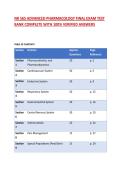
NR 565 ADVANCED PHARMACOLOGY FINAL EXAM TEST
BANK COMPLETE WITH 100% VERIFIED ANSWERS
TABLE OF CONTENTS
Section Domain Approx. Page
Questions Reference
Section Pharmacokinetics and 20 p. 2
1 Pharmacodynamics
Section Cardiovascular System 30 p. 5
2
Section Endocrine System 30 p. 9
3
Section Respiratory System 20 p. 13
4
Section Gastrointestinal System 20 p. 16
5
Section Central Nervous System 30 p. 19
6
Section Antimicrobials 20 p. 24
7
Section Pain Management 15 p. 27
8
Section Special Populations (Peds/Geri) 15 p. 29
9
,SECTION 1: PHARMACOKINETICS AND PHARMACODYNAMICS
Question 1
A patient with a history of heart failure is prescribed a drug with a
narrow therapeutic index. Which pharmacokinetic parameter is MOST
critical for the nurse practitioner to monitor to prevent toxicity?
A) The drug's route of administration
B) The drug's plasma half-life and steady-state concentration
C) The drug's lipid solubility
D) The drug's volume of distribution
CORRECT ANSWER: B
Rationale: Drugs with a narrow therapeutic index have a small margin
between therapeutic and toxic doses. Monitoring half-life and steady-
state concentrations is critical to ensure the drug remains within the
therapeutic window and to prevent accumulation and toxicity.
Question 2
A 45-year-old patient is started on a medication that is 98% protein-
bound. The patient subsequently develops severe malnutrition and
hypoalbuminemia. What effect will this have on the free drug
concentration?
A) Decreased free drug concentration
B) Increased free drug concentration
C) No change in free drug concentration
D) Decreased therapeutic effect
CORRECT ANSWER: B
,Rationale: Hypoalbuminemia reduces the number of protein binding
sites. For a highly protein-bound drug, this leads to a higher free
(unbound) fraction of the drug, increasing the risk of toxicity.
Question 3
Which statement BEST describes the concept of a drug's
bioavailability?
A) The ratio of the toxic dose to the effective dose
B) The percentage of the administered drug that reaches systemic
circulation unchanged
C) The time required for the drug to achieve half of its maximum effect
D) The amount of drug required to produce 50% of maximal effect
CORRECT ANSWER: B
Rationale: Bioavailability refers to the fraction of an administered dose
of unchanged drug that reaches the systemic circulation. Intravenous
administration has 100% bioavailability, while oral administration is
affected by first-pass metabolism.
Question 4
A patient taking warfarin (CYP2C9 substrate) is prescribed fluconazole
(CYP2C9 inhibitor). What is the MOST likely clinical consequence of
this interaction?
A) Decreased warfarin effect and increased clot risk
B) Increased warfarin metabolism and decreased INR
C) Increased warfarin effect and elevated INR
D) No significant interaction
CORRECT ANSWER: C
, Rationale: Fluconazole inhibits the CYP2C9 enzyme, which metabolizes
warfarin. This inhibition decreases the clearance of warfarin, leading to
increased plasma levels, an elevated INR, and a higher risk of bleeding.
Question 5
A patient is prescribed a medication with a half-life of 12 hours.
Approximately how long will it take to reach steady-state
concentration?
A) 12 hours
B) 24 hours
C) 48 to 60 hours
D) 96 hours
CORRECT ANSWER: C
Rationale: Steady-state concentration is typically achieved after 4 to 5
half-lives. With a half-life of 12 hours, 4 to 5 half-lives equate to 48 to 60
hours.
Question 6
Which of the following describes a drug that binds to a receptor and
produces a maximal biological response?
A) Partial agonist
B) Competitive antagonist
C) Full agonist
D) Inverse agonist
CORRECT ANSWER: C
Rationale: A full agonist binds to a receptor and produces a maximal
biological response. A partial agonist produces a submaximal response,
while antagonists block the receptor without producing a response.
BANK COMPLETE WITH 100% VERIFIED ANSWERS
TABLE OF CONTENTS
Section Domain Approx. Page
Questions Reference
Section Pharmacokinetics and 20 p. 2
1 Pharmacodynamics
Section Cardiovascular System 30 p. 5
2
Section Endocrine System 30 p. 9
3
Section Respiratory System 20 p. 13
4
Section Gastrointestinal System 20 p. 16
5
Section Central Nervous System 30 p. 19
6
Section Antimicrobials 20 p. 24
7
Section Pain Management 15 p. 27
8
Section Special Populations (Peds/Geri) 15 p. 29
9
,SECTION 1: PHARMACOKINETICS AND PHARMACODYNAMICS
Question 1
A patient with a history of heart failure is prescribed a drug with a
narrow therapeutic index. Which pharmacokinetic parameter is MOST
critical for the nurse practitioner to monitor to prevent toxicity?
A) The drug's route of administration
B) The drug's plasma half-life and steady-state concentration
C) The drug's lipid solubility
D) The drug's volume of distribution
CORRECT ANSWER: B
Rationale: Drugs with a narrow therapeutic index have a small margin
between therapeutic and toxic doses. Monitoring half-life and steady-
state concentrations is critical to ensure the drug remains within the
therapeutic window and to prevent accumulation and toxicity.
Question 2
A 45-year-old patient is started on a medication that is 98% protein-
bound. The patient subsequently develops severe malnutrition and
hypoalbuminemia. What effect will this have on the free drug
concentration?
A) Decreased free drug concentration
B) Increased free drug concentration
C) No change in free drug concentration
D) Decreased therapeutic effect
CORRECT ANSWER: B
,Rationale: Hypoalbuminemia reduces the number of protein binding
sites. For a highly protein-bound drug, this leads to a higher free
(unbound) fraction of the drug, increasing the risk of toxicity.
Question 3
Which statement BEST describes the concept of a drug's
bioavailability?
A) The ratio of the toxic dose to the effective dose
B) The percentage of the administered drug that reaches systemic
circulation unchanged
C) The time required for the drug to achieve half of its maximum effect
D) The amount of drug required to produce 50% of maximal effect
CORRECT ANSWER: B
Rationale: Bioavailability refers to the fraction of an administered dose
of unchanged drug that reaches the systemic circulation. Intravenous
administration has 100% bioavailability, while oral administration is
affected by first-pass metabolism.
Question 4
A patient taking warfarin (CYP2C9 substrate) is prescribed fluconazole
(CYP2C9 inhibitor). What is the MOST likely clinical consequence of
this interaction?
A) Decreased warfarin effect and increased clot risk
B) Increased warfarin metabolism and decreased INR
C) Increased warfarin effect and elevated INR
D) No significant interaction
CORRECT ANSWER: C
, Rationale: Fluconazole inhibits the CYP2C9 enzyme, which metabolizes
warfarin. This inhibition decreases the clearance of warfarin, leading to
increased plasma levels, an elevated INR, and a higher risk of bleeding.
Question 5
A patient is prescribed a medication with a half-life of 12 hours.
Approximately how long will it take to reach steady-state
concentration?
A) 12 hours
B) 24 hours
C) 48 to 60 hours
D) 96 hours
CORRECT ANSWER: C
Rationale: Steady-state concentration is typically achieved after 4 to 5
half-lives. With a half-life of 12 hours, 4 to 5 half-lives equate to 48 to 60
hours.
Question 6
Which of the following describes a drug that binds to a receptor and
produces a maximal biological response?
A) Partial agonist
B) Competitive antagonist
C) Full agonist
D) Inverse agonist
CORRECT ANSWER: C
Rationale: A full agonist binds to a receptor and produces a maximal
biological response. A partial agonist produces a submaximal response,
while antagonists block the receptor without producing a response.


