
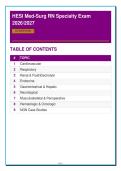
HESI Med-Surg RN Specialty Exam
2026/2027
55 QUESTIONS
TABLE OF CONTENTS
# TOPIC
1 Cardiovascular
2 Respiratory
3 Renal & Fluid/Electrolyte
4 Endocrine
5 Gastrointestinal & Hepatic
6 Neurological
7 Musculoskeletal & Perioperative
8 Hematologic & Oncologic
9 NGN Case Studies
Page 1
,Q1
A client presents with crushing substernal chest pain radiating to the left
jaw, diaphoresis, and nausea. Which action should the nurse take first?
A) *Obtain a 12-lead ECG and apply oxygen if hypoxemic CORRECT
B) Administer sublingual nitroglycerin and reassess in 15 minutes
C) Draw troponin levels and wait for results
D) Place the client in a supine position and restrict fluids
Rationale
ECG within 10 minutes of presentation identifies STEMI and drives reperfusion
decisions.
Q2
A client with heart failure has jugular venous distention, hepatomegaly, and
3+ pitting edema of both legs. Which finding indicates the client is
experiencing right-sided failure rather than left-sided failure?
A) Orthopnea
B) Paroxysmal nocturnal dyspnea
C) *Dependent edema with jugular venous distention CORRECT
D) Crackles auscultated at the lung bases
Rationale
Right-sided failure causes systemic venous congestion; left-sided failure
causes pulmonary congestion.
Page 2
, Q3
A client with type 1 diabetes has a glucose of 520 mg/dL, pH 7.19, large
serum ketones, and Kussmaul respirations. Which prescription should the
nurse question?
A) 0.9% normal saline infusion
B) *Subcutaneous insulin glargine as the sole insulin
CORRECT
therapy
C) IV regular insulin infusion
D) Hourly blood glucose monitoring
Rationale
DKA requires rapid-acting IV insulin; long-acting insulin alone cannot correct
acute acidosis.
Q4
A client is 3 days post-operative from a total hip replacement and suddenly
reports dyspnea and pleuritic chest pain. SpO2 is 86%. Which action should
the nurse take first?
A) Ambulate the client to improve circulation
B) Administer the prescribed PRN analgesic
C) Obtain a D-dimer and await results
D) *Apply high-flow oxygen and notify the rapid response CORRECT
team
Rationale
Suspected pulmonary embolism requires immediate oxygenation and
escalation; diagnostics follow stabilization.
Page 3
2026/2027
55 QUESTIONS
TABLE OF CONTENTS
# TOPIC
1 Cardiovascular
2 Respiratory
3 Renal & Fluid/Electrolyte
4 Endocrine
5 Gastrointestinal & Hepatic
6 Neurological
7 Musculoskeletal & Perioperative
8 Hematologic & Oncologic
9 NGN Case Studies
Page 1
,Q1
A client presents with crushing substernal chest pain radiating to the left
jaw, diaphoresis, and nausea. Which action should the nurse take first?
A) *Obtain a 12-lead ECG and apply oxygen if hypoxemic CORRECT
B) Administer sublingual nitroglycerin and reassess in 15 minutes
C) Draw troponin levels and wait for results
D) Place the client in a supine position and restrict fluids
Rationale
ECG within 10 minutes of presentation identifies STEMI and drives reperfusion
decisions.
Q2
A client with heart failure has jugular venous distention, hepatomegaly, and
3+ pitting edema of both legs. Which finding indicates the client is
experiencing right-sided failure rather than left-sided failure?
A) Orthopnea
B) Paroxysmal nocturnal dyspnea
C) *Dependent edema with jugular venous distention CORRECT
D) Crackles auscultated at the lung bases
Rationale
Right-sided failure causes systemic venous congestion; left-sided failure
causes pulmonary congestion.
Page 2
, Q3
A client with type 1 diabetes has a glucose of 520 mg/dL, pH 7.19, large
serum ketones, and Kussmaul respirations. Which prescription should the
nurse question?
A) 0.9% normal saline infusion
B) *Subcutaneous insulin glargine as the sole insulin
CORRECT
therapy
C) IV regular insulin infusion
D) Hourly blood glucose monitoring
Rationale
DKA requires rapid-acting IV insulin; long-acting insulin alone cannot correct
acute acidosis.
Q4
A client is 3 days post-operative from a total hip replacement and suddenly
reports dyspnea and pleuritic chest pain. SpO2 is 86%. Which action should
the nurse take first?
A) Ambulate the client to improve circulation
B) Administer the prescribed PRN analgesic
C) Obtain a D-dimer and await results
D) *Apply high-flow oxygen and notify the rapid response CORRECT
team
Rationale
Suspected pulmonary embolism requires immediate oxygenation and
escalation; diagnostics follow stabilization.
Page 3


