

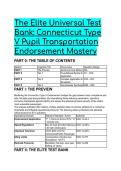
The Elite Universal Test
Bank: Connecticut Type
V Pupil Transportation
Endorsement Mastery
PART 0: THE TABLE OF CONTENTS
Section Cognitive Tier Focus Area Question Range
PART I The Preview Axioms & Core Metrics N/A
PART II Tier 1 Foundational Syntax & Q1 – Q18
Application
PART II Tier 2 Complex Application & Q19 – Q37
Simulation
PART II Tier 3 Grandmaster Synthesis Q38 – Q55
PART I: THE PREVIEW
Mastering the Connecticut Type V Endorsement bridges the gap between basic compliance and
elite, fail-safe pupil transportation. By internalizing these statutory parameters, operators
immunize themselves against liability and ensure the absolute physical security of the state's
most vulnerable passengers.
The analysis indicates that mastery of these statutes relies on precise adherence to numerical
thresholds and inflexible operational protocols. The following table synthesizes the absolute
critical axioms for STV operation:
Operational Domain Statutory Mandate / Axiom Authority
Endorsement Application "V" = Home-to-School STV; "A" CGS 14-44-3
= Activity only.
Speed Regulations Max 50 mph (Divided Highway) CGS 14-281a
/ 40 mph (Undivided).
Chemical Tolerance 0.04% BAC Limit for CGS 14-227n
Commercial/Public Passenger.
Idling Limits 3 consecutive minutes max CGS 14-277
(Exceptions: <20°F).
Railroad Protocols Mandatory full stop; zero gear CGS 14-250
shifting on tracks.
PART II: THE ELITE TEST BANK
,Q1: An applicant possesses a standard Connecticut driver's license and wishes to transport
students from their homes to a local public school using a passenger van. Based on the
principles of Connecticut General Statutes (CGS) 14-44, which action is the FIRST prerequisite
prior to DMV issuance of the required endorsement? A) Acquiring a Commercial Driver's
License (CDL) with a "P" endorsement B) Securing an "A" endorsement from the employing
carrier C) Successfully completing a safety training course and obtaining an R-360 certificate D)
Registering the passenger van as a traditional school bus
● Answer: C (Successfully completing a safety training course and obtaining an R-360
certificate)
● Distractor Analysis:
○ A is incorrect: A CDL is not universally required for STV operation unless the
vehicle is designed to transport 16 or more passengers.
○ B is incorrect: An "A" endorsement restricts the driver to school-sponsored
activities, not home-to-school routes.
○ D is incorrect: An STV is legally defined as a motor vehicle other than a registered
school bus.
The Mentor's Analysis: Statutory authorization precedes physical operation. When facing
endorsement acquisition, the immediate priority is validating specific training compliance. By
utilizing the R-360 certificate mandate, you bypass the common trap of assuming standard
licensing equates to passenger transport authorization. Professional Intuition: No "V"
endorsement can be issued without the foundational R-360 safety training certificate.
Q2: A carrier assigns a driver to transport a special education student directly to school in a
Student Transportation Vehicle (STV). Based on the principles of CGS 14-44-3, which
endorsement is the MOST APPROPRIATE? A) The "S" Endorsement B) The "V" Endorsement
C) The "A" Endorsement D) The "F" Endorsement
● Answer: B (The "V" Endorsement)
● Distractor Analysis:
○ A is incorrect: The "S" endorsement is strictly required for operating a registered
school bus, not an STV.
○ C is incorrect: The "A" endorsement restricts transport to activity vehicles for
school-sponsored events, explicitly excluding home-to-school routes.
○ D is incorrect: The "F" endorsement applies to taxicabs, livery vehicles, and service
buses, not pupil STVs.
The Mentor's Analysis: Endorsement classifications form the absolute legal boundary of an
operator's authority. When facing route assignments, the immediate priority is matching the
route type to the endorsement code. By utilizing the "V" for home-to-school transport, you
bypass the common trap of operating outside legal parameters. Professional Intuition: Route
geometry dictates endorsement necessity: Home-to-School equals "V".
Q3: A driver is operating an STV carrying six students on a rural, undivided highway with a
posted speed limit of 45 mph. Based on the principles of CGS 14-281a, which speed limit is the
MANDATORY maximum? A) 45 mph, as posted by local traffic authorities B) 50 mph, matching
the maximum state threshold C) 40 mph, adhering to the statutory limit for undivided highways
D) 55 mph, allowing for safe flow of surrounding traffic
● Answer: C (40 mph, adhering to the statutory limit for undivided highways)
● Distractor Analysis:
○ A is incorrect: The statutory limit for STVs on undivided highways is 40 mph, which
supersedes higher posted limits.
○ B is incorrect: 50 mph is exclusively reserved for divided, limited-access highways.
, ○ D is incorrect: Exceeding the STV speed limit to match traffic flow is a severe
moving violation.
The Mentor's Analysis: Kinetic energy management is tightly regulated for pupil transport. When
facing variable posted limits, the immediate priority is adhering to the STV statutory maximums.
By utilizing the 40 mph threshold on undivided roads, you bypass the common trap of yielding to
standard civilian traffic speeds. Professional Intuition: Statutory STV speed maximums
supersede higher posted limits without exception.
Q4: An STV operator is approaching a railroad grade crossing. Based on the principles of CGS
14-250, which action is the PIVOT WORD REQUIRED? A) Slow down to 15 mph and proceed if
the tracks are visibly clear B) Stop completely, look and listen, and shift gears smoothly while
crossing the tracks C) Stop completely, open the door to listen, close the door, and proceed
without shifting gears D) Stop only if warning lights are actively flashing or a train is visible
● Answer: C (Stop completely, open the door to listen, close the door, and proceed without
shifting gears)
● Distractor Analysis:
○ A is incorrect: Slowing down is insufficient; a full stop is legally mandated for all
vehicles transporting school children.
○ B is incorrect: Shifting gears while passing over a railway crossing is explicitly
prohibited by regulation.
○ D is incorrect: The stop is mandatory regardless of the presence of flashing lights or
visible trains.
The Mentor's Analysis: Railroad crossings represent peak kinetic vulnerability. When facing a
grade crossing, the immediate priority is total vehicle isolation and sensory verification. By
utilizing the no-shift rule, you bypass the common trap of stalling on the tracks due to a missed
gear. Professional Intuition: A stopped vehicle and a locked gear are the only defenses at a
railroad crossing.
Q5: Under CGS 14-100a, an STV operator is preparing to depart a school loading zone. Based
on passenger safety principles, which verification is the FIRST priority before setting the vehicle
in motion? A) Ensuring the two-way radio is tuned to the carrier's primary frequency B) Verifying
that all occupants are seated and properly restrained by seat belts C) Activating the amber
flashing warning lights for a minimum of 50 feet D) Confirming that the vehicle's interior climate
control is set for passenger comfort
● Answer: B (Verifying that all occupants are seated and properly restrained by seat belts)
● Distractor Analysis:
○ A is incorrect: Communication does not supersede the physical restraint and
seating of children prior to motion.
○ C is incorrect: Amber flashing lights are used prior to stopping, not when beginning
forward progress.
○ D is incorrect: Climate control is a secondary comfort issue, not a primary statutory
safety mandate.
The Mentor's Analysis: Forward motion introduces inertia, demanding immediate physical
security. When facing departure, the immediate priority is the restraint and secure seating of all
passengers. By utilizing mandatory seat belt verifications, you bypass the common trap of
initiating movement while a child is vulnerable. Professional Intuition: Zero motion occurs until
100 percent of passengers are seated and restrained.
Q6: An STV driver receives a text message on a hand-held mobile device while driving
passengers to an event. Based on the principles of CGS 14-296aa, which action is the ONLY
permissible response? A) Read the text quickly while maintaining visual contact with the
Bank: Connecticut Type
V Pupil Transportation
Endorsement Mastery
PART 0: THE TABLE OF CONTENTS
Section Cognitive Tier Focus Area Question Range
PART I The Preview Axioms & Core Metrics N/A
PART II Tier 1 Foundational Syntax & Q1 – Q18
Application
PART II Tier 2 Complex Application & Q19 – Q37
Simulation
PART II Tier 3 Grandmaster Synthesis Q38 – Q55
PART I: THE PREVIEW
Mastering the Connecticut Type V Endorsement bridges the gap between basic compliance and
elite, fail-safe pupil transportation. By internalizing these statutory parameters, operators
immunize themselves against liability and ensure the absolute physical security of the state's
most vulnerable passengers.
The analysis indicates that mastery of these statutes relies on precise adherence to numerical
thresholds and inflexible operational protocols. The following table synthesizes the absolute
critical axioms for STV operation:
Operational Domain Statutory Mandate / Axiom Authority
Endorsement Application "V" = Home-to-School STV; "A" CGS 14-44-3
= Activity only.
Speed Regulations Max 50 mph (Divided Highway) CGS 14-281a
/ 40 mph (Undivided).
Chemical Tolerance 0.04% BAC Limit for CGS 14-227n
Commercial/Public Passenger.
Idling Limits 3 consecutive minutes max CGS 14-277
(Exceptions: <20°F).
Railroad Protocols Mandatory full stop; zero gear CGS 14-250
shifting on tracks.
PART II: THE ELITE TEST BANK
,Q1: An applicant possesses a standard Connecticut driver's license and wishes to transport
students from their homes to a local public school using a passenger van. Based on the
principles of Connecticut General Statutes (CGS) 14-44, which action is the FIRST prerequisite
prior to DMV issuance of the required endorsement? A) Acquiring a Commercial Driver's
License (CDL) with a "P" endorsement B) Securing an "A" endorsement from the employing
carrier C) Successfully completing a safety training course and obtaining an R-360 certificate D)
Registering the passenger van as a traditional school bus
● Answer: C (Successfully completing a safety training course and obtaining an R-360
certificate)
● Distractor Analysis:
○ A is incorrect: A CDL is not universally required for STV operation unless the
vehicle is designed to transport 16 or more passengers.
○ B is incorrect: An "A" endorsement restricts the driver to school-sponsored
activities, not home-to-school routes.
○ D is incorrect: An STV is legally defined as a motor vehicle other than a registered
school bus.
The Mentor's Analysis: Statutory authorization precedes physical operation. When facing
endorsement acquisition, the immediate priority is validating specific training compliance. By
utilizing the R-360 certificate mandate, you bypass the common trap of assuming standard
licensing equates to passenger transport authorization. Professional Intuition: No "V"
endorsement can be issued without the foundational R-360 safety training certificate.
Q2: A carrier assigns a driver to transport a special education student directly to school in a
Student Transportation Vehicle (STV). Based on the principles of CGS 14-44-3, which
endorsement is the MOST APPROPRIATE? A) The "S" Endorsement B) The "V" Endorsement
C) The "A" Endorsement D) The "F" Endorsement
● Answer: B (The "V" Endorsement)
● Distractor Analysis:
○ A is incorrect: The "S" endorsement is strictly required for operating a registered
school bus, not an STV.
○ C is incorrect: The "A" endorsement restricts transport to activity vehicles for
school-sponsored events, explicitly excluding home-to-school routes.
○ D is incorrect: The "F" endorsement applies to taxicabs, livery vehicles, and service
buses, not pupil STVs.
The Mentor's Analysis: Endorsement classifications form the absolute legal boundary of an
operator's authority. When facing route assignments, the immediate priority is matching the
route type to the endorsement code. By utilizing the "V" for home-to-school transport, you
bypass the common trap of operating outside legal parameters. Professional Intuition: Route
geometry dictates endorsement necessity: Home-to-School equals "V".
Q3: A driver is operating an STV carrying six students on a rural, undivided highway with a
posted speed limit of 45 mph. Based on the principles of CGS 14-281a, which speed limit is the
MANDATORY maximum? A) 45 mph, as posted by local traffic authorities B) 50 mph, matching
the maximum state threshold C) 40 mph, adhering to the statutory limit for undivided highways
D) 55 mph, allowing for safe flow of surrounding traffic
● Answer: C (40 mph, adhering to the statutory limit for undivided highways)
● Distractor Analysis:
○ A is incorrect: The statutory limit for STVs on undivided highways is 40 mph, which
supersedes higher posted limits.
○ B is incorrect: 50 mph is exclusively reserved for divided, limited-access highways.
, ○ D is incorrect: Exceeding the STV speed limit to match traffic flow is a severe
moving violation.
The Mentor's Analysis: Kinetic energy management is tightly regulated for pupil transport. When
facing variable posted limits, the immediate priority is adhering to the STV statutory maximums.
By utilizing the 40 mph threshold on undivided roads, you bypass the common trap of yielding to
standard civilian traffic speeds. Professional Intuition: Statutory STV speed maximums
supersede higher posted limits without exception.
Q4: An STV operator is approaching a railroad grade crossing. Based on the principles of CGS
14-250, which action is the PIVOT WORD REQUIRED? A) Slow down to 15 mph and proceed if
the tracks are visibly clear B) Stop completely, look and listen, and shift gears smoothly while
crossing the tracks C) Stop completely, open the door to listen, close the door, and proceed
without shifting gears D) Stop only if warning lights are actively flashing or a train is visible
● Answer: C (Stop completely, open the door to listen, close the door, and proceed without
shifting gears)
● Distractor Analysis:
○ A is incorrect: Slowing down is insufficient; a full stop is legally mandated for all
vehicles transporting school children.
○ B is incorrect: Shifting gears while passing over a railway crossing is explicitly
prohibited by regulation.
○ D is incorrect: The stop is mandatory regardless of the presence of flashing lights or
visible trains.
The Mentor's Analysis: Railroad crossings represent peak kinetic vulnerability. When facing a
grade crossing, the immediate priority is total vehicle isolation and sensory verification. By
utilizing the no-shift rule, you bypass the common trap of stalling on the tracks due to a missed
gear. Professional Intuition: A stopped vehicle and a locked gear are the only defenses at a
railroad crossing.
Q5: Under CGS 14-100a, an STV operator is preparing to depart a school loading zone. Based
on passenger safety principles, which verification is the FIRST priority before setting the vehicle
in motion? A) Ensuring the two-way radio is tuned to the carrier's primary frequency B) Verifying
that all occupants are seated and properly restrained by seat belts C) Activating the amber
flashing warning lights for a minimum of 50 feet D) Confirming that the vehicle's interior climate
control is set for passenger comfort
● Answer: B (Verifying that all occupants are seated and properly restrained by seat belts)
● Distractor Analysis:
○ A is incorrect: Communication does not supersede the physical restraint and
seating of children prior to motion.
○ C is incorrect: Amber flashing lights are used prior to stopping, not when beginning
forward progress.
○ D is incorrect: Climate control is a secondary comfort issue, not a primary statutory
safety mandate.
The Mentor's Analysis: Forward motion introduces inertia, demanding immediate physical
security. When facing departure, the immediate priority is the restraint and secure seating of all
passengers. By utilizing mandatory seat belt verifications, you bypass the common trap of
initiating movement while a child is vulnerable. Professional Intuition: Zero motion occurs until
100 percent of passengers are seated and restrained.
Q6: An STV driver receives a text message on a hand-held mobile device while driving
passengers to an event. Based on the principles of CGS 14-296aa, which action is the ONLY
permissible response? A) Read the text quickly while maintaining visual contact with the


