

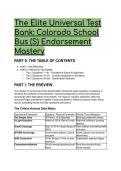
The Elite Universal Test
Bank: Colorado School
Bus (S) Endorsement
Mastery
PART 0: THE TABLE OF CONTENTS
● PART I: THE PREVIEW
● PART II: THE ELITE TEST BANK
○ Tier 1 (Questions 1–18) - Foundational Syntax & Application
○ Tier 2 (Questions 19–37) - Complex Application & Simulation
○ Tier 3 (Questions 38–55) - Grandmaster Synthesis
PART I: THE PREVIEW
The mastery of commercial school transportation transcends basic regulatory compliance; it
demands the synthesis of fluid dynamics, mechanical diagnostics, and human behavioral
psychology within high-stakes environments. The rigorous cognitive calibration within this
document forges practitioners capable of executing flawless, reflexive protocols under critical
duress, translating directly into elite operational dominance.
The Critical Axioms Data Matrix
Operational Framework Statutory / Physical Parameter Primary Threat Mitigation
The Danger Zone 30 ft front; 10 ft sides/rear. Blind-spot pedestrian strikes.
8-Light Actuation Amber at 200 ft; Red at 0 mph. Rear-end collisions; crossing
fatalities.
Grade Crossings Stop 15–50 ft; Hazard lamps at Train collision and trailing traffic
200 ft. confusion.
WTORS Anchorage 4-point frame tiedown; 3-point Kinetic ejection and structural
occupant. detachment.
HOS Constraints 10 hrs driving / 14 hrs on-duty Catastrophic operator fatigue.
maximum.
Compartmentalization 24-inch energy-absorbing seat Blunt force trauma during
backs. frontal impacts.
,PART II: THE ELITE TEST BANK
Tier 1 (Questions 1–18) - Foundational Syntax & Application
Q1: An operator is conducting a pre-trip mirror adjustment on a Type C conventional school bus.
Based on the principles of Colorado CDL danger zone regulations, which viewing area is the
PRIMARY target to establish using the outside crossview mirrors? A) The entire length of the
bus sides extending 200 feet to the rear. B) The top of the rear window and the heads of the
students right behind the driver. C) The entire area in front of the bus from the bumper to where
direct vision overlaps, including the front tires touching the ground. D) The blind spot
immediately below and directly in back of the rear bumper.
● Answer: C (The entire area in front of the bus from the bumper to where direct vision
overlaps, including the front tires touching the ground.)
● Distractor Analysis:
○ A is incorrect: Viewing 200 feet to the rear is the explicit function of the outside flat
mirrors, not crossview mirrors.
○ B is incorrect: Monitoring students inside the bus requires the inside overhead
rearview mirror.
○ D is incorrect: The rear bumper blind spot (extending 50 to 150 feet) cannot be
seen with crossview mirrors and is monitored via physical clearance procedures
and rear cameras if equipped.
The Mentor's Analysis: Crossview mirrors are engineered specifically to defeat the forward
danger zone, an area extending up to 30 feet from the front bumper where pedestrian strikes
are statistically most lethal. When establishing spatial awareness, the immediate priority is
eliminating the forward blind spot. By utilizing proper crossview calibration to see the front tires,
you bypass the common trap of missing a child obscured directly beneath the grille line.
Professional Intuition: If you cannot visually verify the front tires touching the tarmac in
your crossview mirrors, the bus does not move.
Q2: A school bus operator is preparing to discharge students on a residential two-lane highway.
Based on the principles of Colorado C.R.S. 42-4-1903, at what precise distance must the
operator actuate the alternating flashing amber warning lights? A) At least 50 feet prior to the
stop. B) At least 100 feet prior to the stop. C) At least 200 feet prior to the stop. D) At least 300
feet prior to the stop.
● Answer: C (At least 200 feet prior to the stop.)
● Distractor Analysis:
○ A is incorrect: 50 feet is the maximum distance a bus may stop from a railroad
crossing, not the amber light activation parameter.
○ B is incorrect: 100 feet is a legacy distance for standard turn signals in passenger
vehicles, inapplicable to commercial school bus warning systems.
○ D is incorrect: While some local districts may recommend 300 feet in extreme
speed zones, state statute strictly mandates 200 feet as the baseline legal
threshold.
The Mentor's Analysis: The 8-light warning system governs the kinetic flow of surrounding
traffic. When initiating a passenger stop, the immediate priority is broadcasting deceleration
intent to trailing vehicles. By utilizing the 200-foot amber actuation rule, you bypass the common
trap of inducing rear-end collisions caused by abrupt, unannounced stops. Professional
Intuition: Amber implies anticipation. Provide traffic exactly 200 feet of visual warning to
, process your deceleration.
Q3: An operator is approaching a designated school bus stop on an undivided four-lane
highway. Based on the principles of the Colorado Minimum Standards, what is the
MANDATORY action regarding the red visual signal lights? A) Actuate the red lights
concurrently with the amber lights as the bus begins to slow. B) Actuate the red lights only at the
time the bus is actually stopped. C) Actuate the red lights 50 feet before the stop to halt
approaching traffic early. D) Actuate the red lights only after the service door is fully opened and
students are standing.
● Answer: B (Actuate the red lights only at the time the bus is actually stopped.)
● Distractor Analysis:
○ A is incorrect: Amber and red lights operate sequentially within the 8-light system,
never concurrently.
○ C is incorrect: Actuating red lights while in motion is a severe statutory violation that
induces erratic and highly dangerous reactions from surrounding drivers.
○ D is incorrect: While modern bus wiring often links the red lights to the door switch,
the overarching regulatory mandate is that red lights must be active when stopped,
prior to passenger movement.
The Mentor's Analysis: Red flashing lights legally command surrounding traffic to halt
immediately. When facing a loading scenario, the immediate priority is securing a static
perimeter. By utilizing the red lights strictly at zero miles per hour, you bypass the common trap
of paralyzing active traffic lanes while the bus is still coasting. Professional Intuition: Red
means zero forward momentum. Never flash red while the tires are rolling.
Q4: According to Colorado 1 CCR 301-26, when a school bus approaches a railroad-highway
grade crossing, what is the FIRST required mechanical action the driver must execute to alert
other motorists? A) Turn off the master warning light switch. B) Activate the alternating flashing
amber warning lights. C) Open the service door and operator window. D) Activate the four-way
hazard lamps not less than 200 feet from the crossing.
● Answer: D (Activate the four-way hazard lamps not less than 200 feet from the crossing.)
● Distractor Analysis:
○ A is incorrect: The master switch controls the 8-light system, which is strictly
prohibited for railroad crossing protocol.
○ B is incorrect: Amber warning lights are strictly reserved for student loading and
unloading zones, never for grade crossings.
○ C is incorrect: Opening the door and window is required after the bus is completely
stopped within the 15-50 foot threshold, not during the approach.
The Mentor's Analysis: Railroad crossings present an asymmetric threat profile requiring distinct
communication. When approaching a crossing, the immediate priority is signaling a mandatory
stop to the vehicles behind you without triggering the 8-light student-loading protocol. By
utilizing the four-way hazard lamps at 200 feet, you bypass the common trap of confusing
motorists with conflicting visual signals. Professional Intuition: Hazards for tracks, ambers
for kids. Never cross-contaminate the lighting systems.
Q5: An operator conducts a pre-trip inspection of a Type C school bus. Based on the
requirements of 1 CCR 301-26 for emergency equipment, which item is NOT statutorily required
to be secured on the bus? A) A 24-unit first aid kit. B) Three emergency triangle reflectors. C) A
5-pound Halon fire extinguisher. D) A durable webbing cutter accessible to the seated driver.
● Answer: C (A 5-pound Halon fire extinguisher.)
● Distractor Analysis:
○ A is incorrect: A 24-unit first aid kit is explicitly required by regulation.
Bank: Colorado School
Bus (S) Endorsement
Mastery
PART 0: THE TABLE OF CONTENTS
● PART I: THE PREVIEW
● PART II: THE ELITE TEST BANK
○ Tier 1 (Questions 1–18) - Foundational Syntax & Application
○ Tier 2 (Questions 19–37) - Complex Application & Simulation
○ Tier 3 (Questions 38–55) - Grandmaster Synthesis
PART I: THE PREVIEW
The mastery of commercial school transportation transcends basic regulatory compliance; it
demands the synthesis of fluid dynamics, mechanical diagnostics, and human behavioral
psychology within high-stakes environments. The rigorous cognitive calibration within this
document forges practitioners capable of executing flawless, reflexive protocols under critical
duress, translating directly into elite operational dominance.
The Critical Axioms Data Matrix
Operational Framework Statutory / Physical Parameter Primary Threat Mitigation
The Danger Zone 30 ft front; 10 ft sides/rear. Blind-spot pedestrian strikes.
8-Light Actuation Amber at 200 ft; Red at 0 mph. Rear-end collisions; crossing
fatalities.
Grade Crossings Stop 15–50 ft; Hazard lamps at Train collision and trailing traffic
200 ft. confusion.
WTORS Anchorage 4-point frame tiedown; 3-point Kinetic ejection and structural
occupant. detachment.
HOS Constraints 10 hrs driving / 14 hrs on-duty Catastrophic operator fatigue.
maximum.
Compartmentalization 24-inch energy-absorbing seat Blunt force trauma during
backs. frontal impacts.
,PART II: THE ELITE TEST BANK
Tier 1 (Questions 1–18) - Foundational Syntax & Application
Q1: An operator is conducting a pre-trip mirror adjustment on a Type C conventional school bus.
Based on the principles of Colorado CDL danger zone regulations, which viewing area is the
PRIMARY target to establish using the outside crossview mirrors? A) The entire length of the
bus sides extending 200 feet to the rear. B) The top of the rear window and the heads of the
students right behind the driver. C) The entire area in front of the bus from the bumper to where
direct vision overlaps, including the front tires touching the ground. D) The blind spot
immediately below and directly in back of the rear bumper.
● Answer: C (The entire area in front of the bus from the bumper to where direct vision
overlaps, including the front tires touching the ground.)
● Distractor Analysis:
○ A is incorrect: Viewing 200 feet to the rear is the explicit function of the outside flat
mirrors, not crossview mirrors.
○ B is incorrect: Monitoring students inside the bus requires the inside overhead
rearview mirror.
○ D is incorrect: The rear bumper blind spot (extending 50 to 150 feet) cannot be
seen with crossview mirrors and is monitored via physical clearance procedures
and rear cameras if equipped.
The Mentor's Analysis: Crossview mirrors are engineered specifically to defeat the forward
danger zone, an area extending up to 30 feet from the front bumper where pedestrian strikes
are statistically most lethal. When establishing spatial awareness, the immediate priority is
eliminating the forward blind spot. By utilizing proper crossview calibration to see the front tires,
you bypass the common trap of missing a child obscured directly beneath the grille line.
Professional Intuition: If you cannot visually verify the front tires touching the tarmac in
your crossview mirrors, the bus does not move.
Q2: A school bus operator is preparing to discharge students on a residential two-lane highway.
Based on the principles of Colorado C.R.S. 42-4-1903, at what precise distance must the
operator actuate the alternating flashing amber warning lights? A) At least 50 feet prior to the
stop. B) At least 100 feet prior to the stop. C) At least 200 feet prior to the stop. D) At least 300
feet prior to the stop.
● Answer: C (At least 200 feet prior to the stop.)
● Distractor Analysis:
○ A is incorrect: 50 feet is the maximum distance a bus may stop from a railroad
crossing, not the amber light activation parameter.
○ B is incorrect: 100 feet is a legacy distance for standard turn signals in passenger
vehicles, inapplicable to commercial school bus warning systems.
○ D is incorrect: While some local districts may recommend 300 feet in extreme
speed zones, state statute strictly mandates 200 feet as the baseline legal
threshold.
The Mentor's Analysis: The 8-light warning system governs the kinetic flow of surrounding
traffic. When initiating a passenger stop, the immediate priority is broadcasting deceleration
intent to trailing vehicles. By utilizing the 200-foot amber actuation rule, you bypass the common
trap of inducing rear-end collisions caused by abrupt, unannounced stops. Professional
Intuition: Amber implies anticipation. Provide traffic exactly 200 feet of visual warning to
, process your deceleration.
Q3: An operator is approaching a designated school bus stop on an undivided four-lane
highway. Based on the principles of the Colorado Minimum Standards, what is the
MANDATORY action regarding the red visual signal lights? A) Actuate the red lights
concurrently with the amber lights as the bus begins to slow. B) Actuate the red lights only at the
time the bus is actually stopped. C) Actuate the red lights 50 feet before the stop to halt
approaching traffic early. D) Actuate the red lights only after the service door is fully opened and
students are standing.
● Answer: B (Actuate the red lights only at the time the bus is actually stopped.)
● Distractor Analysis:
○ A is incorrect: Amber and red lights operate sequentially within the 8-light system,
never concurrently.
○ C is incorrect: Actuating red lights while in motion is a severe statutory violation that
induces erratic and highly dangerous reactions from surrounding drivers.
○ D is incorrect: While modern bus wiring often links the red lights to the door switch,
the overarching regulatory mandate is that red lights must be active when stopped,
prior to passenger movement.
The Mentor's Analysis: Red flashing lights legally command surrounding traffic to halt
immediately. When facing a loading scenario, the immediate priority is securing a static
perimeter. By utilizing the red lights strictly at zero miles per hour, you bypass the common trap
of paralyzing active traffic lanes while the bus is still coasting. Professional Intuition: Red
means zero forward momentum. Never flash red while the tires are rolling.
Q4: According to Colorado 1 CCR 301-26, when a school bus approaches a railroad-highway
grade crossing, what is the FIRST required mechanical action the driver must execute to alert
other motorists? A) Turn off the master warning light switch. B) Activate the alternating flashing
amber warning lights. C) Open the service door and operator window. D) Activate the four-way
hazard lamps not less than 200 feet from the crossing.
● Answer: D (Activate the four-way hazard lamps not less than 200 feet from the crossing.)
● Distractor Analysis:
○ A is incorrect: The master switch controls the 8-light system, which is strictly
prohibited for railroad crossing protocol.
○ B is incorrect: Amber warning lights are strictly reserved for student loading and
unloading zones, never for grade crossings.
○ C is incorrect: Opening the door and window is required after the bus is completely
stopped within the 15-50 foot threshold, not during the approach.
The Mentor's Analysis: Railroad crossings present an asymmetric threat profile requiring distinct
communication. When approaching a crossing, the immediate priority is signaling a mandatory
stop to the vehicles behind you without triggering the 8-light student-loading protocol. By
utilizing the four-way hazard lamps at 200 feet, you bypass the common trap of confusing
motorists with conflicting visual signals. Professional Intuition: Hazards for tracks, ambers
for kids. Never cross-contaminate the lighting systems.
Q5: An operator conducts a pre-trip inspection of a Type C school bus. Based on the
requirements of 1 CCR 301-26 for emergency equipment, which item is NOT statutorily required
to be secured on the bus? A) A 24-unit first aid kit. B) Three emergency triangle reflectors. C) A
5-pound Halon fire extinguisher. D) A durable webbing cutter accessible to the seated driver.
● Answer: C (A 5-pound Halon fire extinguisher.)
● Distractor Analysis:
○ A is incorrect: A 24-unit first aid kit is explicitly required by regulation.


