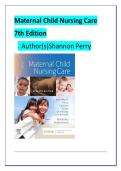
Maternal Child Nursing Care
7th Edition
• Author(s)Shannon Perry
,Question 1
Question:
A nurse working in a contemporary maternity unit wants to provide
care that reflects the major goals of 21st-century maternity nursing.
Which nursing action best demonstrates this approach?
A. Following the same care plan for every postpartum patient
B. Incorporating current evidence, patient preferences, and family
needs into care
C. Limiting family involvement to prevent interruptions in care
D. Focusing primarily on completing routine procedures efficiently
Correct Answer: B. Incorporating current evidence, patient
preferences, and family needs into care
Rationale:
Contemporary maternity nursing emphasizes evidence-informed
practice, individualized care, patient participation, and family-centered
care. The nurse should recognize that mothers and infants have
different needs, risks, preferences, and social circumstances.
Why the Other Options Are Incorrect:
A. Standardized approaches can promote consistency, but they should
not replace individualized assessment and care planning.
C. Appropriate family involvement can support maternal and infant
outcomes and should be encouraged when consistent with the patient's
preferences.
D. Efficient completion of tasks is important, but contemporary
maternity nursing prioritizes safe, individualized, relationship-centered
care over task completion alone.
,Question 2
Question:
Which development has most contributed to improved outcomes for
mothers and infants in contemporary maternity care?
A. Greater reliance on routine procedures regardless of risk level
B. Expansion of evidence-based screening, monitoring, and preventive
care
C. Reduced prenatal contact for patients with uncomplicated
pregnancies
D. Limiting maternal education to the immediate postpartum period
Correct Answer: B. Expansion of evidence-based screening,
monitoring, and preventive care
Rationale:
Advances in maternity care include improved screening, early
identification of complications, preventive interventions, health
education, and technologies that support maternal and fetal
assessment. These advances help identify risks earlier and improve
opportunities for timely intervention.
Why the Other Options Are Incorrect:
A. Contemporary care seeks to avoid unnecessary interventions and
match care to clinical need.
C. Appropriate prenatal care remains important even for patients
considered low risk because complications can develop unexpectedly.
D. Patient education should occur throughout pregnancy, birth,
, postpartum care, and transition home rather than being limited to one
period.
Question 3
Question:
A pregnant patient states, “I am worried that the healthcare system will
not listen to me because English is not my first language.” Which
nursing response best reflects contemporary maternity nursing?
A. “Your family member can translate for you during the visit.”
B. “Most maternity information is simple enough to understand without
interpretation.”
C. “We will use an appropriate qualified interpreter so you can
participate fully in your care.”
D. “You can ask questions after the provider finishes the examination.”
Correct Answer: C. “We will use an appropriate qualified interpreter
so you can participate fully in your care.”
Rationale:
Effective communication is essential for informed decision-making,
safety, health education, and equitable maternity care. Use of a
qualified interpreter supports accurate communication and allows the
patient to participate meaningfully in decisions.
Why the Other Options Are Incorrect:
A. Family members may omit, misunderstand, or alter information and
should not routinely replace appropriate professional interpretation.
B. Assuming that a patient understands healthcare information can
create serious communication and safety problems.
7th Edition
• Author(s)Shannon Perry
,Question 1
Question:
A nurse working in a contemporary maternity unit wants to provide
care that reflects the major goals of 21st-century maternity nursing.
Which nursing action best demonstrates this approach?
A. Following the same care plan for every postpartum patient
B. Incorporating current evidence, patient preferences, and family
needs into care
C. Limiting family involvement to prevent interruptions in care
D. Focusing primarily on completing routine procedures efficiently
Correct Answer: B. Incorporating current evidence, patient
preferences, and family needs into care
Rationale:
Contemporary maternity nursing emphasizes evidence-informed
practice, individualized care, patient participation, and family-centered
care. The nurse should recognize that mothers and infants have
different needs, risks, preferences, and social circumstances.
Why the Other Options Are Incorrect:
A. Standardized approaches can promote consistency, but they should
not replace individualized assessment and care planning.
C. Appropriate family involvement can support maternal and infant
outcomes and should be encouraged when consistent with the patient's
preferences.
D. Efficient completion of tasks is important, but contemporary
maternity nursing prioritizes safe, individualized, relationship-centered
care over task completion alone.
,Question 2
Question:
Which development has most contributed to improved outcomes for
mothers and infants in contemporary maternity care?
A. Greater reliance on routine procedures regardless of risk level
B. Expansion of evidence-based screening, monitoring, and preventive
care
C. Reduced prenatal contact for patients with uncomplicated
pregnancies
D. Limiting maternal education to the immediate postpartum period
Correct Answer: B. Expansion of evidence-based screening,
monitoring, and preventive care
Rationale:
Advances in maternity care include improved screening, early
identification of complications, preventive interventions, health
education, and technologies that support maternal and fetal
assessment. These advances help identify risks earlier and improve
opportunities for timely intervention.
Why the Other Options Are Incorrect:
A. Contemporary care seeks to avoid unnecessary interventions and
match care to clinical need.
C. Appropriate prenatal care remains important even for patients
considered low risk because complications can develop unexpectedly.
D. Patient education should occur throughout pregnancy, birth,
, postpartum care, and transition home rather than being limited to one
period.
Question 3
Question:
A pregnant patient states, “I am worried that the healthcare system will
not listen to me because English is not my first language.” Which
nursing response best reflects contemporary maternity nursing?
A. “Your family member can translate for you during the visit.”
B. “Most maternity information is simple enough to understand without
interpretation.”
C. “We will use an appropriate qualified interpreter so you can
participate fully in your care.”
D. “You can ask questions after the provider finishes the examination.”
Correct Answer: C. “We will use an appropriate qualified interpreter
so you can participate fully in your care.”
Rationale:
Effective communication is essential for informed decision-making,
safety, health education, and equitable maternity care. Use of a
qualified interpreter supports accurate communication and allows the
patient to participate meaningfully in decisions.
Why the Other Options Are Incorrect:
A. Family members may omit, misunderstand, or alter information and
should not routinely replace appropriate professional interpretation.
B. Assuming that a patient understands healthcare information can
create serious communication and safety problems.