
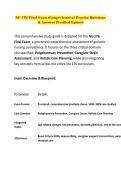
NU 176 Final Exam (Comprehensive) Practice Questions
& Answers (Verified Update)
This comprehensive study guide is designed for the NU 176
Final Exam, a proctored comprehensive assessment of geriatric
nursing competency. It focuses on the three critical domains
you specified: Polypharmacy Prevention, Caregiver Strain
Assessment, and Holistic Care Planning, while also integrating
key concepts from across the entire NU 176 curriculum.
Exam Overview & Blueprint:
Parameter Details
Exam Format Proctored, comprehensive (multiple-choice, SATA, NGN case studies)
Core Domains Polypharmacy Prevention, Caregiver Strain, Holistic Care Planning
Integrated
Age-related changes, fall prevention, dementia/delirium, end-of-life care
Topics
Beers Criteria 2026, deprescribing, caregiver support interventions, perso
2026 Focus
centered care
,Section 1: Polypharmacy Prevention & Medication Safety
1.1 Polypharmacy Definitions & Risk Factors
Q1. What is the most widely accepted definition of
polypharmacy in geriatric care?
A) The use of any prescription medication
B) The use of two or more over-the-counter medications
C) The use of five or more medications concurrently
D) The use of ten or more medications concurrently
Answer: C
Rationale: Polypharmacy is commonly defined as the use of five
or more medications concurrently, including prescription drugs,
over-the-counter products, and supplements. This threshold is
widely used in geriatric literature as a marker for increased risk
of adverse drug events.
Q2. Which physiological change in aging most significantly
affects drug clearance and increases the risk of toxicity?
A) Increased gastric acid production
B) Reduced renal function
C) Increased muscle mass
D) Increased liver size
,Answer: B
Rationale: Renal function declines with age, reducing drug
excretion and increasing the risk of toxicity for renally cleared
medications. This is a primary reason why older adults are more
vulnerable to adverse drug events.
Q3. A 78-year-old patient is taking 10 different daily
medications. The nurse identifies this as polypharmacy. Which
is the highest priority nursing intervention for this patient?
A) Encourage the patient to use multiple pharmacies for the
best price
B) Educate the patient to take all medications at once in the
morning
C) Review the medication list for potential drug-drug
interactions and duplications
D) Tell the patient to stop taking all over-the-counter
medications immediately
Answer: C
Rationale: The highest priority intervention is to review the
complete medication list for potential drug-drug interactions,
duplications, and inappropriate medications. This requires a
thorough medication reconciliation, not abrupt discontinuation
without provider guidance.
Q4. Which factor most increases the risk of adverse drug events
in older adults?
, A) Taking generic medications
B) Polypharmacy and drug interactions
C) Using a single pharmacy
D) Taking medications with food
Answer: B
Rationale: Polypharmacy and drug interactions are the leading
risk factors for adverse drug events in older adults. The more
medications a person takes, the greater the risk of harmful
interactions.
Q5. Why can polypharmacy increase fall risk in older adults?
A) All medications directly weaken bones
B) Multiple medications can contribute to dizziness, sedation, or
hypotension
C) Polypharmacy prevents older adults from exercising
D) All medications cause vision changes
Answer: B
Rationale: Multiple medications can contribute to dizziness,
sedation, orthostatic hypotension, and confusion, all of which
increase fall risk. This is a key concern in geriatric medication
management.
Q6. Which population is at greatest risk for polypharmacy?
A) Healthy older adults living independently
B) Older adults with multiple chronic conditions seeing multiple
& Answers (Verified Update)
This comprehensive study guide is designed for the NU 176
Final Exam, a proctored comprehensive assessment of geriatric
nursing competency. It focuses on the three critical domains
you specified: Polypharmacy Prevention, Caregiver Strain
Assessment, and Holistic Care Planning, while also integrating
key concepts from across the entire NU 176 curriculum.
Exam Overview & Blueprint:
Parameter Details
Exam Format Proctored, comprehensive (multiple-choice, SATA, NGN case studies)
Core Domains Polypharmacy Prevention, Caregiver Strain, Holistic Care Planning
Integrated
Age-related changes, fall prevention, dementia/delirium, end-of-life care
Topics
Beers Criteria 2026, deprescribing, caregiver support interventions, perso
2026 Focus
centered care
,Section 1: Polypharmacy Prevention & Medication Safety
1.1 Polypharmacy Definitions & Risk Factors
Q1. What is the most widely accepted definition of
polypharmacy in geriatric care?
A) The use of any prescription medication
B) The use of two or more over-the-counter medications
C) The use of five or more medications concurrently
D) The use of ten or more medications concurrently
Answer: C
Rationale: Polypharmacy is commonly defined as the use of five
or more medications concurrently, including prescription drugs,
over-the-counter products, and supplements. This threshold is
widely used in geriatric literature as a marker for increased risk
of adverse drug events.
Q2. Which physiological change in aging most significantly
affects drug clearance and increases the risk of toxicity?
A) Increased gastric acid production
B) Reduced renal function
C) Increased muscle mass
D) Increased liver size
,Answer: B
Rationale: Renal function declines with age, reducing drug
excretion and increasing the risk of toxicity for renally cleared
medications. This is a primary reason why older adults are more
vulnerable to adverse drug events.
Q3. A 78-year-old patient is taking 10 different daily
medications. The nurse identifies this as polypharmacy. Which
is the highest priority nursing intervention for this patient?
A) Encourage the patient to use multiple pharmacies for the
best price
B) Educate the patient to take all medications at once in the
morning
C) Review the medication list for potential drug-drug
interactions and duplications
D) Tell the patient to stop taking all over-the-counter
medications immediately
Answer: C
Rationale: The highest priority intervention is to review the
complete medication list for potential drug-drug interactions,
duplications, and inappropriate medications. This requires a
thorough medication reconciliation, not abrupt discontinuation
without provider guidance.
Q4. Which factor most increases the risk of adverse drug events
in older adults?
, A) Taking generic medications
B) Polypharmacy and drug interactions
C) Using a single pharmacy
D) Taking medications with food
Answer: B
Rationale: Polypharmacy and drug interactions are the leading
risk factors for adverse drug events in older adults. The more
medications a person takes, the greater the risk of harmful
interactions.
Q5. Why can polypharmacy increase fall risk in older adults?
A) All medications directly weaken bones
B) Multiple medications can contribute to dizziness, sedation, or
hypotension
C) Polypharmacy prevents older adults from exercising
D) All medications cause vision changes
Answer: B
Rationale: Multiple medications can contribute to dizziness,
sedation, orthostatic hypotension, and confusion, all of which
increase fall risk. This is a key concern in geriatric medication
management.
Q6. Which population is at greatest risk for polypharmacy?
A) Healthy older adults living independently
B) Older adults with multiple chronic conditions seeing multiple


