
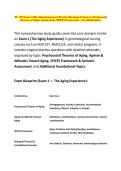
NU 176 Exam 1 (The Aging Experience) Practice Questions & Answers Psychosocial
Theories of Aging, Ageism & the SPICES Framework — (Verified) Update
This comprehensive study guide covers the core domains tested
on Exam 1 (The Aging Experience) in gerontological nursing
courses such as NUR 257, NUR2214, and similar programs. It
includes original practice questions with detailed rationales,
organized by topic: Psychosocial Theories of Aging, Ageism &
Attitudes Toward Aging, SPICES Framework & Geriatric
Assessment, and Additional Foundational Topics.
Exam Blueprint (Exam 1 — The Aging Experience):
Content Area Key Focus
Disengagement, Activity, Continuity, Socioemotional
Psychosocial Theories of Aging
Selectivity, Erikson's Integrity vs. Despair
Ageism & Attitudes Toward Definitions, manifestations, nursing interventions, cultural
Aging considerations
Sleep, Problems with Eating/Feeding, Incontinence,
SPICES Framework
Confusion, Evidence of Falls, Skin Breakdown
Biological Theories &
Free Radical, Telomere, Hormonal, Immunological theories
Foundational Concepts
,Content Area Key Focus
Nursing Application & Clinical
Assessment, interventions, patient scenarios
Judgment
Section 1: Psychosocial Theories of Aging
Disengagement Theory
Q1. The disengagement theory of aging proposes that:
A) Older adults should remain as active as possible for
successful aging
B) Aging involves a natural and mutual withdrawal between the
older adult and society
C) Personality and behavior remain consistent throughout the
lifespan
D) Older adults prioritize emotionally meaningful relationships
as time becomes limited
Answer: B
Rationale: Disengagement theory (Cumming & Henry, 1961)
was the first formal psychosocial theory of aging. It proposes
that successful aging involves a gradual, mutual withdrawal
between the older adult and society. This theory is now largely
,rejected because it fails to account for the many older adults
who remain actively engaged and satisfied.
Q2. Which statement best describes the current status of
disengagement theory in gerontological nursing?
A) It is the primary framework used for discharge planning
B) It is now largely rejected as a universal theory of aging
C) It has been proven correct by longitudinal research
D) It is only applicable to institutionalized older adults
Answer: B
Rationale: Disengagement theory is now largely rejected.
Research has shown that many older adults remain actively
engaged and derive satisfaction from continued involvement.
The theory was criticized for assuming withdrawal is natural and
universal when it is often driven by societal barriers.
Q3. A nurse is caring for an older adult who recently retired and
has stopped attending community events. According to
disengagement theory, this behavior would be considered:
A) A pathological sign of depression
B) A natural and mutually beneficial process
C) Evidence of ageism in the community
D) A failure to achieve ego integrity
Answer: B
Rationale: According to disengagement theory, the withdrawal
, between the older adult and society is considered natural and
mutually beneficial. However, the nurse should assess whether
the withdrawal is voluntary and satisfying or driven by
depression, physical limitations, or social exclusion.
Q4. Why is disengagement theory considered problematic for
nursing practice?
A) It encourages nurses to force activity on all older adults
B) It may justify neglecting older adults by labeling withdrawal
as normal
C) It overemphasizes the role of medications
D) It ignores biological theories of aging entirely
Answer: B
Rationale: Disengagement theory may justify neglect by
labeling withdrawal as a normal and natural process, when in
fact many older adults benefit from continued engagement.
Nurses should assess each individual's preferences and
circumstances rather than assuming withdrawal is inevitable.
Activity Theory
Q5. The activity theory of aging proposes that:
A) Older adults should disengage from society to prepare for
death
B) Life satisfaction in late adulthood is highest when individuals
maintain the level of activity they displayed earlier in life
Theories of Aging, Ageism & the SPICES Framework — (Verified) Update
This comprehensive study guide covers the core domains tested
on Exam 1 (The Aging Experience) in gerontological nursing
courses such as NUR 257, NUR2214, and similar programs. It
includes original practice questions with detailed rationales,
organized by topic: Psychosocial Theories of Aging, Ageism &
Attitudes Toward Aging, SPICES Framework & Geriatric
Assessment, and Additional Foundational Topics.
Exam Blueprint (Exam 1 — The Aging Experience):
Content Area Key Focus
Disengagement, Activity, Continuity, Socioemotional
Psychosocial Theories of Aging
Selectivity, Erikson's Integrity vs. Despair
Ageism & Attitudes Toward Definitions, manifestations, nursing interventions, cultural
Aging considerations
Sleep, Problems with Eating/Feeding, Incontinence,
SPICES Framework
Confusion, Evidence of Falls, Skin Breakdown
Biological Theories &
Free Radical, Telomere, Hormonal, Immunological theories
Foundational Concepts
,Content Area Key Focus
Nursing Application & Clinical
Assessment, interventions, patient scenarios
Judgment
Section 1: Psychosocial Theories of Aging
Disengagement Theory
Q1. The disengagement theory of aging proposes that:
A) Older adults should remain as active as possible for
successful aging
B) Aging involves a natural and mutual withdrawal between the
older adult and society
C) Personality and behavior remain consistent throughout the
lifespan
D) Older adults prioritize emotionally meaningful relationships
as time becomes limited
Answer: B
Rationale: Disengagement theory (Cumming & Henry, 1961)
was the first formal psychosocial theory of aging. It proposes
that successful aging involves a gradual, mutual withdrawal
between the older adult and society. This theory is now largely
,rejected because it fails to account for the many older adults
who remain actively engaged and satisfied.
Q2. Which statement best describes the current status of
disengagement theory in gerontological nursing?
A) It is the primary framework used for discharge planning
B) It is now largely rejected as a universal theory of aging
C) It has been proven correct by longitudinal research
D) It is only applicable to institutionalized older adults
Answer: B
Rationale: Disengagement theory is now largely rejected.
Research has shown that many older adults remain actively
engaged and derive satisfaction from continued involvement.
The theory was criticized for assuming withdrawal is natural and
universal when it is often driven by societal barriers.
Q3. A nurse is caring for an older adult who recently retired and
has stopped attending community events. According to
disengagement theory, this behavior would be considered:
A) A pathological sign of depression
B) A natural and mutually beneficial process
C) Evidence of ageism in the community
D) A failure to achieve ego integrity
Answer: B
Rationale: According to disengagement theory, the withdrawal
, between the older adult and society is considered natural and
mutually beneficial. However, the nurse should assess whether
the withdrawal is voluntary and satisfying or driven by
depression, physical limitations, or social exclusion.
Q4. Why is disengagement theory considered problematic for
nursing practice?
A) It encourages nurses to force activity on all older adults
B) It may justify neglecting older adults by labeling withdrawal
as normal
C) It overemphasizes the role of medications
D) It ignores biological theories of aging entirely
Answer: B
Rationale: Disengagement theory may justify neglect by
labeling withdrawal as a normal and natural process, when in
fact many older adults benefit from continued engagement.
Nurses should assess each individual's preferences and
circumstances rather than assuming withdrawal is inevitable.
Activity Theory
Q5. The activity theory of aging proposes that:
A) Older adults should disengage from society to prepare for
death
B) Life satisfaction in late adulthood is highest when individuals
maintain the level of activity they displayed earlier in life


