
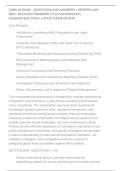
CAMs HI EXAM – QUESTIONS AND ANSWERS | VERIFIED AND
WELL DETAILED ANSWERS | PLUS RATIONALES |
GUARANTEED PASS | LATEST EXAM UPDATE
Core Domains:
Anti-Money Laundering (AML) Regulations and Legal
Frameworks
Customer Due Diligence (CDD) and Know Your Customer
(KYC) Standards
Transaction Monitoring and Suspicious Activity Reporting (SAR)
Risk Assessment Methodologies and Enterprise Risk
Management
Sanctions Compliance and Screening Practices
Global Standards and International Regulatory Bodies (FATF)
Investigative Techniques and Financial Crime Detection
Ethics, Governance, and Compliance Program Management
This comprehensive assessment is designed to evaluate professional
competency and proficiency in anti-money laundering and financial
crime compliance. The examination rigorously tests foundational
knowledge, applied analytical skills, regulatory frameworks, and
operational decision-making across complex financial landscapes.
Featuring a balanced combination of multiple-choice questions and
realistic scenario-based challenges, the exam emphasizes critical
thinking and the effective application of compliance standards to real-
world institutional environments. Successful candidates demonstrate
a robust understanding of international compliance mandates, risk
mitigation strategies, and investigative protocols required to
safeguard global financial systems against illicit activities.
SECTION ONE: QUESTIONS 1–100
Which international body is primarily responsible for
establishing global anti-money laundering and counter-terrorist
,financing standards?
A. The International Monetary Fund
B. The Financial Action Task Force
C. The World Bank
D. The Basel Committee on Banking Supervision
🟢 B. The Financial Action Task Force
🔴 Explanation: The Financial Action Task Force (FATF) is the
global standard-setting body for anti-money laundering (AML)
and counter-terrorist financing (CTF), establishing the
foundational 40 Recommendations.
What is the primary objective of the placement stage in the
money laundering process?
A. To integrate illicit funds into legitimate business investments
B. To obscure the audit trail through complex financial
transactions
C. To introduce illegal proceeds into the financial system
D. To legally protect the criminal from prosecution
🟢 C. To introduce illegal proceeds into the financial system
🔴 Explanation: Placement is the first stage of money
laundering, where illicit cash is physically or electronically
introduced into the legitimate financial system, often via bank
deposits or asset purchases.
During layering, the second stage of money laundering, what is
the primary goal of the launderer?
A. To convert cash into physical commodities
B. To distance the funds from their illegal source through
complex transactions
C. To return the funds to the criminal enterprise openly
D. To pay taxes on illicit earnings
🟢 B. To distance the funds from their illegal source through
complex transactions
🔴 Explanation: Layering involves moving funds around
through various accounts, shell companies, and investments to
create a complex web that obscures the audit trail and
separates the funds from their illicit origin.
,Which of the following best defines integration, the final stage
of money laundering?
A. Depositing cash into multiple bank accounts in small
amounts
B. Re-entering illicit funds into the legitimate economy to
appear legitimate
C. Transferring funds between international offshore accounts
D. Converting physical currency into foreign exchange
instruments
🟢 B. Re-entering illicit funds into the legitimate economy to
appear legitimate
🔴 Explanation: Integration involves placing laundered funds
back into the legitimate economic and financial system so they
can be used without raising suspicion, often through real
estate, luxury assets, or business investments.
What does the acronym KYC stand for in the context of
compliance programs?
A. Know Your Customer
B. Keep Your Cash
C. Key Yield Calculation
D. Knowledge Yield Control
🟢 A. Know Your Customer
🔴 Explanation: Know Your Customer (KYC) refers to the
mandatory process by which financial institutions verify the
identity of their clients and assess potential risks.
Under risk-based approaches, how should a financial institution
allocate its compliance resources?
A. Evenly across all customer accounts regardless of profile
B. Focus exclusively on retail banking customers with low
balances
C. Concentrate resources on higher-risk customers, products,
and geographies
D. Minimize compliance monitoring to reduce overhead
operational costs
🟢 C. Concentrate resources on higher-risk customers,
products, and geographies
, 🔴 Explanation: A risk-based approach requires institutions to
apply enhanced due diligence and allocate more resources to
areas identified as presenting higher risks for money laundering
or terrorist financing.
What is a Politically Exposed Person (PEP)?
A. Any individual who works in a government regulatory agency
B. An individual entrusted with a prominent public function,
posing higher corruption risks
C. A corporate executive managing a publicly traded
multinational company
D. A high-net-worth individual who donates heavily to political
campaigns
🟢 B. An individual entrusted with a prominent public function,
posing higher corruption risks
🔴 Explanation: PEPs are individuals who hold or have held
prominent public positions (e.g., heads of state, senior
politicians, high-ranking judges) whose positions may be
abused for illicit enrichment.
Which regulatory requirement mandates that financial
institutions report suspicious financial activities to authorities?
A. Privacy Act Compliance
B. Suspicious Activity Reporting (SAR)
C. Balance Sheet Reconciliation
D. Annual Tax Disclosure
🟢 B. Suspicious Activity Reporting (SAR)
🔴 Explanation: Financial institutions are required by law to file
Suspicious Activity Reports (SARs) or Suspicious Transaction
Reports (STRs) when they detect transactions indicative of
potential financial crime.
What is "smurfing" in the context of money laundering?
A. Structuring cash deposits into multiple smaller amounts to
evade reporting thresholds
B. Using offshore shell companies to hide ownership structures
C. Over-invoicing international trade shipments to transfer
funds illegally
D. Bribing bank tellers to ignore cash transaction reporting
WELL DETAILED ANSWERS | PLUS RATIONALES |
GUARANTEED PASS | LATEST EXAM UPDATE
Core Domains:
Anti-Money Laundering (AML) Regulations and Legal
Frameworks
Customer Due Diligence (CDD) and Know Your Customer
(KYC) Standards
Transaction Monitoring and Suspicious Activity Reporting (SAR)
Risk Assessment Methodologies and Enterprise Risk
Management
Sanctions Compliance and Screening Practices
Global Standards and International Regulatory Bodies (FATF)
Investigative Techniques and Financial Crime Detection
Ethics, Governance, and Compliance Program Management
This comprehensive assessment is designed to evaluate professional
competency and proficiency in anti-money laundering and financial
crime compliance. The examination rigorously tests foundational
knowledge, applied analytical skills, regulatory frameworks, and
operational decision-making across complex financial landscapes.
Featuring a balanced combination of multiple-choice questions and
realistic scenario-based challenges, the exam emphasizes critical
thinking and the effective application of compliance standards to real-
world institutional environments. Successful candidates demonstrate
a robust understanding of international compliance mandates, risk
mitigation strategies, and investigative protocols required to
safeguard global financial systems against illicit activities.
SECTION ONE: QUESTIONS 1–100
Which international body is primarily responsible for
establishing global anti-money laundering and counter-terrorist
,financing standards?
A. The International Monetary Fund
B. The Financial Action Task Force
C. The World Bank
D. The Basel Committee on Banking Supervision
🟢 B. The Financial Action Task Force
🔴 Explanation: The Financial Action Task Force (FATF) is the
global standard-setting body for anti-money laundering (AML)
and counter-terrorist financing (CTF), establishing the
foundational 40 Recommendations.
What is the primary objective of the placement stage in the
money laundering process?
A. To integrate illicit funds into legitimate business investments
B. To obscure the audit trail through complex financial
transactions
C. To introduce illegal proceeds into the financial system
D. To legally protect the criminal from prosecution
🟢 C. To introduce illegal proceeds into the financial system
🔴 Explanation: Placement is the first stage of money
laundering, where illicit cash is physically or electronically
introduced into the legitimate financial system, often via bank
deposits or asset purchases.
During layering, the second stage of money laundering, what is
the primary goal of the launderer?
A. To convert cash into physical commodities
B. To distance the funds from their illegal source through
complex transactions
C. To return the funds to the criminal enterprise openly
D. To pay taxes on illicit earnings
🟢 B. To distance the funds from their illegal source through
complex transactions
🔴 Explanation: Layering involves moving funds around
through various accounts, shell companies, and investments to
create a complex web that obscures the audit trail and
separates the funds from their illicit origin.
,Which of the following best defines integration, the final stage
of money laundering?
A. Depositing cash into multiple bank accounts in small
amounts
B. Re-entering illicit funds into the legitimate economy to
appear legitimate
C. Transferring funds between international offshore accounts
D. Converting physical currency into foreign exchange
instruments
🟢 B. Re-entering illicit funds into the legitimate economy to
appear legitimate
🔴 Explanation: Integration involves placing laundered funds
back into the legitimate economic and financial system so they
can be used without raising suspicion, often through real
estate, luxury assets, or business investments.
What does the acronym KYC stand for in the context of
compliance programs?
A. Know Your Customer
B. Keep Your Cash
C. Key Yield Calculation
D. Knowledge Yield Control
🟢 A. Know Your Customer
🔴 Explanation: Know Your Customer (KYC) refers to the
mandatory process by which financial institutions verify the
identity of their clients and assess potential risks.
Under risk-based approaches, how should a financial institution
allocate its compliance resources?
A. Evenly across all customer accounts regardless of profile
B. Focus exclusively on retail banking customers with low
balances
C. Concentrate resources on higher-risk customers, products,
and geographies
D. Minimize compliance monitoring to reduce overhead
operational costs
🟢 C. Concentrate resources on higher-risk customers,
products, and geographies
, 🔴 Explanation: A risk-based approach requires institutions to
apply enhanced due diligence and allocate more resources to
areas identified as presenting higher risks for money laundering
or terrorist financing.
What is a Politically Exposed Person (PEP)?
A. Any individual who works in a government regulatory agency
B. An individual entrusted with a prominent public function,
posing higher corruption risks
C. A corporate executive managing a publicly traded
multinational company
D. A high-net-worth individual who donates heavily to political
campaigns
🟢 B. An individual entrusted with a prominent public function,
posing higher corruption risks
🔴 Explanation: PEPs are individuals who hold or have held
prominent public positions (e.g., heads of state, senior
politicians, high-ranking judges) whose positions may be
abused for illicit enrichment.
Which regulatory requirement mandates that financial
institutions report suspicious financial activities to authorities?
A. Privacy Act Compliance
B. Suspicious Activity Reporting (SAR)
C. Balance Sheet Reconciliation
D. Annual Tax Disclosure
🟢 B. Suspicious Activity Reporting (SAR)
🔴 Explanation: Financial institutions are required by law to file
Suspicious Activity Reports (SARs) or Suspicious Transaction
Reports (STRs) when they detect transactions indicative of
potential financial crime.
What is "smurfing" in the context of money laundering?
A. Structuring cash deposits into multiple smaller amounts to
evade reporting thresholds
B. Using offshore shell companies to hide ownership structures
C. Over-invoicing international trade shipments to transfer
funds illegally
D. Bribing bank tellers to ignore cash transaction reporting


