
1-201 of 201
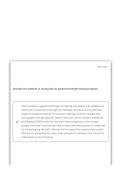
Describe two methods of varying sets for advanced strength training programs.
Some research suggests that single-set training is as effective as multiple-set
training for increasing the strength of untrained individuals during the initial
stage of resistance training. For long-term training, however, multiple sets
elicit greater strength gains for trained men and women. Paulsen, Myklested,
and Reestad (2003) noted that the best method depends on the muscle
groups exercised. They reported that multiple sets were superior to single sets
for increasing leg strength, whereas the two types of programs were equally
effective for increasing the upper body strength of untrained men during the
initial phase (6 wk) of training.
,What are the physiological mechanisms responsible for gains in ROM from PNF
stretching?
Autogenic inhibition refers to a reduction in the excitability of the targeted
muscle because of inhibitory signals sent from the Golgi tendon organ, or
GTO, during isometric contraction (i.e., greater GTO activation leads to reflex
relaxation). Also, voluntary contraction of opposing muscle groups during
CRAC stretching was simply explained by reciprocal inhibition (as the
opposing muscle group is voluntarily contracted, the target muscle group is
reflexively inhibited). Traditionally, increases in ROM from PNF stretching were
attributed to autogenic or reciprocal inhibition or both; however, these simple
explanations are likely inadequate to explain the complex mechanisms
underlying muscle stretch.
In contrast to the neurophysiological hypotheses of autogenic and reciprocal
inhibition, more contemporary views of how PNF stretching improves ROM
include the viscoelastic properties of stretched muscle (stress relaxation
hypothesis) and the ability to tolerate stretching (gate control theory). Muscles
and tendons have both elastic and viscous properties. The amount of tension
needed to elongate the musculotendinous unit (MTU) is dictated by the elastic
property of the MTU, while the viscous property resists the elongation of a
rapid stretch. However, the viscous material loses its ability to resist the
elongation force over time (stress relaxation), and the MTU will elongate if the
tension is sustained. Although this seems like a plausible theory, the change in
passive torque within the muscle that accompanies stress relaxation is short
lived, lasting less than an hour after PNF stretching (Magnusson et al. 1996).
The gate control theory, explaining what occurs when two stimuli such as pain
and stretch activate their respective receptors simultaneously, may help
explain longer-term adaptations from PNF stretching. Stretching a muscle
beyond its natural ROM and contracting it is seen as potentially damaging,
resulting in activation of the GTOs to prevent injury. However, with a consistent
and repeated PNF protocol, the GTOs adapt, becoming more accustomed to
increased stretch and force applied to the muscle, and cause less inhibition
(Hindle et al. 2012).
,What are the guidelines for an exercise prescription for cardiorespiratory fitness for Type
(mode)?
Select rhythmic aerobic activities that can be maintained continuously and that
involve large muscle groups and require little skill to perform. Introduce other
aerobic activities requiring more stamina or skill later in the program.
Describe three methods used to prescribe intensity for an aerobic exercise prescription.
Instead of expressing relative intensity as a straight percentage of O2 max
(% O2 max) or HRmax (%HRmax), the ACSM (2018) recommends using the
percent O2 reserve (% O2R). The O2R is the difference between the O2
max and resting oxygen consumption ( O2 rest). With this modification,
percent values for the % O2R and %HRR methods for prescribing exercise
intensity are approximately equal, thereby improving the accuracy of
calculating a target O2 , particularly for clients who are engaging in low-
intensity aerobic exercise.
Rating of perceived exertion method: In light of the limitations associated with
using HR for setting exercise intensity, consider using a combination of HR and
RPE in developing prescriptions for your clients. You can use RPEs to
prescribe and monitor exercise intensity for healthy and clinical clientele. The
ACSM (2018) recommends using RPE values (10-point scale) to prescribe
exercise intensity for older adults (moderate intensity: 5 to 6, vigorous
intensity: 7 to 8). The RPE scales (see table 4.2 and appendix B.4) are valid and
reliable tools for assessing the level of physical exertion during continuous
aerobic exercise.
, what is the purpose of 2018 PAR-Q+
To determine client's readiness for physical activity
What percentage of the American population does not get the recommended amount of
physical activity for health benefits?
Results from survey data collected from 146 countries representing all income
levels estimated that 23% of the global adult (≥15 yr) population was physically
inactive in 2016.
What are stage 1 hypertension cut off values for resting BP
systolic: 130-139. Diastolic 80-89
What are type B activities?
Describe two methods of varying sets for advanced strength training programs.
Some research suggests that single-set training is as effective as multiple-set
training for increasing the strength of untrained individuals during the initial
stage of resistance training. For long-term training, however, multiple sets
elicit greater strength gains for trained men and women. Paulsen, Myklested,
and Reestad (2003) noted that the best method depends on the muscle
groups exercised. They reported that multiple sets were superior to single sets
for increasing leg strength, whereas the two types of programs were equally
effective for increasing the upper body strength of untrained men during the
initial phase (6 wk) of training.
,What are the physiological mechanisms responsible for gains in ROM from PNF
stretching?
Autogenic inhibition refers to a reduction in the excitability of the targeted
muscle because of inhibitory signals sent from the Golgi tendon organ, or
GTO, during isometric contraction (i.e., greater GTO activation leads to reflex
relaxation). Also, voluntary contraction of opposing muscle groups during
CRAC stretching was simply explained by reciprocal inhibition (as the
opposing muscle group is voluntarily contracted, the target muscle group is
reflexively inhibited). Traditionally, increases in ROM from PNF stretching were
attributed to autogenic or reciprocal inhibition or both; however, these simple
explanations are likely inadequate to explain the complex mechanisms
underlying muscle stretch.
In contrast to the neurophysiological hypotheses of autogenic and reciprocal
inhibition, more contemporary views of how PNF stretching improves ROM
include the viscoelastic properties of stretched muscle (stress relaxation
hypothesis) and the ability to tolerate stretching (gate control theory). Muscles
and tendons have both elastic and viscous properties. The amount of tension
needed to elongate the musculotendinous unit (MTU) is dictated by the elastic
property of the MTU, while the viscous property resists the elongation of a
rapid stretch. However, the viscous material loses its ability to resist the
elongation force over time (stress relaxation), and the MTU will elongate if the
tension is sustained. Although this seems like a plausible theory, the change in
passive torque within the muscle that accompanies stress relaxation is short
lived, lasting less than an hour after PNF stretching (Magnusson et al. 1996).
The gate control theory, explaining what occurs when two stimuli such as pain
and stretch activate their respective receptors simultaneously, may help
explain longer-term adaptations from PNF stretching. Stretching a muscle
beyond its natural ROM and contracting it is seen as potentially damaging,
resulting in activation of the GTOs to prevent injury. However, with a consistent
and repeated PNF protocol, the GTOs adapt, becoming more accustomed to
increased stretch and force applied to the muscle, and cause less inhibition
(Hindle et al. 2012).
,What are the guidelines for an exercise prescription for cardiorespiratory fitness for Type
(mode)?
Select rhythmic aerobic activities that can be maintained continuously and that
involve large muscle groups and require little skill to perform. Introduce other
aerobic activities requiring more stamina or skill later in the program.
Describe three methods used to prescribe intensity for an aerobic exercise prescription.
Instead of expressing relative intensity as a straight percentage of O2 max
(% O2 max) or HRmax (%HRmax), the ACSM (2018) recommends using the
percent O2 reserve (% O2R). The O2R is the difference between the O2
max and resting oxygen consumption ( O2 rest). With this modification,
percent values for the % O2R and %HRR methods for prescribing exercise
intensity are approximately equal, thereby improving the accuracy of
calculating a target O2 , particularly for clients who are engaging in low-
intensity aerobic exercise.
Rating of perceived exertion method: In light of the limitations associated with
using HR for setting exercise intensity, consider using a combination of HR and
RPE in developing prescriptions for your clients. You can use RPEs to
prescribe and monitor exercise intensity for healthy and clinical clientele. The
ACSM (2018) recommends using RPE values (10-point scale) to prescribe
exercise intensity for older adults (moderate intensity: 5 to 6, vigorous
intensity: 7 to 8). The RPE scales (see table 4.2 and appendix B.4) are valid and
reliable tools for assessing the level of physical exertion during continuous
aerobic exercise.
, what is the purpose of 2018 PAR-Q+
To determine client's readiness for physical activity
What percentage of the American population does not get the recommended amount of
physical activity for health benefits?
Results from survey data collected from 146 countries representing all income
levels estimated that 23% of the global adult (≥15 yr) population was physically
inactive in 2016.
What are stage 1 hypertension cut off values for resting BP
systolic: 130-139. Diastolic 80-89
What are type B activities?


