

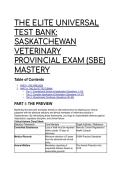
THE ELITE UNIVERSAL
TEST BANK:
SASKATCHEWAN
VETERINARY
PROVINCIAL EXAM (SBE)
MASTERY
Table of Contents
1. PART I: THE PREVIEW
2. PART II: THE ELITE TEST BANK
○ Tier 1: Foundational Syntax & Application (Questions 1–18)
○ Tier 2: Complex Application & Simulation (Questions 19–37)
○ Tier 3: Grandmaster Synthesis (Questions 38–55)
PART I: THE PREVIEW
Mastering this test bank translates directly to elite performance by aligning your clinical
judgment with the absolute statutory and ethical mandates of veterinary practice in
Saskatchewan. By internalizing these frameworks, you forge an impenetrable defense against
malpractice, regulatory discipline, and clinical failure.
Critical Axioms Cheat Sheet:
Statutory Framework Core Mandate Target Authority / Reference
Controlled Substances Loss or theft must be reported Narcotic Control Regulations /
within exactly 10 days of Health Canada
discovery.
Medical Records Minimum retention of 5 years SVMA Practice Standards
from the absolute last clinical
entry.
Animal Welfare Mandatory reporting of The Animal Protection Act,
suspected distress based on 2018
reasonable grounds.
,Statutory Framework Core Mandate Target Authority / Reference
Continuing Education 20 credits per 2-year cycle SVMA Bylaws
(minimum 18 from Category 1).
Professional Conduct VCPR required to prescribe; The Veterinarians Act, 1987 /
mandatory emergency SVMA
coverage required.
PART II: THE ELITE TEST BANK
Tier 1: Foundational Syntax & Application
Q1: A registered veterinary technologist (RVT) discovers a discrepancy in the clinic's narcotic
log, confirming a theft of ketamine. Based on the principles of the federal Narcotic Control
Regulations, what is the MAXIMUM timeframe allowed to report this loss to Health Canada?
A) 24 hours B) 72 hours C) 10 days D) 14 days
● Answer: C (10 days)
● Distractor Analysis:
○ A is incorrect: This is a common internal clinic policy for reporting to management,
not the federal statutory limit.
○ B is incorrect: This timeline often applies to certain provincial adverse event
reporting, but not federal narcotic loss.
○ D is incorrect: This is an arbitrary two-week window representing a legacy
misconception of reporting grace periods.
The Mentor's Analysis: Federal law requires precise accountability for controlled substances to
prevent diversion. When facing a narcotic loss or theft, the immediate priority is securing the
remaining inventory and notifying authorities. By utilizing the strict 10-day reporting window, you
bypass the common trap of regulatory non-compliance and subsequent loss of dispensing
privileges. Professional Intuition: Always report controlled substance losses to Health
Canada within 10 days of discovery.
Q2: A companion animal clinic in Saskatoon is auditing its archives to destroy old physical files.
Based on the principles of Saskatchewan Veterinary Medical Association (SVMA) bylaws, what
is the MINIMUM retention period for veterinary medical records?
A) 2 years from the date of the patient's death B) 5 years from the date of the last entry C) 7
years from the date of the first examination D) 10 years from the date of the last entry
● Answer: B (5 years from the date of the last entry)
● Distractor Analysis:
○ A is incorrect: Record retention is measured from the last entry, not the patient's
lifespan or death.
○ C is incorrect: While seven years is standard for financial tax records, SVMA
medical record mandates require five years.
○ D is incorrect: This represents human medical record legacy standards, not current
Saskatchewan veterinary requirements.
The Mentor's Analysis: Medical records are legal documents that protect both the patient's
continuity of care and the practitioner's liability. When facing archive purges, the immediate
priority is verifying the date of the final entry. By utilizing the 5-year retention rule, you bypass
the common trap of premature evidence destruction. Professional Intuition: Retain all
veterinary medical records for a minimum of 5 years from the absolute last clinical entry.
Q3: A veterinarian licensed in Ontario moves to Saskatchewan and applies for a temporary
, license while awaiting the results of their national board examinations. Based on the principles
of The Veterinarians Act, 1987, what is the MAXIMUM duration this temporary registration can
remain valid?
A) 3 months B) 6 months C) 12 months D) 24 months
● Answer: C (12 months)
● Distractor Analysis:
○ A is incorrect: Three months is the standard probationary period for employment,
not statutory temporary licensure.
○ B is incorrect: This is a plausible half-year distractor commonly used in other
provincial health professions.
○ D is incorrect: Two years exceeds the statutory limit designed to force examination
completion.
The Mentor's Analysis: Temporary licensure exists strictly to bridge administrative gaps without
compromising public safety. When facing inter-provincial relocation, the immediate priority is
securing full credentials rapidly. By utilizing the 12-month expiration deadline, you bypass the
common trap of practicing illegally on an expired provisional license. Professional Intuition:
Temporary veterinary registration in Saskatchewan expires strictly within 12 months of
issue.
Q4: A cattle rancher employs a full-time farmhand to assist with husbandry. The farmhand
administers routine antibiotics to a sick calf without veterinary supervision. Based on the
principles of The Veterinarians Act, 1987, which conclusion is MOST ACCURATE?
A) The farmhand is practicing veterinary medicine illegally. B) The farmhand is exempt from the
Act as a full-time employee of the owner. C) The farmhand may only administer oral
medications, not injectables. D) The farmhand requires a direct telemedicine consultation prior
to administration.
● Answer: B (The farmhand is exempt from the Act as a full-time employee of the owner.)
● Distractor Analysis:
○ A is incorrect: The Veterinarians Act specifically exempts owners and their
employees when treating their own animals.
○ C is incorrect: The Act does not differentiate between routes of administration for
owner-employees treating their own livestock.
○ D is incorrect: While telemedicine is useful, statutory exemptions for
owner-employees do not legally mandate it for basic treatment.
The Mentor's Analysis: Agricultural realities dictate that primary producers must manage routine
herd health. When facing questions of illegal practice, the immediate priority is determining the
ownership relationship of the animal. By utilizing the owner-employee exemption clause, you
bypass the common trap of misapplying clinical practice laws to routine agricultural husbandry.
Professional Intuition: Owners and their direct employees are legally exempt from
unauthorized practice rules when treating their own animals.
Q5: A client brings in a heavily matted dog with an embedded collar. The veterinarian suspects
chronic, intentional neglect. Based on the principles of The Animal Protection Act, 2018, what is
the veterinarian's FIRST legal obligation?
A) Seize the animal immediately and refuse return to the owner. B) Report the suspicion to an
Animal Protection Officer on reasonable grounds. C) Euthanize the animal to prevent further
distress without owner consent. D) Confront the owner and demand a signed surrender form.
● Answer: B (Report the suspicion to an Animal Protection Officer on reasonable grounds.)
● Distractor Analysis:
○ A is incorrect: Veterinarians do not possess unilateral seizure powers; this requires
TEST BANK:
SASKATCHEWAN
VETERINARY
PROVINCIAL EXAM (SBE)
MASTERY
Table of Contents
1. PART I: THE PREVIEW
2. PART II: THE ELITE TEST BANK
○ Tier 1: Foundational Syntax & Application (Questions 1–18)
○ Tier 2: Complex Application & Simulation (Questions 19–37)
○ Tier 3: Grandmaster Synthesis (Questions 38–55)
PART I: THE PREVIEW
Mastering this test bank translates directly to elite performance by aligning your clinical
judgment with the absolute statutory and ethical mandates of veterinary practice in
Saskatchewan. By internalizing these frameworks, you forge an impenetrable defense against
malpractice, regulatory discipline, and clinical failure.
Critical Axioms Cheat Sheet:
Statutory Framework Core Mandate Target Authority / Reference
Controlled Substances Loss or theft must be reported Narcotic Control Regulations /
within exactly 10 days of Health Canada
discovery.
Medical Records Minimum retention of 5 years SVMA Practice Standards
from the absolute last clinical
entry.
Animal Welfare Mandatory reporting of The Animal Protection Act,
suspected distress based on 2018
reasonable grounds.
,Statutory Framework Core Mandate Target Authority / Reference
Continuing Education 20 credits per 2-year cycle SVMA Bylaws
(minimum 18 from Category 1).
Professional Conduct VCPR required to prescribe; The Veterinarians Act, 1987 /
mandatory emergency SVMA
coverage required.
PART II: THE ELITE TEST BANK
Tier 1: Foundational Syntax & Application
Q1: A registered veterinary technologist (RVT) discovers a discrepancy in the clinic's narcotic
log, confirming a theft of ketamine. Based on the principles of the federal Narcotic Control
Regulations, what is the MAXIMUM timeframe allowed to report this loss to Health Canada?
A) 24 hours B) 72 hours C) 10 days D) 14 days
● Answer: C (10 days)
● Distractor Analysis:
○ A is incorrect: This is a common internal clinic policy for reporting to management,
not the federal statutory limit.
○ B is incorrect: This timeline often applies to certain provincial adverse event
reporting, but not federal narcotic loss.
○ D is incorrect: This is an arbitrary two-week window representing a legacy
misconception of reporting grace periods.
The Mentor's Analysis: Federal law requires precise accountability for controlled substances to
prevent diversion. When facing a narcotic loss or theft, the immediate priority is securing the
remaining inventory and notifying authorities. By utilizing the strict 10-day reporting window, you
bypass the common trap of regulatory non-compliance and subsequent loss of dispensing
privileges. Professional Intuition: Always report controlled substance losses to Health
Canada within 10 days of discovery.
Q2: A companion animal clinic in Saskatoon is auditing its archives to destroy old physical files.
Based on the principles of Saskatchewan Veterinary Medical Association (SVMA) bylaws, what
is the MINIMUM retention period for veterinary medical records?
A) 2 years from the date of the patient's death B) 5 years from the date of the last entry C) 7
years from the date of the first examination D) 10 years from the date of the last entry
● Answer: B (5 years from the date of the last entry)
● Distractor Analysis:
○ A is incorrect: Record retention is measured from the last entry, not the patient's
lifespan or death.
○ C is incorrect: While seven years is standard for financial tax records, SVMA
medical record mandates require five years.
○ D is incorrect: This represents human medical record legacy standards, not current
Saskatchewan veterinary requirements.
The Mentor's Analysis: Medical records are legal documents that protect both the patient's
continuity of care and the practitioner's liability. When facing archive purges, the immediate
priority is verifying the date of the final entry. By utilizing the 5-year retention rule, you bypass
the common trap of premature evidence destruction. Professional Intuition: Retain all
veterinary medical records for a minimum of 5 years from the absolute last clinical entry.
Q3: A veterinarian licensed in Ontario moves to Saskatchewan and applies for a temporary
, license while awaiting the results of their national board examinations. Based on the principles
of The Veterinarians Act, 1987, what is the MAXIMUM duration this temporary registration can
remain valid?
A) 3 months B) 6 months C) 12 months D) 24 months
● Answer: C (12 months)
● Distractor Analysis:
○ A is incorrect: Three months is the standard probationary period for employment,
not statutory temporary licensure.
○ B is incorrect: This is a plausible half-year distractor commonly used in other
provincial health professions.
○ D is incorrect: Two years exceeds the statutory limit designed to force examination
completion.
The Mentor's Analysis: Temporary licensure exists strictly to bridge administrative gaps without
compromising public safety. When facing inter-provincial relocation, the immediate priority is
securing full credentials rapidly. By utilizing the 12-month expiration deadline, you bypass the
common trap of practicing illegally on an expired provisional license. Professional Intuition:
Temporary veterinary registration in Saskatchewan expires strictly within 12 months of
issue.
Q4: A cattle rancher employs a full-time farmhand to assist with husbandry. The farmhand
administers routine antibiotics to a sick calf without veterinary supervision. Based on the
principles of The Veterinarians Act, 1987, which conclusion is MOST ACCURATE?
A) The farmhand is practicing veterinary medicine illegally. B) The farmhand is exempt from the
Act as a full-time employee of the owner. C) The farmhand may only administer oral
medications, not injectables. D) The farmhand requires a direct telemedicine consultation prior
to administration.
● Answer: B (The farmhand is exempt from the Act as a full-time employee of the owner.)
● Distractor Analysis:
○ A is incorrect: The Veterinarians Act specifically exempts owners and their
employees when treating their own animals.
○ C is incorrect: The Act does not differentiate between routes of administration for
owner-employees treating their own livestock.
○ D is incorrect: While telemedicine is useful, statutory exemptions for
owner-employees do not legally mandate it for basic treatment.
The Mentor's Analysis: Agricultural realities dictate that primary producers must manage routine
herd health. When facing questions of illegal practice, the immediate priority is determining the
ownership relationship of the animal. By utilizing the owner-employee exemption clause, you
bypass the common trap of misapplying clinical practice laws to routine agricultural husbandry.
Professional Intuition: Owners and their direct employees are legally exempt from
unauthorized practice rules when treating their own animals.
Q5: A client brings in a heavily matted dog with an embedded collar. The veterinarian suspects
chronic, intentional neglect. Based on the principles of The Animal Protection Act, 2018, what is
the veterinarian's FIRST legal obligation?
A) Seize the animal immediately and refuse return to the owner. B) Report the suspicion to an
Animal Protection Officer on reasonable grounds. C) Euthanize the animal to prevent further
distress without owner consent. D) Confront the owner and demand a signed surrender form.
● Answer: B (Report the suspicion to an Animal Protection Officer on reasonable grounds.)
● Distractor Analysis:
○ A is incorrect: Veterinarians do not possess unilateral seizure powers; this requires


