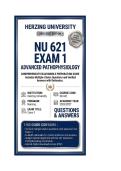
,NU 621 Exam 1 Advanced Pathophysiology Questions And Answers
2026/2027 Herzing University
Q1. Which hemodynamic relationship determines cardiac output?
A) Cardiac output = blood pressure × systemic vascular resistance
B) Cardiac output = preload × afterload
C) Cardiac output = heart rate × stroke volume
D) Cardiac output = contractility × venous pressure
Correct Answer: C) Cardiac output = heart rate × stroke volume
Rationale: Cardiac output is the volume of blood pumped per minute and is
determined by multiplying heart rate by stroke volume.
Q2. Which factor represents preload?
A) Resistance against ventricular ejection
B) Intrinsic strength of myocardial contraction
C) Systemic vascular resistance
D) Ventricular end-diastolic filling and stretch
Correct Answer: D) Ventricular end-diastolic filling and stretch
Rationale: Preload reflects ventricular filling and myocardial fiber stretch
immediately before contraction.
Q3. Which change most directly increases left ventricular afterload?
A) Reduced systemic vascular resistance
B) Decreased arterial pressure
C) Systemic hypertension
D) Reduced circulating volume
Correct Answer: C) Systemic hypertension
Rationale: Elevated arterial pressure increases the resistance the left
ventricle must overcome to eject blood.
Q4. According to the Frank-Starling mechanism, increasing
ventricular filling within physiologic limits causes:
A) Decreased myocardial fiber stretch
B) Reduced stroke volume
C) Increased force of contraction and stroke volume
D) Immediate ventricular failure
Correct Answer: C) Increased force of contraction and stroke volume
Rationale: Greater myocardial fiber stretch during filling increases
contraction strength until excessive stretch impairs function.
Q5. Which condition most directly decreases myocardial
contractility?
, A) Increased venous return
B) Mild exercise
C) Sympathetic stimulation
D) Myocardial infarction
Correct Answer: D) Myocardial infarction
Rationale: Ischemic necrosis damages contractile myocardium and reduces
the ventricle's ability to generate force.
Q6. A sustained increase in systemic vascular resistance primarily
causes which cardiac adaptation?
A) Reduced afterload
B) Decreased myocardial workload
C) Immediate ventricular dilation in every patient
D) Left ventricular hypertrophy
Correct Answer: D) Left ventricular hypertrophy
Rationale: Chronic pressure overload stimulates myocardial hypertrophy as
the ventricle adapts to increased resistance.
Q7. Which mechanism has the greatest role in primary
hypertension?
A) Persistent reduction in cardiac output only
B) Abnormal regulation of vascular resistance and volume
C) Loss of all sympathetic activity
D) Reduced renal sodium reabsorption
Correct Answer: B) Abnormal regulation of vascular resistance and volume
Rationale: Primary hypertension results from complex interactions involving
vascular tone, renal sodium balance, neurohormonal regulation, and
genetics.
Q8. Activation of the renin-angiotensin-aldosterone system
increases blood pressure primarily by:
A) Promoting vasoconstriction and sodium-water retention
B) Decreasing aldosterone secretion
C) Increasing sodium excretion
D) Blocking sympathetic activity
Correct Answer: A) Promoting vasoconstriction and sodium-water retention
Rationale: Angiotensin II causes vasoconstriction, while aldosterone
promotes sodium and water retention, increasing pressure and volume.
Q9. Which organ is particularly vulnerable to chronic hypertensive
target-organ damage?
A) Appendix
2026/2027 Herzing University
Q1. Which hemodynamic relationship determines cardiac output?
A) Cardiac output = blood pressure × systemic vascular resistance
B) Cardiac output = preload × afterload
C) Cardiac output = heart rate × stroke volume
D) Cardiac output = contractility × venous pressure
Correct Answer: C) Cardiac output = heart rate × stroke volume
Rationale: Cardiac output is the volume of blood pumped per minute and is
determined by multiplying heart rate by stroke volume.
Q2. Which factor represents preload?
A) Resistance against ventricular ejection
B) Intrinsic strength of myocardial contraction
C) Systemic vascular resistance
D) Ventricular end-diastolic filling and stretch
Correct Answer: D) Ventricular end-diastolic filling and stretch
Rationale: Preload reflects ventricular filling and myocardial fiber stretch
immediately before contraction.
Q3. Which change most directly increases left ventricular afterload?
A) Reduced systemic vascular resistance
B) Decreased arterial pressure
C) Systemic hypertension
D) Reduced circulating volume
Correct Answer: C) Systemic hypertension
Rationale: Elevated arterial pressure increases the resistance the left
ventricle must overcome to eject blood.
Q4. According to the Frank-Starling mechanism, increasing
ventricular filling within physiologic limits causes:
A) Decreased myocardial fiber stretch
B) Reduced stroke volume
C) Increased force of contraction and stroke volume
D) Immediate ventricular failure
Correct Answer: C) Increased force of contraction and stroke volume
Rationale: Greater myocardial fiber stretch during filling increases
contraction strength until excessive stretch impairs function.
Q5. Which condition most directly decreases myocardial
contractility?
, A) Increased venous return
B) Mild exercise
C) Sympathetic stimulation
D) Myocardial infarction
Correct Answer: D) Myocardial infarction
Rationale: Ischemic necrosis damages contractile myocardium and reduces
the ventricle's ability to generate force.
Q6. A sustained increase in systemic vascular resistance primarily
causes which cardiac adaptation?
A) Reduced afterload
B) Decreased myocardial workload
C) Immediate ventricular dilation in every patient
D) Left ventricular hypertrophy
Correct Answer: D) Left ventricular hypertrophy
Rationale: Chronic pressure overload stimulates myocardial hypertrophy as
the ventricle adapts to increased resistance.
Q7. Which mechanism has the greatest role in primary
hypertension?
A) Persistent reduction in cardiac output only
B) Abnormal regulation of vascular resistance and volume
C) Loss of all sympathetic activity
D) Reduced renal sodium reabsorption
Correct Answer: B) Abnormal regulation of vascular resistance and volume
Rationale: Primary hypertension results from complex interactions involving
vascular tone, renal sodium balance, neurohormonal regulation, and
genetics.
Q8. Activation of the renin-angiotensin-aldosterone system
increases blood pressure primarily by:
A) Promoting vasoconstriction and sodium-water retention
B) Decreasing aldosterone secretion
C) Increasing sodium excretion
D) Blocking sympathetic activity
Correct Answer: A) Promoting vasoconstriction and sodium-water retention
Rationale: Angiotensin II causes vasoconstriction, while aldosterone
promotes sodium and water retention, increasing pressure and volume.
Q9. Which organ is particularly vulnerable to chronic hypertensive
target-organ damage?
A) Appendix