
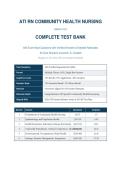
ATI RN COMMUNITY HEALTH NURSING
Edition 10.0
COMPLETE TEST BANK
500 Exam-Style Questions with Verified Answers & Detailed Rationales
All Core Domains Covered | A+ Graded
Chapters 1-30 | 2026 ATI Curriculum Standards
Total Questions 500 (Verified Sequential Q1-Q500)
Format Multiple Choice (A-D), Single Best Answer
Cognitive Levels 25% Recall | 55% Application | 20% Analysis
Question Style 75% Scenario-Based | 25% Direct Recall
Sections 6 Sections Aligned to ATI Content Domains
Rationale Depth Comprehensive ATI-Specific Community Health Reasoning
Aligned With 2026 ATI Content Mastery Series & NCLEX Test Plan
Section Domain Questions Chapters
1 Foundations of Community Health Nursing Q1-75 1-5
2 Epidemiology and Population Health Q76-150 6-10
3 Health Promotion, Education, Disease Prevention Q151-235 11-15
4 Vulnerable Populations, Cultural Competence, Health
Q236-325
Equity 16-21
5 Environmental, Occupational, Global Health Q326-400 22-26
6 Settings, Disaster Management, Integration Q401-500 27-30
, Section 1: Foundations of Community Health Nursing (Chapters
1-5)
Q1: A community health nurse is working with a local health department to develop a
new policy addressing childhood obesity. The nurse collects data on current obesity
rates, available community resources, and community member perceptions. Which of
the three core public health functions does this activity best represent?
A. Assurance
B. Policy development
C. Assessment [CORRECT]
D. Evaluation
Correct Answer: C
Rationale: Assessment, one of the three core public health functions identified by the Institute of
Medicine (IOM), involves systematic data collection on the population's health status, community
resources, and perceptions to identify health problems and assets. In this scenario, the nurse is
gathering data on obesity rates, resources, and perceptions before any policy is developed. Assurance
refers to ensuring services are available and competent, while policy development involves using
assessment data to develop comprehensive policies. Evaluation is a later program stage. The ATI
testing strategy emphasizes that community assessment MUST precede intervention, reflecting the
assessment core function as the foundational step in the public health process.
Q2: A public health nurse is reviewing historical nursing contributions. Which nurse is
credited with establishing the Henry Street Settlement in 1893, considered a foundational
event in the evolution of community health nursing in the United States?
A. Florence Nightingale
B. Clara Barton
C. Lillian Wald [CORRECT]
D. Margaret Sanger
Correct Answer: C
Rationale: Lillian Wald and Mary Brewster established the Henry Street Settlement in New York City
in 1893, marking the formal beginning of public health nursing in the United States. Wald coined the
term 'public health nurse' to emphasize the nurse's role in addressing social, economic, and
environmental determinants of health. Florence Nightingale is associated with nursing in the Crimean
War and statistical contributions, Clara Barton founded the American Red Cross, and Margaret Sanger
advocated for birth control. ATI content emphasizes Wald's contribution as establishing the link
between nursing and social reform, which is foundational to current community health nursing
practice.
Q3: A community health nurse speaks to a city council about the need for safe sidewalks
and bicycle lanes to promote physical activity. The nurse's role in this situation is best
described as:
, A. Case manager
B. Advocate [CORRECT]
C. Direct caregiver
D. Counselor
Correct Answer: B
Rationale: The advocate role involves speaking on behalf of clients or communities to influence policy
decisions, secure resources, or address systemic barriers. By addressing the city council regarding
environmental supports for physical activity, the nurse is advocating for population-level change.
Case management involves coordinating services for individual clients; direct caregiving refers to
hands-on clinical services; counseling is supportive guidance for individuals or families. ATI Content
Mastery Series emphasizes the advocate role as essential for addressing social determinants of health
through policy change, distinguishing it from individual-focused interventions.
Q4: A community health nurse administers influenza vaccines at a community clinic.
This activity represents which level of prevention?
A. Primary prevention [CORRECT]
B. Secondary prevention
C. Tertiary prevention
D. Quaternary prevention
Correct Answer: A
Rationale: Primary prevention aims to prevent disease or injury before it occurs by reducing
susceptibility or limiting exposure. Immunization is a classic primary prevention strategy that
enhances host resistance through active or passive immunity. Secondary prevention involves early
detection and prompt treatment (e.g., screening). Tertiary prevention focuses on rehabilitation and
limiting complications of established disease. ATI testing frequently distinguishes prevention levels;
immunizations, health education, and environmental modifications are hallmarks of primary
prevention. Quaternary prevention is not a standard category in the ATI framework but refers to
preventing overmedicalization in some European models.
Q5: A nurse is conducting a community assessment using a windshield survey. Which of
the following best describes this method?
A. A systematic review of community health records and statistics
B. A comprehensive motorized observation of community boundaries, environment, and
resources [CORRECT]
C. A structured interview with community leaders about perceived needs
D. A written questionnaire mailed to randomly selected households
Correct Answer: B
Rationale: A windshield survey is a systematic, mobile observation technique where the nurse drives
or walks through the community to observe physical environment, housing, businesses, schools,
transportation, recreational facilities, and residents' characteristics. It provides a snapshot of
community assets and deficits. Health record review is secondary data analysis; interviews with
, leaders are key informant interviews; mailed questionnaires are surveys. ATI Content Mastery Series
emphasizes the windshield survey as a primary data collection method useful for understanding
community context, environmental hazards, and resource availability before program planning.
Q6: Which of the following is one of the 10 Essential Public Health Services?
A. Perform daily individual health assessments
B. Diagnose and investigate health problems and health hazards in the community
[CORRECT]
C. Provide direct medical treatment to all community members
D. Maintain a database of all client medical records
Correct Answer: B
Rationale: The 10 Essential Public Health Services framework, developed by the Public Health
Functions Steering Committee, includes 'Diagnose and investigate health problems and health
hazards in the community' as a core service. This aligns with the assessment and assurance functions
of public health. The other options misrepresent the framework: essential services are
population-focused rather than individual, emphasize prevention over treatment, and address
system-level functions rather than individual records. ATI Content Mastery Series expects nurses to
differentiate population-focused essential services from individual clinical care.
Q7: A nurse is implementing a program that provides smoking cessation counseling to
adults who currently smoke. This intervention best represents which level of
prevention?
A. Primary prevention
B. Secondary prevention [CORRECT]
C. Tertiary prevention
D. Primordial prevention
Correct Answer: B
Rationale: Secondary prevention focuses on early detection and intervention to halt the disease
process in individuals who already have risk factors or are in early disease stages. Smoking cessation
for current smokers aims to reduce risk of cardiovascular disease, COPD, and cancer before serious
manifestations occur. Primary prevention targets nonsmokers to prevent initiation; tertiary
prevention rehabilitates those already diagnosed with smoking-related diseases. ATI testing often
distinguishes risk-reduction interventions in already-exposed individuals as secondary prevention.
Primordial prevention addresses underlying social conditions that foster risk factor development.
Q8: A community health nurse is working with a faith community to establish a blood
pressure screening program. The nurse's role in this setting best exemplifies:
A. Faith community nurse [CORRECT]
B. Forensic nurse
C. Occupational health nurse
Edition 10.0
COMPLETE TEST BANK
500 Exam-Style Questions with Verified Answers & Detailed Rationales
All Core Domains Covered | A+ Graded
Chapters 1-30 | 2026 ATI Curriculum Standards
Total Questions 500 (Verified Sequential Q1-Q500)
Format Multiple Choice (A-D), Single Best Answer
Cognitive Levels 25% Recall | 55% Application | 20% Analysis
Question Style 75% Scenario-Based | 25% Direct Recall
Sections 6 Sections Aligned to ATI Content Domains
Rationale Depth Comprehensive ATI-Specific Community Health Reasoning
Aligned With 2026 ATI Content Mastery Series & NCLEX Test Plan
Section Domain Questions Chapters
1 Foundations of Community Health Nursing Q1-75 1-5
2 Epidemiology and Population Health Q76-150 6-10
3 Health Promotion, Education, Disease Prevention Q151-235 11-15
4 Vulnerable Populations, Cultural Competence, Health
Q236-325
Equity 16-21
5 Environmental, Occupational, Global Health Q326-400 22-26
6 Settings, Disaster Management, Integration Q401-500 27-30
, Section 1: Foundations of Community Health Nursing (Chapters
1-5)
Q1: A community health nurse is working with a local health department to develop a
new policy addressing childhood obesity. The nurse collects data on current obesity
rates, available community resources, and community member perceptions. Which of
the three core public health functions does this activity best represent?
A. Assurance
B. Policy development
C. Assessment [CORRECT]
D. Evaluation
Correct Answer: C
Rationale: Assessment, one of the three core public health functions identified by the Institute of
Medicine (IOM), involves systematic data collection on the population's health status, community
resources, and perceptions to identify health problems and assets. In this scenario, the nurse is
gathering data on obesity rates, resources, and perceptions before any policy is developed. Assurance
refers to ensuring services are available and competent, while policy development involves using
assessment data to develop comprehensive policies. Evaluation is a later program stage. The ATI
testing strategy emphasizes that community assessment MUST precede intervention, reflecting the
assessment core function as the foundational step in the public health process.
Q2: A public health nurse is reviewing historical nursing contributions. Which nurse is
credited with establishing the Henry Street Settlement in 1893, considered a foundational
event in the evolution of community health nursing in the United States?
A. Florence Nightingale
B. Clara Barton
C. Lillian Wald [CORRECT]
D. Margaret Sanger
Correct Answer: C
Rationale: Lillian Wald and Mary Brewster established the Henry Street Settlement in New York City
in 1893, marking the formal beginning of public health nursing in the United States. Wald coined the
term 'public health nurse' to emphasize the nurse's role in addressing social, economic, and
environmental determinants of health. Florence Nightingale is associated with nursing in the Crimean
War and statistical contributions, Clara Barton founded the American Red Cross, and Margaret Sanger
advocated for birth control. ATI content emphasizes Wald's contribution as establishing the link
between nursing and social reform, which is foundational to current community health nursing
practice.
Q3: A community health nurse speaks to a city council about the need for safe sidewalks
and bicycle lanes to promote physical activity. The nurse's role in this situation is best
described as:
, A. Case manager
B. Advocate [CORRECT]
C. Direct caregiver
D. Counselor
Correct Answer: B
Rationale: The advocate role involves speaking on behalf of clients or communities to influence policy
decisions, secure resources, or address systemic barriers. By addressing the city council regarding
environmental supports for physical activity, the nurse is advocating for population-level change.
Case management involves coordinating services for individual clients; direct caregiving refers to
hands-on clinical services; counseling is supportive guidance for individuals or families. ATI Content
Mastery Series emphasizes the advocate role as essential for addressing social determinants of health
through policy change, distinguishing it from individual-focused interventions.
Q4: A community health nurse administers influenza vaccines at a community clinic.
This activity represents which level of prevention?
A. Primary prevention [CORRECT]
B. Secondary prevention
C. Tertiary prevention
D. Quaternary prevention
Correct Answer: A
Rationale: Primary prevention aims to prevent disease or injury before it occurs by reducing
susceptibility or limiting exposure. Immunization is a classic primary prevention strategy that
enhances host resistance through active or passive immunity. Secondary prevention involves early
detection and prompt treatment (e.g., screening). Tertiary prevention focuses on rehabilitation and
limiting complications of established disease. ATI testing frequently distinguishes prevention levels;
immunizations, health education, and environmental modifications are hallmarks of primary
prevention. Quaternary prevention is not a standard category in the ATI framework but refers to
preventing overmedicalization in some European models.
Q5: A nurse is conducting a community assessment using a windshield survey. Which of
the following best describes this method?
A. A systematic review of community health records and statistics
B. A comprehensive motorized observation of community boundaries, environment, and
resources [CORRECT]
C. A structured interview with community leaders about perceived needs
D. A written questionnaire mailed to randomly selected households
Correct Answer: B
Rationale: A windshield survey is a systematic, mobile observation technique where the nurse drives
or walks through the community to observe physical environment, housing, businesses, schools,
transportation, recreational facilities, and residents' characteristics. It provides a snapshot of
community assets and deficits. Health record review is secondary data analysis; interviews with
, leaders are key informant interviews; mailed questionnaires are surveys. ATI Content Mastery Series
emphasizes the windshield survey as a primary data collection method useful for understanding
community context, environmental hazards, and resource availability before program planning.
Q6: Which of the following is one of the 10 Essential Public Health Services?
A. Perform daily individual health assessments
B. Diagnose and investigate health problems and health hazards in the community
[CORRECT]
C. Provide direct medical treatment to all community members
D. Maintain a database of all client medical records
Correct Answer: B
Rationale: The 10 Essential Public Health Services framework, developed by the Public Health
Functions Steering Committee, includes 'Diagnose and investigate health problems and health
hazards in the community' as a core service. This aligns with the assessment and assurance functions
of public health. The other options misrepresent the framework: essential services are
population-focused rather than individual, emphasize prevention over treatment, and address
system-level functions rather than individual records. ATI Content Mastery Series expects nurses to
differentiate population-focused essential services from individual clinical care.
Q7: A nurse is implementing a program that provides smoking cessation counseling to
adults who currently smoke. This intervention best represents which level of
prevention?
A. Primary prevention
B. Secondary prevention [CORRECT]
C. Tertiary prevention
D. Primordial prevention
Correct Answer: B
Rationale: Secondary prevention focuses on early detection and intervention to halt the disease
process in individuals who already have risk factors or are in early disease stages. Smoking cessation
for current smokers aims to reduce risk of cardiovascular disease, COPD, and cancer before serious
manifestations occur. Primary prevention targets nonsmokers to prevent initiation; tertiary
prevention rehabilitates those already diagnosed with smoking-related diseases. ATI testing often
distinguishes risk-reduction interventions in already-exposed individuals as secondary prevention.
Primordial prevention addresses underlying social conditions that foster risk factor development.
Q8: A community health nurse is working with a faith community to establish a blood
pressure screening program. The nurse's role in this setting best exemplifies:
A. Faith community nurse [CORRECT]
B. Forensic nurse
C. Occupational health nurse


