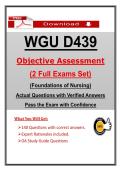
WGU D439
Objective Assessment
(2 Full Exams Set)
(Foundations of Nursing)
Actual Questions with Verified Answers
Pass the Exam with Confidence
What You Will Get:
➢140 Questions with correct answers.
➢Expert Rationales included.
➢OA Study Guide Questions
, PREVIEW ACCESS
Preview Pages
Below
Get the Complete PDF
After Purchase
If you require further clarification or in need of any study
resources, feel free to Message me.
Clean preview. Full resource available after purchase.
,Contents
D439 OA Exam Set 1 ............................................................. 2
D439 OA Exam Set 2 ........................................................... 37
D439 OA Study Guide ......................................................... 66
D439 OA Exam Set 1
1. A child has experienced several episodes of vomiting. After the nurse revie ws the
need to provide only clear liquids, the parent of the child reports making clear liquid
popsicles out of flavored gelatin for the child. Which information should the nurse
obtain about the popsicles?
A. Whether they contain artificial coloring or sweeteners
B. Whether they contain fruit or pulp
C. The temperature at which they were frozen
D. The brand of gelatin used to make the popsicles
Correct Answer: B
Rationale: Clear liquid diets consist of transparent, residue-free fluids that leave minimal
gastric content and are easily digested. The critical concern with homemade gelatin
popsicles is whether they contain fruit pieces, pulp, or other solid additives that would
violate the clear liquid requirement. Fruit or pulp increases gastric residue, potentially
worsening vomiting or delaying gastric emptying. Plain gelatin (which becomes liquid at
body temperature) is acceptable. Options A, C, and D are irrelevant to the classification
of the popsicle as a clear liquid and do not affect its suitability for a child with vomiting.
, 2. The nurse is caring for a client with type 2 diabetes mellitus who had surgery for a
large bowel resection with a colostomy placement. The client has now developed
hyperglycemia which requires self-injections of insulin after discharge. When designing
the postoperative plan of care, which outcome statement should the nurse use?
A. The client will demonstrate ability to change the ostomy bag in two days
B. The client will adhere to the medication regimen after discharge
C. The client will achieve a hemoglobin A1c of less than 7% within 3 months
D. The client will list three signs of hypoglycemia before discharge
Correct Answer: B
Rationale: The outcome statement must be specific, measurable, achievable, relevant,
and time-bound (SMART). "The client will adhere to the medication regimen after
discharge" addresses the newly prescribed insulin therapy, is measurable through
follow-up assessment, achievable with education, directly relevant to the hyperglycemia
management, and time-bound to the post-discharge period. Option A focuses on
ostomy care rather than the new insulin requirement; Option C is a long-term goal
beyond the immediate postoperative plan; Option D is relevant but secondary to
medication adherence for a client newly requiring insulin.
3. A 16-year-old emancipated client is being seen in the emergency department
following a minor automobile accident. The client's parents arrive and are asking
questions about the client's laboratory results. Which response is best for the nurse to
provide?
A. "I can only give medical information to your child because they are legally an adult."
B. "I will share the results with you since you are the parents."
C. "I need your child's written consent before I can discuss any medical information with
you."
D. "The healthcare provider will discuss the results with all of you together."
Correct Answer: A
Rationale: An emancipated minor has the legal status of an adult for healthcare
decision-making and privacy rights under HIPAA. Emancipation grants the minor
autonomy to consent to treatment, access medical records, and control the disclosure of
Objective Assessment
(2 Full Exams Set)
(Foundations of Nursing)
Actual Questions with Verified Answers
Pass the Exam with Confidence
What You Will Get:
➢140 Questions with correct answers.
➢Expert Rationales included.
➢OA Study Guide Questions
, PREVIEW ACCESS
Preview Pages
Below
Get the Complete PDF
After Purchase
If you require further clarification or in need of any study
resources, feel free to Message me.
Clean preview. Full resource available after purchase.
,Contents
D439 OA Exam Set 1 ............................................................. 2
D439 OA Exam Set 2 ........................................................... 37
D439 OA Study Guide ......................................................... 66
D439 OA Exam Set 1
1. A child has experienced several episodes of vomiting. After the nurse revie ws the
need to provide only clear liquids, the parent of the child reports making clear liquid
popsicles out of flavored gelatin for the child. Which information should the nurse
obtain about the popsicles?
A. Whether they contain artificial coloring or sweeteners
B. Whether they contain fruit or pulp
C. The temperature at which they were frozen
D. The brand of gelatin used to make the popsicles
Correct Answer: B
Rationale: Clear liquid diets consist of transparent, residue-free fluids that leave minimal
gastric content and are easily digested. The critical concern with homemade gelatin
popsicles is whether they contain fruit pieces, pulp, or other solid additives that would
violate the clear liquid requirement. Fruit or pulp increases gastric residue, potentially
worsening vomiting or delaying gastric emptying. Plain gelatin (which becomes liquid at
body temperature) is acceptable. Options A, C, and D are irrelevant to the classification
of the popsicle as a clear liquid and do not affect its suitability for a child with vomiting.
, 2. The nurse is caring for a client with type 2 diabetes mellitus who had surgery for a
large bowel resection with a colostomy placement. The client has now developed
hyperglycemia which requires self-injections of insulin after discharge. When designing
the postoperative plan of care, which outcome statement should the nurse use?
A. The client will demonstrate ability to change the ostomy bag in two days
B. The client will adhere to the medication regimen after discharge
C. The client will achieve a hemoglobin A1c of less than 7% within 3 months
D. The client will list three signs of hypoglycemia before discharge
Correct Answer: B
Rationale: The outcome statement must be specific, measurable, achievable, relevant,
and time-bound (SMART). "The client will adhere to the medication regimen after
discharge" addresses the newly prescribed insulin therapy, is measurable through
follow-up assessment, achievable with education, directly relevant to the hyperglycemia
management, and time-bound to the post-discharge period. Option A focuses on
ostomy care rather than the new insulin requirement; Option C is a long-term goal
beyond the immediate postoperative plan; Option D is relevant but secondary to
medication adherence for a client newly requiring insulin.
3. A 16-year-old emancipated client is being seen in the emergency department
following a minor automobile accident. The client's parents arrive and are asking
questions about the client's laboratory results. Which response is best for the nurse to
provide?
A. "I can only give medical information to your child because they are legally an adult."
B. "I will share the results with you since you are the parents."
C. "I need your child's written consent before I can discuss any medical information with
you."
D. "The healthcare provider will discuss the results with all of you together."
Correct Answer: A
Rationale: An emancipated minor has the legal status of an adult for healthcare
decision-making and privacy rights under HIPAA. Emancipation grants the minor
autonomy to consent to treatment, access medical records, and control the disclosure of