
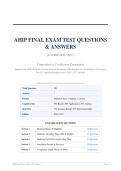
AHIP FINAL EXAM TEST QUESTIONS
& ANSWERS
( LATEST )
Comprehensive Certification Examination
Aligned with AHIP Medicare Training Program Standards, CMS Regulations, and Medicare Advantage /
Part D Compliance Requirements ( Edition)
Total Questions 150
Sections 7
Format Multiple Choice (4 options, 1 correct)
Cognitive Mix 30% Recall | 50% Application | 20% Analysis
Style Mix 75% Scenario-Based | 25% Direct Knowledge
Edition
EXAMINATION SECTIONS
Section 1 Medicare Basics & Eligibility 20 Questions
Section 2 Medicare Advantage Plans (MA & MAPD) 25 Questions
Section 3 Medicare Part D Prescription Drug Plans 25 Questions
Section 4 Enrollment Periods & Processes 20 Questions
Section 5 Compliance, Fraud, Waste, & Abuse 20 Questions
AHIP Final Exam | Edition Page 1
, AHIP Final Exam Test Questions & Answers (Latest )
Section 6 Member Communications & Marketing Guidelines 20 Questions
Section 7 Appeals, Grievances, & Coverage Determinations 20 Questions
AHIP Certification Examination Preparation | Medicare Advantage & Part D
Confidential Study Resource | Edition
AHIP Final Exam | Edition Page 2
, AHIP Final Exam Test Questions & Answers (Latest )
Examination Instructions
Purpose of This Examination
This comprehensive certification examination is designed to assess the candidate's mastery of Medicare
Advantage and Part D concepts required for AHIP certification. The questions cover the core domains
established by AHIP and align with CMS regulations, Medicare Marketing Guidelines, and federal
compliance requirements applicable to the plan year. Each question has been constructed to
reflect either a real-world member scenario or a direct knowledge checkpoint drawn from CMS rules at 42
C.F.R. Parts 422 and 423, the Social Security Act, and the annual Medicare Marketing Guidelines published
by CMS.
Examination Structure
The examination consists of 150 multiple-choice questions distributed across seven sections corresponding
to the AHIP module framework. Section 1 covers Medicare Basics & Eligibility (20 questions); Section 2
covers Medicare Advantage Plans, including HMO, PPO, PFFS, SNP, and MSA plan types (25 questions);
Section 3 addresses Medicare Part D Prescription Drug Plans, including formularies, coverage phases, and
utilization management (25 questions); Section 4 examines Enrollment Periods and Processes (20
questions); Section 5 covers Compliance, Fraud, Waste, and Abuse (20 questions); Section 6 addresses
Member Communications and Marketing Guidelines (20 questions); and Section 7 covers Appeals,
Grievances, and Coverage Determinations (20 questions). The cognitive level distribution is 30% recall,
50% application, and 20% analysis.
Question Format and Answer Key
Each question presents four answer choices labeled A through D, with exactly one correct answer. The
correct choice is identified by the marker *[CORRECT]* and reinforced by an explicit 'Correct Answer'
line beneath the options. A detailed rationale follows each answer, explaining why the correct choice is right
and why the distractors are incorrect, with references to the relevant CMS regulation, statute, or AHIP
training methodology. Candidates should read each scenario carefully before selecting an answer, paying
particular attention to qualifying timeframes, dollar amounts, and beneficiary circumstances, as the
distractors reflect common AHIP exam traps and CMS regulation misconceptions.
Special Topic Coverage
In addition to the standard section framework, the examination includes three required concentrations: 25
scenario-based enrollment and eligibility questions distributed across Sections 1 and 4; 25 questions on
CMS compliance and marketing regulations distributed across Sections 5 and 6; and 15 questions focused
on FWA (Fraud, Waste, and Abuse) identification and reporting procedures concentrated in Section 5. These
concentrations reflect the practical and compliance-focused emphasis of the modern AHIP curriculum and
the federal government's ongoing enforcement priorities in the Medicare program.
AHIP Final Exam | Edition Page 3
, AHIP Final Exam Test Questions & Answers (Latest )
Section 1: Medicare Basics & Eligibility
Q1: Robert is a 67-year-old U.S. citizen who has worked and paid Medicare taxes for 30 quarters
(7.5 years). He is approaching retirement and asks you whether he will qualify for premium-free
Medicare Part A. What is the correct response?
A. He qualifies for premium-free Part A because he is over 65 and a U.S. citizen.
B. He does not qualify for premium-free Part A; he needs 40 quarters (10 years) of
Medicare-covered employment. *[CORRECT]*
C. He qualifies for premium-free Part A only if his spouse has 40 quarters of coverage.
D. He must pay the full Part A premium regardless of work history because he is not yet 65.
Correct Answer: B
Rationale: Premium-free Medicare Part A requires 40 quarters (10 years) of Medicare-covered employment.
Robert has only 30 quarters (7.5 years), so he is not eligible for premium-free Part A. He may purchase Part A,
but in 2026 the premium for someone with 30-39 quarters is reduced (approximately $297/month) versus the
full premium (~$594/month) for fewer than 30 quarters. Citizenship and age alone do not establish
premium-free Part A eligibility; the work-history requirement is controlling under Social Security Act §1818.
Q2: Maria, age 62, was diagnosed with ALS (Lou Gehrig's disease) three months ago. She is
currently covered under her employer's group health plan. Which statement correctly describes
her Medicare eligibility?
A. She must wait until age 65 to become eligible for Medicare regardless of her ALS diagnosis.
B. She is eligible for Medicare the month her Social Security disability benefits begin, but no earlier
than 24 months after onset.
C. She is eligible for Medicare the first month she is entitled to Social Security disability benefits
(SSDI) based on ALS, with no 24-month waiting period. *[CORRECT]*
D. She is eligible only for Part D until she reaches age 65, because ALS does not waive the waiting
period.
Correct Answer: C
Rationale: Under 42 U.S.C. § 426(b), individuals diagnosed with ALS (amyotrophic lateral sclerosis) are
exempt from the standard 24-month SSDI waiting period. Medicare coverage begins the first month they are
entitled to SSDI benefits based on ALS. This is a special eligibility rule under AHIP Medicare Basics training
and CMS regulations. The 24-month waiting period applies to most other disabilities, but ALS and ESRD each
have distinct expedited pathways.
AHIP Final Exam | Edition Page 4
& ANSWERS
( LATEST )
Comprehensive Certification Examination
Aligned with AHIP Medicare Training Program Standards, CMS Regulations, and Medicare Advantage /
Part D Compliance Requirements ( Edition)
Total Questions 150
Sections 7
Format Multiple Choice (4 options, 1 correct)
Cognitive Mix 30% Recall | 50% Application | 20% Analysis
Style Mix 75% Scenario-Based | 25% Direct Knowledge
Edition
EXAMINATION SECTIONS
Section 1 Medicare Basics & Eligibility 20 Questions
Section 2 Medicare Advantage Plans (MA & MAPD) 25 Questions
Section 3 Medicare Part D Prescription Drug Plans 25 Questions
Section 4 Enrollment Periods & Processes 20 Questions
Section 5 Compliance, Fraud, Waste, & Abuse 20 Questions
AHIP Final Exam | Edition Page 1
, AHIP Final Exam Test Questions & Answers (Latest )
Section 6 Member Communications & Marketing Guidelines 20 Questions
Section 7 Appeals, Grievances, & Coverage Determinations 20 Questions
AHIP Certification Examination Preparation | Medicare Advantage & Part D
Confidential Study Resource | Edition
AHIP Final Exam | Edition Page 2
, AHIP Final Exam Test Questions & Answers (Latest )
Examination Instructions
Purpose of This Examination
This comprehensive certification examination is designed to assess the candidate's mastery of Medicare
Advantage and Part D concepts required for AHIP certification. The questions cover the core domains
established by AHIP and align with CMS regulations, Medicare Marketing Guidelines, and federal
compliance requirements applicable to the plan year. Each question has been constructed to
reflect either a real-world member scenario or a direct knowledge checkpoint drawn from CMS rules at 42
C.F.R. Parts 422 and 423, the Social Security Act, and the annual Medicare Marketing Guidelines published
by CMS.
Examination Structure
The examination consists of 150 multiple-choice questions distributed across seven sections corresponding
to the AHIP module framework. Section 1 covers Medicare Basics & Eligibility (20 questions); Section 2
covers Medicare Advantage Plans, including HMO, PPO, PFFS, SNP, and MSA plan types (25 questions);
Section 3 addresses Medicare Part D Prescription Drug Plans, including formularies, coverage phases, and
utilization management (25 questions); Section 4 examines Enrollment Periods and Processes (20
questions); Section 5 covers Compliance, Fraud, Waste, and Abuse (20 questions); Section 6 addresses
Member Communications and Marketing Guidelines (20 questions); and Section 7 covers Appeals,
Grievances, and Coverage Determinations (20 questions). The cognitive level distribution is 30% recall,
50% application, and 20% analysis.
Question Format and Answer Key
Each question presents four answer choices labeled A through D, with exactly one correct answer. The
correct choice is identified by the marker *[CORRECT]* and reinforced by an explicit 'Correct Answer'
line beneath the options. A detailed rationale follows each answer, explaining why the correct choice is right
and why the distractors are incorrect, with references to the relevant CMS regulation, statute, or AHIP
training methodology. Candidates should read each scenario carefully before selecting an answer, paying
particular attention to qualifying timeframes, dollar amounts, and beneficiary circumstances, as the
distractors reflect common AHIP exam traps and CMS regulation misconceptions.
Special Topic Coverage
In addition to the standard section framework, the examination includes three required concentrations: 25
scenario-based enrollment and eligibility questions distributed across Sections 1 and 4; 25 questions on
CMS compliance and marketing regulations distributed across Sections 5 and 6; and 15 questions focused
on FWA (Fraud, Waste, and Abuse) identification and reporting procedures concentrated in Section 5. These
concentrations reflect the practical and compliance-focused emphasis of the modern AHIP curriculum and
the federal government's ongoing enforcement priorities in the Medicare program.
AHIP Final Exam | Edition Page 3
, AHIP Final Exam Test Questions & Answers (Latest )
Section 1: Medicare Basics & Eligibility
Q1: Robert is a 67-year-old U.S. citizen who has worked and paid Medicare taxes for 30 quarters
(7.5 years). He is approaching retirement and asks you whether he will qualify for premium-free
Medicare Part A. What is the correct response?
A. He qualifies for premium-free Part A because he is over 65 and a U.S. citizen.
B. He does not qualify for premium-free Part A; he needs 40 quarters (10 years) of
Medicare-covered employment. *[CORRECT]*
C. He qualifies for premium-free Part A only if his spouse has 40 quarters of coverage.
D. He must pay the full Part A premium regardless of work history because he is not yet 65.
Correct Answer: B
Rationale: Premium-free Medicare Part A requires 40 quarters (10 years) of Medicare-covered employment.
Robert has only 30 quarters (7.5 years), so he is not eligible for premium-free Part A. He may purchase Part A,
but in 2026 the premium for someone with 30-39 quarters is reduced (approximately $297/month) versus the
full premium (~$594/month) for fewer than 30 quarters. Citizenship and age alone do not establish
premium-free Part A eligibility; the work-history requirement is controlling under Social Security Act §1818.
Q2: Maria, age 62, was diagnosed with ALS (Lou Gehrig's disease) three months ago. She is
currently covered under her employer's group health plan. Which statement correctly describes
her Medicare eligibility?
A. She must wait until age 65 to become eligible for Medicare regardless of her ALS diagnosis.
B. She is eligible for Medicare the month her Social Security disability benefits begin, but no earlier
than 24 months after onset.
C. She is eligible for Medicare the first month she is entitled to Social Security disability benefits
(SSDI) based on ALS, with no 24-month waiting period. *[CORRECT]*
D. She is eligible only for Part D until she reaches age 65, because ALS does not waive the waiting
period.
Correct Answer: C
Rationale: Under 42 U.S.C. § 426(b), individuals diagnosed with ALS (amyotrophic lateral sclerosis) are
exempt from the standard 24-month SSDI waiting period. Medicare coverage begins the first month they are
entitled to SSDI benefits based on ALS. This is a special eligibility rule under AHIP Medicare Basics training
and CMS regulations. The 24-month waiting period applies to most other disabilities, but ALS and ESRD each
have distinct expedited pathways.
AHIP Final Exam | Edition Page 4


