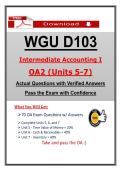
WGU D103
Intermediate Accounting I
OA2 (Units 5-7)
Actual Questions with Verified Answers
Pass the Exam with Confidence
What You Will Get:
➢70 OA Exam Questions w/ Answers
➢ Complete Units 5, 6, and 7
➢ Unit 5 - Time Value of Money = 20%
➢ Unit 6 - Cash & Receivables = 40%
➢ Unit 7 - Inventory = 40%
Take and pass the OA :)
, PREVIEW ACCESS
Preview Pages
Below
Get the Complete PDF
After Purchase
If you require further clarification or in need of any study
i
resources, feel free to Message me.
,UNIT 5 — TIME VALUE OF MONEY & RECEIVABLES
QUESTION 1
A company deposits $10,000 in a bank where it will earn simple interest of 10%
annually. Wh
hat is the amount of interest earned in Year 2?
A. $500
B. $1,000
C. $1,100
D. $2,000
CORRECT ANSWER:
E B. $1,000
CALCULATION:
Simple Interest = Principal × Rate × Time
Simple Interest = $10,000 × 10% × 1 year = $1,000
EXPERT RATIONALE:
Simple interest is calculated ONLY on the original principal amount. Unlike compound
interest, simple interest does NOT earn interest on previously earned interest. Each year,
the interest remains constant at $1,000 ($10,000 × 10%). The interest earned in Year 2 is
identical to Year 1 because the principal never changes under simple interest. This is a
fundamental distinction between simple and compound interest methods.
ACCOUNTING RULE:
Under GAAP, simple interest is recorded as Interest Revenue when earned, with no
compounding effect on the principal balance.
QUESTION 2
A company is putting together a list of transactions that are affected by the time value
of money. Wh
hich transaction should be included in this list?
A. Cash sales
B. Short-term accounts payable (30 days)
, C. Long-term leases
D. Prepaid insurance (6 months)
CORRECT ANSWER:
E C. Long-term leases
EXPERT RATIONALE:
The time value of money (TVM) concept applies to transactions where cash flows extend
over multiple periods, making the timing of cash receipts/payments materially
significant. Long-term leases involve payments spanning multiple years, so the present
value of those future payments must be calculated to properly record the lease liability
and right-of-use asset. Short-term transactions (cash sales, 30-day payables, 6-month
prepaid insurance) do not span a long enough period for the time value of money to be
material.
ACCOUNTING RULE:
Per ASC 842 (Leases) and ASC 310 (Receivables), any long-term contractual arrangement
with deferred payments requires present value calculations to determine the
appropriate carrying amount at inception.
QUESTION 3
A company needs to have $70,000 in cash at the end of four years. The company can
invest the cash now in a money market account that will return 6% interest
compounded annually.
The following present value factors are given:
• Assuming 4% for 6 years: PV factor = 0.79031 → $70,000 × 0.79031 = $55,322
• Assuming 6% for 4 years: PV factor = 0.79209 → $70,000 × 0.79209 = $55,446
• Assuming 6% for 6 years: PV factor = 0.70946 → $70,000 × 0.70946 = $49,662
How much does this company need to deposit today?
A. $55,322
B. $55,446
C. $49,662
D. $70,000
Intermediate Accounting I
OA2 (Units 5-7)
Actual Questions with Verified Answers
Pass the Exam with Confidence
What You Will Get:
➢70 OA Exam Questions w/ Answers
➢ Complete Units 5, 6, and 7
➢ Unit 5 - Time Value of Money = 20%
➢ Unit 6 - Cash & Receivables = 40%
➢ Unit 7 - Inventory = 40%
Take and pass the OA :)
, PREVIEW ACCESS
Preview Pages
Below
Get the Complete PDF
After Purchase
If you require further clarification or in need of any study
i
resources, feel free to Message me.
,UNIT 5 — TIME VALUE OF MONEY & RECEIVABLES
QUESTION 1
A company deposits $10,000 in a bank where it will earn simple interest of 10%
annually. Wh
hat is the amount of interest earned in Year 2?
A. $500
B. $1,000
C. $1,100
D. $2,000
CORRECT ANSWER:
E B. $1,000
CALCULATION:
Simple Interest = Principal × Rate × Time
Simple Interest = $10,000 × 10% × 1 year = $1,000
EXPERT RATIONALE:
Simple interest is calculated ONLY on the original principal amount. Unlike compound
interest, simple interest does NOT earn interest on previously earned interest. Each year,
the interest remains constant at $1,000 ($10,000 × 10%). The interest earned in Year 2 is
identical to Year 1 because the principal never changes under simple interest. This is a
fundamental distinction between simple and compound interest methods.
ACCOUNTING RULE:
Under GAAP, simple interest is recorded as Interest Revenue when earned, with no
compounding effect on the principal balance.
QUESTION 2
A company is putting together a list of transactions that are affected by the time value
of money. Wh
hich transaction should be included in this list?
A. Cash sales
B. Short-term accounts payable (30 days)
, C. Long-term leases
D. Prepaid insurance (6 months)
CORRECT ANSWER:
E C. Long-term leases
EXPERT RATIONALE:
The time value of money (TVM) concept applies to transactions where cash flows extend
over multiple periods, making the timing of cash receipts/payments materially
significant. Long-term leases involve payments spanning multiple years, so the present
value of those future payments must be calculated to properly record the lease liability
and right-of-use asset. Short-term transactions (cash sales, 30-day payables, 6-month
prepaid insurance) do not span a long enough period for the time value of money to be
material.
ACCOUNTING RULE:
Per ASC 842 (Leases) and ASC 310 (Receivables), any long-term contractual arrangement
with deferred payments requires present value calculations to determine the
appropriate carrying amount at inception.
QUESTION 3
A company needs to have $70,000 in cash at the end of four years. The company can
invest the cash now in a money market account that will return 6% interest
compounded annually.
The following present value factors are given:
• Assuming 4% for 6 years: PV factor = 0.79031 → $70,000 × 0.79031 = $55,322
• Assuming 6% for 4 years: PV factor = 0.79209 → $70,000 × 0.79209 = $55,446
• Assuming 6% for 6 years: PV factor = 0.70946 → $70,000 × 0.70946 = $49,662
How much does this company need to deposit today?
A. $55,322
B. $55,446
C. $49,662
D. $70,000