
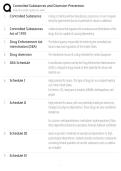
Controlled Substances and Diversion Prevention
Study online at https://quizlet.com/_ic6akh
1. Controlled Substance A drug or chemical whose manufacture, possession, or use is regulat-
ed by the government due to its potential for abuse or addiction.
2. Controlled Substances a federal statute that regulates the manufacture and distribution of the
Act of 1970 drugs that are capable of causing dependency.
3. Drug Enforcement Ad- The federal agency responsible for enforcing the controlled sub-
ministration (DEA) stances laws and regulations of the United States.
4. Drug diversion The intentional misuse of a drug intended for medical purposes
5. DEA Schedule A classification system used by the Drug Enforcement Administration
(DEA) to categorize drugs based on their potential for abuse and
medical use.
6. Schedule I High potential for abuse. This type of drug has no accepted medical
use in the United States.
Ex: heroin, LSD, marijuana (cannabis), MDMA, methaqualone, and
peyote
7. Schedule II High potential for abuse, with use potentially leading to severe psy-
chological or physical dependence. These drugs are also considered
dangerous.
Ex: cocaine, methamphetamine, methadone, hydromorphone (Dilau-
did), meperidine (Demerol), oxycodone, fentanyl, Adderall, and Ritalin
8. Schedule III abuse may lead to moderate to low physical dependence or high
psychological dependence. anabolic steroids and various compounds
containing limited quantities of narcotic substances such as codeine
are included
9. Schedule IV
1/7
, Controlled Substances and Diversion Prevention
Study online at https://quizlet.com/_ic6akh
drugs with a low potential for abuse and low risk of dependence.
Ex: Xanax, Soma, Valium, Ambien, Tramadol
10. Schedule V lower potential for abuse than IV and consist of preparations con-
taining limited quantities of certain narcotics. Schedule V drugs are
generally used for antidiarrheal, antitussive, and analgesic purposes.
Ex: cough preparations with less than 200 milligrams of codeine or per
100 milliliters (Robitussin AC), Lomotil, Motofen, Lyrica,
11. Refills Schedule II prescriptions cannot be refilled.
Schedule III-V drugs are permitted to be refilled a maximum of 5-times
within a 6-month period from the date of issuance. Partial dispensing
is permitted, but the remaining quantity must be dispensed to the pa-
tient within a 72-hour window. Prescriptions for Schedule III-V drugs
may be transferred between pharmacies.
12. When to notify the DEA in Within 24 hours
writing after discovering
a robbery or theft of con-
trolled substances
13. Schedule II medications Every two years, and be manually counted. Any inventory review of
must be inventoried Schedule II drugs must be done and filed separately from Schedule
III-V drugs.
14. When inventorying They can be estimated except if their total number of pills exceeds
Schedule III-to-V drugs 1,000. In these exceptional cases, manual counting is required.
15. Controlled substance retained for a minimum of two years
records must be
2/7
Study online at https://quizlet.com/_ic6akh
1. Controlled Substance A drug or chemical whose manufacture, possession, or use is regulat-
ed by the government due to its potential for abuse or addiction.
2. Controlled Substances a federal statute that regulates the manufacture and distribution of the
Act of 1970 drugs that are capable of causing dependency.
3. Drug Enforcement Ad- The federal agency responsible for enforcing the controlled sub-
ministration (DEA) stances laws and regulations of the United States.
4. Drug diversion The intentional misuse of a drug intended for medical purposes
5. DEA Schedule A classification system used by the Drug Enforcement Administration
(DEA) to categorize drugs based on their potential for abuse and
medical use.
6. Schedule I High potential for abuse. This type of drug has no accepted medical
use in the United States.
Ex: heroin, LSD, marijuana (cannabis), MDMA, methaqualone, and
peyote
7. Schedule II High potential for abuse, with use potentially leading to severe psy-
chological or physical dependence. These drugs are also considered
dangerous.
Ex: cocaine, methamphetamine, methadone, hydromorphone (Dilau-
did), meperidine (Demerol), oxycodone, fentanyl, Adderall, and Ritalin
8. Schedule III abuse may lead to moderate to low physical dependence or high
psychological dependence. anabolic steroids and various compounds
containing limited quantities of narcotic substances such as codeine
are included
9. Schedule IV
1/7
, Controlled Substances and Diversion Prevention
Study online at https://quizlet.com/_ic6akh
drugs with a low potential for abuse and low risk of dependence.
Ex: Xanax, Soma, Valium, Ambien, Tramadol
10. Schedule V lower potential for abuse than IV and consist of preparations con-
taining limited quantities of certain narcotics. Schedule V drugs are
generally used for antidiarrheal, antitussive, and analgesic purposes.
Ex: cough preparations with less than 200 milligrams of codeine or per
100 milliliters (Robitussin AC), Lomotil, Motofen, Lyrica,
11. Refills Schedule II prescriptions cannot be refilled.
Schedule III-V drugs are permitted to be refilled a maximum of 5-times
within a 6-month period from the date of issuance. Partial dispensing
is permitted, but the remaining quantity must be dispensed to the pa-
tient within a 72-hour window. Prescriptions for Schedule III-V drugs
may be transferred between pharmacies.
12. When to notify the DEA in Within 24 hours
writing after discovering
a robbery or theft of con-
trolled substances
13. Schedule II medications Every two years, and be manually counted. Any inventory review of
must be inventoried Schedule II drugs must be done and filed separately from Schedule
III-V drugs.
14. When inventorying They can be estimated except if their total number of pills exceeds
Schedule III-to-V drugs 1,000. In these exceptional cases, manual counting is required.
15. Controlled substance retained for a minimum of two years
records must be
2/7


