Association of Taxation Technicians (ATT)
Personal Taxation Paper 1 – National
Insurance Practice Exam 2026 | Practice
Questions & Study Guide | Complete Exam-
Style Questions with Correct Detailed Answers
& Rationales (Reliable Answers) | Latest
Updated Version | Instant Download PDf
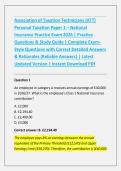
Question 1
An employee in category A receives annual earnings of £40,000
in 2026/27. What is the employee's Class 1 National Insurance
contribution?
A. £2,000
B. £2,194.40
C. £2,400.00
D. £3,000
Correct answer: B. £2,194.40
The employee pays 8% on earnings between the annual
equivalent of the Primary Threshold (£12,570) and Upper
Earnings Limit (£50,270). Therefore, the contribution is (£40,000
,− £12,570) × 8% = £27,430 × 8% = £2,194.40. There is no 2%
element because the employee's earnings do not exceed the
Upper Earnings Limit.
Question 2
An employee earns £70,000 during 2026/27 and is in category
A. What is the employee's annual Class 1 contribution?
A. £3,016.00
B. £3,410.60
C. £4,200.00
D. £4,410.60
Correct answer: B. £3,410.60
The employee pays 8% on the first band from £12,570 to
£50,270, giving £37,700 × 8% = £3,016. The remaining £19,730
is above the Upper Earnings Limit and is subject to 2%, giving
£394.60. The total is therefore £3,410.60.
Question 3
Which of the following best describes the effect of the Lower
Earnings Limit for an employee in 2026/27?
,A. Earnings below it are always subject to Class 1 at 2%
B. Earnings between it and the Primary Threshold can generally
produce benefit entitlement without employee Class 1 being
payable
C. It is the point at which employer Class 1 begins
D. It is the Upper Earnings Limit for employee contributions
Correct answer: B. Earnings between it and the Primary
Threshold can generally produce benefit entitlement without
employee Class 1 being payable
The Lower Earnings Limit is £129 per week in 2026/27. An
employee earning at least the LEL but not more than the
Primary Threshold does not normally pay employee Class 1 NIC,
but the earnings can still count for certain contributory benefit
and State Pension purposes. The LEL is therefore important even
though it is not itself the employee's contribution threshold.
Question 4
An employee earns £20,000 in 2026/27 and has a valid married
woman's reduced-rate election. What rate generally applies to
earnings between the Primary Threshold and Upper Earnings
Limit?
A. 1.85%
B. 2%
, C. 6%
D. 8%
Correct answer: A. 1.85%
The special reduced rate for a married woman or widow with a
valid certificate of election is 1.85% on earnings between the
Primary Threshold and Upper Earnings Limit in 2026/27. The
rate above the Upper Earnings Limit remains 2%. This reduced
rate only applies where the relevant historical election
conditions are satisfied.
Question 5
An employee earns £11,500 in 2026/27 from one employment.
Assuming category A and no special circumstances, how much
employee Class 1 NIC is payable?
A. £920
B. £234
C. £0
D. £57.50
Correct answer: C. £0
The annual Primary Threshold is £12,570. Because the
employee's earnings of £11,500 do not exceed that threshold,
no employee Class 1 contribution is due. The Lower Earnings
Personal Taxation Paper 1 – National
Insurance Practice Exam 2026 | Practice
Questions & Study Guide | Complete Exam-
Style Questions with Correct Detailed Answers
& Rationales (Reliable Answers) | Latest
Updated Version | Instant Download PDf
Question 1
An employee in category A receives annual earnings of £40,000
in 2026/27. What is the employee's Class 1 National Insurance
contribution?
A. £2,000
B. £2,194.40
C. £2,400.00
D. £3,000
Correct answer: B. £2,194.40
The employee pays 8% on earnings between the annual
equivalent of the Primary Threshold (£12,570) and Upper
Earnings Limit (£50,270). Therefore, the contribution is (£40,000
,− £12,570) × 8% = £27,430 × 8% = £2,194.40. There is no 2%
element because the employee's earnings do not exceed the
Upper Earnings Limit.
Question 2
An employee earns £70,000 during 2026/27 and is in category
A. What is the employee's annual Class 1 contribution?
A. £3,016.00
B. £3,410.60
C. £4,200.00
D. £4,410.60
Correct answer: B. £3,410.60
The employee pays 8% on the first band from £12,570 to
£50,270, giving £37,700 × 8% = £3,016. The remaining £19,730
is above the Upper Earnings Limit and is subject to 2%, giving
£394.60. The total is therefore £3,410.60.
Question 3
Which of the following best describes the effect of the Lower
Earnings Limit for an employee in 2026/27?
,A. Earnings below it are always subject to Class 1 at 2%
B. Earnings between it and the Primary Threshold can generally
produce benefit entitlement without employee Class 1 being
payable
C. It is the point at which employer Class 1 begins
D. It is the Upper Earnings Limit for employee contributions
Correct answer: B. Earnings between it and the Primary
Threshold can generally produce benefit entitlement without
employee Class 1 being payable
The Lower Earnings Limit is £129 per week in 2026/27. An
employee earning at least the LEL but not more than the
Primary Threshold does not normally pay employee Class 1 NIC,
but the earnings can still count for certain contributory benefit
and State Pension purposes. The LEL is therefore important even
though it is not itself the employee's contribution threshold.
Question 4
An employee earns £20,000 in 2026/27 and has a valid married
woman's reduced-rate election. What rate generally applies to
earnings between the Primary Threshold and Upper Earnings
Limit?
A. 1.85%
B. 2%
, C. 6%
D. 8%
Correct answer: A. 1.85%
The special reduced rate for a married woman or widow with a
valid certificate of election is 1.85% on earnings between the
Primary Threshold and Upper Earnings Limit in 2026/27. The
rate above the Upper Earnings Limit remains 2%. This reduced
rate only applies where the relevant historical election
conditions are satisfied.
Question 5
An employee earns £11,500 in 2026/27 from one employment.
Assuming category A and no special circumstances, how much
employee Class 1 NIC is payable?
A. £920
B. £234
C. £0
D. £57.50
Correct answer: C. £0
The annual Primary Threshold is £12,570. Because the
employee's earnings of £11,500 do not exceed that threshold,
no employee Class 1 contribution is due. The Lower Earnings