

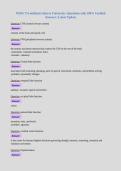
NURS 751 midterm Liberty University | Questions with 100% Verified
Answers | Latest Update
Question: CNS (central nervous system)
Answer:
consists of the brain and spinal cord
Question: PNS (peripheral nervous system)
Answer:
the sensory and motor neurons that connect the CNS to the rest of the body
-Autonomic- internal involuntary funct.
-Somatic- voluntary
Question: Frontal lobe function
Answer:
associated with reasoning, planning, parts of speech, movement, emotions, and problem solving
-problem- personality changes
Question: temporal lobe function
Answer:
auditory, receptive speech (werniche)
Question: occipital lobe function
Answer:
vision
Question: parietal lobe function
Answer:
sensation, taste, read/write
-problem- agonosia
Question: cerebral cortex function
Answer:
Is the center for humans highest functions governing thought, memory, reasoning, sensation and
voluntary movement.
Question: Depolarization
Answer:
, Initial (excitatory) - when sodium is rushing into the cell causing the interior to become more positive.
Question: Repolarization
Answer:
Restoration (inhibitory)- caused by reentry of potassium into the cell while sodium exits the cell.
Question: Dopamine (DA)
Answer:
A monoamine transmitter found in the midbrain—especially the substantia nigra—and basal forebrain
** Ventral Tegmental Area- Nucleus accumbens.
Question: Norepinephrine (NE)
Answer:
a monoamine neurotransmitter in locus of ceruleus
-involved in alertness and vigilance and control of REM sleep in mood, anxiety and concentration d/o
Question: Epinephrine
Answer:
Monoamine Neurotransmitter secreted by the adrenal medulla in response to stress. Also known as
adrenaline.
Question: Serotonin
Answer:
a monoamine neurotransmitter in RAPHE nuclei of brainstem
-important for a wide range of psychological activity, including emotional states, impulse control, and
dreaming
-mood and anxiety d/o
Question: Glutamate
Answer:
Amino acid - excitatory neurotransmitter
- in seizures, mood, bipolar, & schizophrenia
Question: Asparate
Answer:
Amino acid- inhibitory neurotransmitter
Question: GABA (gamma-aminobutyric acid)
Answer:
Answers | Latest Update
Question: CNS (central nervous system)
Answer:
consists of the brain and spinal cord
Question: PNS (peripheral nervous system)
Answer:
the sensory and motor neurons that connect the CNS to the rest of the body
-Autonomic- internal involuntary funct.
-Somatic- voluntary
Question: Frontal lobe function
Answer:
associated with reasoning, planning, parts of speech, movement, emotions, and problem solving
-problem- personality changes
Question: temporal lobe function
Answer:
auditory, receptive speech (werniche)
Question: occipital lobe function
Answer:
vision
Question: parietal lobe function
Answer:
sensation, taste, read/write
-problem- agonosia
Question: cerebral cortex function
Answer:
Is the center for humans highest functions governing thought, memory, reasoning, sensation and
voluntary movement.
Question: Depolarization
Answer:
, Initial (excitatory) - when sodium is rushing into the cell causing the interior to become more positive.
Question: Repolarization
Answer:
Restoration (inhibitory)- caused by reentry of potassium into the cell while sodium exits the cell.
Question: Dopamine (DA)
Answer:
A monoamine transmitter found in the midbrain—especially the substantia nigra—and basal forebrain
** Ventral Tegmental Area- Nucleus accumbens.
Question: Norepinephrine (NE)
Answer:
a monoamine neurotransmitter in locus of ceruleus
-involved in alertness and vigilance and control of REM sleep in mood, anxiety and concentration d/o
Question: Epinephrine
Answer:
Monoamine Neurotransmitter secreted by the adrenal medulla in response to stress. Also known as
adrenaline.
Question: Serotonin
Answer:
a monoamine neurotransmitter in RAPHE nuclei of brainstem
-important for a wide range of psychological activity, including emotional states, impulse control, and
dreaming
-mood and anxiety d/o
Question: Glutamate
Answer:
Amino acid - excitatory neurotransmitter
- in seizures, mood, bipolar, & schizophrenia
Question: Asparate
Answer:
Amino acid- inhibitory neurotransmitter
Question: GABA (gamma-aminobutyric acid)
Answer:


