
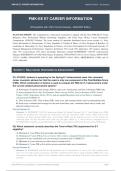
PMK-EE E7 CAREER INFORMATION 2026/2027 Edition | 85 Questions
PMK-EE E7 CAREER INFORMATION
85 Questions with 100% Correct Answers - 2026/2027 Edition
EXAM BLUEPRINT: This comprehensive certification examination is aligned with the Navy PMK-EE E7 Exam
Blueprint, Navy Professional Military Knowledge Standards, and Chief Petty Officer Career Information
Competencies (2026/2027 Edition). The exam contains 85 questions distributed across seven sections: (1) Navy
Career Information & Advancement; (2) Navy Standards of Conduct & Ethics; (3) Navy Programs & Benefits; (4)
Leadership & Mentorship; (5) Navy Regulations & Policies; (6) Career Development & Professional Growth; (7)
Financial Management & Retirement. Cognitive distribution: 25% recall, 50% application, 25% analysis. Question
style: 75% scenario-based, 25% direct knowledge. References include BUPERSINST 1430.16F (Advancement
Manual), BUPERSINST 1610.10D (Performance Evaluation), OPNAVINST 5350.1A (Core Values), OPNAVINST
1752.1C (SAPR), OPNAVINST 5354.1F (EO), OPNAVINST 6110.1J (PFA), MILPERSMAN, UCMJ, and 10
U.S.C. authorities.
Section 1: Navy Career Information & Advancement
Q1: HT2(SW) Jackson is preparing for the Spring E-7 advancement exam. Her command
career counselor advises her that the exam is only one component of the Final Multiple Score
(FMS). Which combination of factors is used to compute the FMS for E-7 advancement under
the current enlisted advancement system?
A. Performance Evaluation trait average, PMAA, exam score, award points, and Pass-to-Promote (PMP) only
B. Exam Standard Score (SS), Performance Mark Average (PMA), Pass-to-Promote (PMP), Award
Points (AWD), Experience Factor (PNA), and any applicable points such as Sea Duty or command
advancement [CORRECT]
C. Time-in-Service (TIS), Time-in-Rate (TIR), exam score, and command master chief recommendation only
D. Exam score, evaluation trait averages for the most recent three years, command climate survey results, and
physical readiness test score
Correct Answer: B
Rationale: Per BUPERSINST 1430.16F (Advancement Manual for Enlisted Personnel), the E-7 Final Multiple Score (FMS)
integrates the Standard Score (SS) from the advancement exam, the Performance Mark Average (PMA) derived from
evaluations, the Pass-to-Promote (PMP) status, Award Points (AWD), and the Experience Factor via PNA (Passed, Not
Advanced) points. Sea duty and other factor points may also apply. Options A, C, and D omit key components such as
PNA/PMP/AWD or substitute non-quantified items (e.g., CMC recommendation or PRT score) that are not direct FMS inputs.
Q2: Which statement correctly describes the Time-in-Rate (TIR) requirement for E-7
eligibility?
A. Minimum of 1 year TIR as E-6 and a high school diploma
B. Minimum of 3 years TIR as E-6, or 2 years with a waiver, computed from the date of rating
designation to the established cycle advancement expiration date [CORRECT]
C. Minimum of 6 years total service with at least 18 months as E-6
D. Minimum of 5 years TIR as E-6 with no waivers permitted under any circumstances
Correct Answer: B
Rationale: Per BUPERSINST 1430.16F, the TIR requirement for E-7 advancement is 3 years as E-6, with a possible waiver
down to 2 years under specific circumstances. The TIR is computed from the date of rating designation (DOR) to the cycle's
advancement expiration date. Options A and C substitute arbitrary numbers, and option D incorrectly states waivers are never
permitted.
Navy PMK-EE E7 Exam Blueprint - Professional Military Knowledge Page 1
,PMK-EE E7 CAREER INFORMATION 2026/2027 Edition | 85 Questions
Q3: YNC1(PAC) Thompson has 18 years of service and is currently an E-6. He is concerned
about High Year Tenure (HYT) impacting his ability to advance to E-7. Which statement most
accurately reflects his situation under current HYT policy?
A. He has already exceeded HYT for E-6 and must be separated immediately, regardless of advancement
potential
B. HYT for E-6 is 20 years; he is within limits and may continue to compete for E-7 advancement
provided he remains otherwise eligible and is recommended in his EVAL [CORRECT]
C. HYT for E-6 is 14 years; he must request retirement within 6 months
D. HYT does not apply to sailors in paygrade E-6 and below; it only restricts E-7 through E-9
Correct Answer: B
Rationale: Per MILPERSMAN 1160-120, the High Year Tenure (HYT) for E-6 is 20 years of active naval service. YNC1 is at 18
years and remains within HYT limits, allowing continued advancement competition if recommended by the command and
otherwise eligible. HYT for E-7 is 24 years, E-8 is 26 years, and E-9 is 30 years (with extended limits possible). Options A, C, and
D reflect incorrect HYT thresholds.
Q4: An E-6 reporting senior is completing a Block 43 performance trait grade entry for a
Sailor being evaluated for advancement to E-7. The reporting senior assigns a 5.0 in
Leadership but writes a narrative that highlights only routine performance with no specific
examples. Which principle of evaluation writing does this violate?
A. The 'one-touch rule' for performance documentation
B. The 'trait-grade-to-narrative correlation' principle, which requires that trait grades be substantiated
with corresponding performance examples in the comments on performance [CORRECT]
C. The 'frocking rule,' which prohibits 5.0 marks in leadership for E-6 candidates
D. The 'promotion recommendation rule,' which requires a 5.0 mark to be matched with an Early Promote (EP)
summary
Correct Answer: B
Rationale: Per BUPERSINST 1610.10D (Performance Evaluation System), trait grades recorded in Block 43 must be
substantiated by the narrative comments in Block 43. A 5.0 in Leadership requires specific examples of exemplary leadership
performance; the reporting senior's narrative must support the trait grade assigned. This is the trait-grade-to-narrative correlation
principle. Options A, C, and D reference rules that either do not exist or mischaracterize evaluation policy.
Q5: Which statement best describes the Selective Reenlistment Bonus (SRB) program as it
applies to a critical-skills E-6 Sailor considering reenlistment?
A. SRB is a flat-rate bonus awarded to every sailor who reenlists, regardless of rating or NEC
B. SRB is awarded based on rating, NEC, skill criticality, and zone; award levels are published in
NAVADMIN messages and the SRB plan is updated as needed [CORRECT]
C. SRB is paid only to E-7 and above personnel in designated leadership billets
D. SRB is restricted to first-term sailors only; career Sailors are not eligible
Correct Answer: B
Rationale: Per OPNAVINST 1160.6B and the SRB award message, the Selective Reenlistment Bonus (SRB) targets specific
ratings, Navy Enlisted Classifications (NECs), and skill criticality levels across SRB Zones A, B, and C. Award multiples and caps
are published via NAVADMIN and updated regularly. Options A, C, and D mischaracterize SRB as either universal,
leadership-restricted, or first-term-only - all incorrect.
Navy PMK-EE E7 Exam Blueprint - Professional Military Knowledge Page 2
, PMK-EE E7 CAREER INFORMATION 2026/2027 Edition | 85 Questions
Q6: LS1(AW) Davis was selected for advancement to Chief Petty Officer effective September
1. She asks her CCC when she may wear the CPO uniform and be addressed as 'Chief.'
Which statement reflects current frocking policy?
A. She may wear the CPO uniform immediately upon selection board results posting on NPC public website
B. Frocking authorizes wear of the uniform and use of the title but does not entitle her to pay; effective
date and authority must be promulgated via NAVADMIN before frocking is permitted, and she must
complete CPO 365 Phase II requirements [CORRECT]
C. She may be paid at the E-7 rate immediately upon selection, but cannot wear the uniform until officially
pinned
D. Frocking is not authorized for E-7 selectees; only E-8 and E-9 may be frocked
Correct Answer: B
Rationale: Per MILPERSMAN 1420-010, frocking authorizes a Sailor to wear the insignia and use the title of the higher
paygrade, but does NOT entitle the Sailor to pay, allowances, or benefits of that paygrade until the actual advancement effective
date. Frocking requires specific authorization via NAVADMIN and is contingent on completion of CPO 365 Phase II (and
previously, the CPO initiation season). Option C confuses frocking with advancement, and option D is incorrect because frocking
applies to all advancement levels.
Q7: ET2(SW/SCW) Patel, with 4 years of service and a 3.6 college GPA, is interested in
applying for the Seaman to Admiral-21 (STA-21) program. Which scenario most accurately
describes an eligibility requirement she must meet?
A. She must be at least 25 years old by the application deadline with no age waiver permitted
B. She must have less than 12 years of active naval service and less than 11 years of active service since
age 18 at the time of application, and meet citizenship, AFQT, and physical requirements [CORRECT]
C. She must already possess a bachelor's degree to apply for STA-21
D. STA-21 is restricted to nuclear-trained Sailors only; conventional ratings are not eligible
Correct Answer: B
Rationale: Per OPNAVINST 1420.1A (STA-21 Program Application), applicants must have less than 12 years of active naval
service and less than 11 years of active service since their 18th birthday at the time of application. Additional requirements
include U.S. citizenship, AFQT scores, and commissioning physical standards. Age waivers are considered on a case-by-case
basis. Options A, C, and D reflect incorrect age limits or scope restrictions.
Q8: Which of the following correctly distinguishes a Limited Duty Officer (LDO) from a Chief
Warrant Officer (CWO) in the Navy?
A. LDOs are commissioned officers with broader command authority; CWOs are technical specialists who serve
only in staff positions and cannot hold command
B. LDOs are commissioned officers appointed from enlisted ranks who serve in technical and staff
leadership roles; CWOs are also appointed from enlisted ranks but serve as highly specialized technical
experts in a narrower scope [CORRECT]
C. Both LDOs and CWOs are appointed directly from civilian life without prior enlisted service
D. LDOs outrank all CWOs by virtue of their commission; CWOs hold enlisted paygrades
Correct Answer: B
Rationale: Per OPNAVINST 1420.2A (LDO and CWO Programs), both LDOs and CWOs are commissioned officers appointed
from the enlisted ranks. LDOs serve in broader technical and staff leadership roles (e.g., division officer duties), while CWOs are
highly specialized technical experts focused on a narrower specialty. Both require prior enlisted service. Option A is partially
incorrect because CWOs can command certain activities; options C and D are factually wrong.
Navy PMK-EE E7 Exam Blueprint - Professional Military Knowledge Page 3
PMK-EE E7 CAREER INFORMATION
85 Questions with 100% Correct Answers - 2026/2027 Edition
EXAM BLUEPRINT: This comprehensive certification examination is aligned with the Navy PMK-EE E7 Exam
Blueprint, Navy Professional Military Knowledge Standards, and Chief Petty Officer Career Information
Competencies (2026/2027 Edition). The exam contains 85 questions distributed across seven sections: (1) Navy
Career Information & Advancement; (2) Navy Standards of Conduct & Ethics; (3) Navy Programs & Benefits; (4)
Leadership & Mentorship; (5) Navy Regulations & Policies; (6) Career Development & Professional Growth; (7)
Financial Management & Retirement. Cognitive distribution: 25% recall, 50% application, 25% analysis. Question
style: 75% scenario-based, 25% direct knowledge. References include BUPERSINST 1430.16F (Advancement
Manual), BUPERSINST 1610.10D (Performance Evaluation), OPNAVINST 5350.1A (Core Values), OPNAVINST
1752.1C (SAPR), OPNAVINST 5354.1F (EO), OPNAVINST 6110.1J (PFA), MILPERSMAN, UCMJ, and 10
U.S.C. authorities.
Section 1: Navy Career Information & Advancement
Q1: HT2(SW) Jackson is preparing for the Spring E-7 advancement exam. Her command
career counselor advises her that the exam is only one component of the Final Multiple Score
(FMS). Which combination of factors is used to compute the FMS for E-7 advancement under
the current enlisted advancement system?
A. Performance Evaluation trait average, PMAA, exam score, award points, and Pass-to-Promote (PMP) only
B. Exam Standard Score (SS), Performance Mark Average (PMA), Pass-to-Promote (PMP), Award
Points (AWD), Experience Factor (PNA), and any applicable points such as Sea Duty or command
advancement [CORRECT]
C. Time-in-Service (TIS), Time-in-Rate (TIR), exam score, and command master chief recommendation only
D. Exam score, evaluation trait averages for the most recent three years, command climate survey results, and
physical readiness test score
Correct Answer: B
Rationale: Per BUPERSINST 1430.16F (Advancement Manual for Enlisted Personnel), the E-7 Final Multiple Score (FMS)
integrates the Standard Score (SS) from the advancement exam, the Performance Mark Average (PMA) derived from
evaluations, the Pass-to-Promote (PMP) status, Award Points (AWD), and the Experience Factor via PNA (Passed, Not
Advanced) points. Sea duty and other factor points may also apply. Options A, C, and D omit key components such as
PNA/PMP/AWD or substitute non-quantified items (e.g., CMC recommendation or PRT score) that are not direct FMS inputs.
Q2: Which statement correctly describes the Time-in-Rate (TIR) requirement for E-7
eligibility?
A. Minimum of 1 year TIR as E-6 and a high school diploma
B. Minimum of 3 years TIR as E-6, or 2 years with a waiver, computed from the date of rating
designation to the established cycle advancement expiration date [CORRECT]
C. Minimum of 6 years total service with at least 18 months as E-6
D. Minimum of 5 years TIR as E-6 with no waivers permitted under any circumstances
Correct Answer: B
Rationale: Per BUPERSINST 1430.16F, the TIR requirement for E-7 advancement is 3 years as E-6, with a possible waiver
down to 2 years under specific circumstances. The TIR is computed from the date of rating designation (DOR) to the cycle's
advancement expiration date. Options A and C substitute arbitrary numbers, and option D incorrectly states waivers are never
permitted.
Navy PMK-EE E7 Exam Blueprint - Professional Military Knowledge Page 1
,PMK-EE E7 CAREER INFORMATION 2026/2027 Edition | 85 Questions
Q3: YNC1(PAC) Thompson has 18 years of service and is currently an E-6. He is concerned
about High Year Tenure (HYT) impacting his ability to advance to E-7. Which statement most
accurately reflects his situation under current HYT policy?
A. He has already exceeded HYT for E-6 and must be separated immediately, regardless of advancement
potential
B. HYT for E-6 is 20 years; he is within limits and may continue to compete for E-7 advancement
provided he remains otherwise eligible and is recommended in his EVAL [CORRECT]
C. HYT for E-6 is 14 years; he must request retirement within 6 months
D. HYT does not apply to sailors in paygrade E-6 and below; it only restricts E-7 through E-9
Correct Answer: B
Rationale: Per MILPERSMAN 1160-120, the High Year Tenure (HYT) for E-6 is 20 years of active naval service. YNC1 is at 18
years and remains within HYT limits, allowing continued advancement competition if recommended by the command and
otherwise eligible. HYT for E-7 is 24 years, E-8 is 26 years, and E-9 is 30 years (with extended limits possible). Options A, C, and
D reflect incorrect HYT thresholds.
Q4: An E-6 reporting senior is completing a Block 43 performance trait grade entry for a
Sailor being evaluated for advancement to E-7. The reporting senior assigns a 5.0 in
Leadership but writes a narrative that highlights only routine performance with no specific
examples. Which principle of evaluation writing does this violate?
A. The 'one-touch rule' for performance documentation
B. The 'trait-grade-to-narrative correlation' principle, which requires that trait grades be substantiated
with corresponding performance examples in the comments on performance [CORRECT]
C. The 'frocking rule,' which prohibits 5.0 marks in leadership for E-6 candidates
D. The 'promotion recommendation rule,' which requires a 5.0 mark to be matched with an Early Promote (EP)
summary
Correct Answer: B
Rationale: Per BUPERSINST 1610.10D (Performance Evaluation System), trait grades recorded in Block 43 must be
substantiated by the narrative comments in Block 43. A 5.0 in Leadership requires specific examples of exemplary leadership
performance; the reporting senior's narrative must support the trait grade assigned. This is the trait-grade-to-narrative correlation
principle. Options A, C, and D reference rules that either do not exist or mischaracterize evaluation policy.
Q5: Which statement best describes the Selective Reenlistment Bonus (SRB) program as it
applies to a critical-skills E-6 Sailor considering reenlistment?
A. SRB is a flat-rate bonus awarded to every sailor who reenlists, regardless of rating or NEC
B. SRB is awarded based on rating, NEC, skill criticality, and zone; award levels are published in
NAVADMIN messages and the SRB plan is updated as needed [CORRECT]
C. SRB is paid only to E-7 and above personnel in designated leadership billets
D. SRB is restricted to first-term sailors only; career Sailors are not eligible
Correct Answer: B
Rationale: Per OPNAVINST 1160.6B and the SRB award message, the Selective Reenlistment Bonus (SRB) targets specific
ratings, Navy Enlisted Classifications (NECs), and skill criticality levels across SRB Zones A, B, and C. Award multiples and caps
are published via NAVADMIN and updated regularly. Options A, C, and D mischaracterize SRB as either universal,
leadership-restricted, or first-term-only - all incorrect.
Navy PMK-EE E7 Exam Blueprint - Professional Military Knowledge Page 2
, PMK-EE E7 CAREER INFORMATION 2026/2027 Edition | 85 Questions
Q6: LS1(AW) Davis was selected for advancement to Chief Petty Officer effective September
1. She asks her CCC when she may wear the CPO uniform and be addressed as 'Chief.'
Which statement reflects current frocking policy?
A. She may wear the CPO uniform immediately upon selection board results posting on NPC public website
B. Frocking authorizes wear of the uniform and use of the title but does not entitle her to pay; effective
date and authority must be promulgated via NAVADMIN before frocking is permitted, and she must
complete CPO 365 Phase II requirements [CORRECT]
C. She may be paid at the E-7 rate immediately upon selection, but cannot wear the uniform until officially
pinned
D. Frocking is not authorized for E-7 selectees; only E-8 and E-9 may be frocked
Correct Answer: B
Rationale: Per MILPERSMAN 1420-010, frocking authorizes a Sailor to wear the insignia and use the title of the higher
paygrade, but does NOT entitle the Sailor to pay, allowances, or benefits of that paygrade until the actual advancement effective
date. Frocking requires specific authorization via NAVADMIN and is contingent on completion of CPO 365 Phase II (and
previously, the CPO initiation season). Option C confuses frocking with advancement, and option D is incorrect because frocking
applies to all advancement levels.
Q7: ET2(SW/SCW) Patel, with 4 years of service and a 3.6 college GPA, is interested in
applying for the Seaman to Admiral-21 (STA-21) program. Which scenario most accurately
describes an eligibility requirement she must meet?
A. She must be at least 25 years old by the application deadline with no age waiver permitted
B. She must have less than 12 years of active naval service and less than 11 years of active service since
age 18 at the time of application, and meet citizenship, AFQT, and physical requirements [CORRECT]
C. She must already possess a bachelor's degree to apply for STA-21
D. STA-21 is restricted to nuclear-trained Sailors only; conventional ratings are not eligible
Correct Answer: B
Rationale: Per OPNAVINST 1420.1A (STA-21 Program Application), applicants must have less than 12 years of active naval
service and less than 11 years of active service since their 18th birthday at the time of application. Additional requirements
include U.S. citizenship, AFQT scores, and commissioning physical standards. Age waivers are considered on a case-by-case
basis. Options A, C, and D reflect incorrect age limits or scope restrictions.
Q8: Which of the following correctly distinguishes a Limited Duty Officer (LDO) from a Chief
Warrant Officer (CWO) in the Navy?
A. LDOs are commissioned officers with broader command authority; CWOs are technical specialists who serve
only in staff positions and cannot hold command
B. LDOs are commissioned officers appointed from enlisted ranks who serve in technical and staff
leadership roles; CWOs are also appointed from enlisted ranks but serve as highly specialized technical
experts in a narrower scope [CORRECT]
C. Both LDOs and CWOs are appointed directly from civilian life without prior enlisted service
D. LDOs outrank all CWOs by virtue of their commission; CWOs hold enlisted paygrades
Correct Answer: B
Rationale: Per OPNAVINST 1420.2A (LDO and CWO Programs), both LDOs and CWOs are commissioned officers appointed
from the enlisted ranks. LDOs serve in broader technical and staff leadership roles (e.g., division officer duties), while CWOs are
highly specialized technical experts focused on a narrower specialty. Both require prior enlisted service. Option A is partially
incorrect because CWOs can command certain activities; options C and D are factually wrong.
Navy PMK-EE E7 Exam Blueprint - Professional Military Knowledge Page 3


