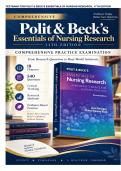
TESTBANK FOR POLIT & BECK’S ESSENTIALS OF NURSING RESEARCH, 11TH EDITION
, Table of Contents
Polit & Beck’s Essentials of Nursing Research, 11th Edition
Part Ch. Chapter
I — Overview of Nursing Research & Its Role in Evidence-Based Practice 1 Introducing Nursing Research for Evidence-Based Practice
2 Understanding Key Concepts and Steps in Quantitative and Qualitative Research
3 Reading and Critically Appraising Research Articles
4 Attending to Ethics in Research
II — Preliminary Steps in Quantitative and Qualitative Research 5 Identifying Research Problems, Research Questions, and Hypotheses
6 Finding and Reviewing Research Evidence in the Literature
7 Understanding Theoretical and Conceptual Frameworks
III — Designs and Methods for Quantitative and Qualitative Nursing Research 8 Appraising Quantitative Research Design
9 Appraising Sampling and Data Collection in Quantitative Studies
10 Appraising Qualitative Designs and Approaches
11 Appraising Sampling and Data Collection in Qualitative Studies
12 Understanding Mixed Methods Research, Quality Improvement, and Other Special Types of Research
IV — Analysis, Interpretation, and Application of Nursing Research 13 Understanding Statistical Analysis of Quantitative Data
14 Interpreting Quantitative Findings and Evaluating Clinical Significance
15 Understanding the Analysis of Qualitative Data
16 Appraising Trustworthiness and Integrity in Qualitative Research
17 Learning From Systematic Reviews
18 Putting Research Evidence Into Practice: Evidence-Based Practice and Practice-Based Evidence
Total Chapters: 18
Total Questions: 540
30 Questions per Chapter
Part I — Overview of Nursing Research & Its Role in Evidence-Based Practice
Chapter 1 — Introducing Nursing Research for Evidence-Based Practice
📝 Question 1
Review of a proposed pressure-injury prevention project shows prospective assignment to intervention and
comparison conditions, standardized outcome measurement, and plans to contribute findings to nursing
knowledge beyond the participating hospitals.
Which feature most strongly supports classifying the project as research?
A. Pressure injuries prompted development of the project
B. Clinical staff will receive performance feedback
C. The investigation is intended to generate knowledge extending beyond the immediate settings
D. Outcomes will be reviewed after implementation
✅ Correct Answer: C. The investigation is intended to generate knowledge extending beyond the immediate settings
📘 Rationale: Research is systematic inquiry undertaken to develop, refine, or extend knowledge. Local improvement projects may also collect data and
evaluate outcomes, but their primary purpose generally centers on improving performance within a particular setting. Intent to contribute to a broader
knowledge base strongly supports classification as research.
🔍 Why not the others? A, B, and D can occur in research, evidence-based practice, and quality-improvement initiatives, so none independently establishes
that the project is research.
💡 High-Yield Rule: Purpose is one of the strongest clues for distinguishing research from local quality improvement.
🎯 Exam Strategy: Ask whether the activity is mainly generating broader knowledge or correcting a specific local performance problem.
📝 Question 2
Findings from several rigorous trials support early mobility after critical illness, yet implementation planning
also identifies patient preferences, staffing limitations, and concerns raised by experienced clinicians.
Which decision best represents evidence-based practice?
Page 2 of 160
, A. Integrate the strongest research evidence with clinical expertise, patient preferences, and relevant
circumstances
B. Apply the trial protocol exactly as published regardless of local conditions
C. Give clinical experience priority because research cannot account for individual patients
D. Permit patient preference to replace all scientific evidence
✅ Correct Answer: A. Integrate the strongest research evidence with clinical expertise, patient preferences, and relevant circumstances
📘 Rationale: Evidence-based practice integrates the best available research evidence with clinical expertise and patient values, preferences, and
circumstances. Evidence informs decisions but does not eliminate professional judgment or individualization. Context and feasibility influence how evidence is
translated into practice.
🔍 Why not the others? B treats evidence as rigid instructions, C substitutes experience for evidence, and D incorrectly allows one EBP component to replace
all others.
💡 High-Yield Rule: EBP is integration, not automatic application of research findings.
🎯 Exam Strategy: When several legitimate decision inputs appear, favor the option that combines them rather than allowing one to dominate automatically.
📝 Question 3
Comparison of four proposed initiatives yields the following information:
Initiative Primary Purpose
I Explain factors associated with medication errors across several health systems
II Increase hand-hygiene compliance on one hospital unit
III Verify whether employees completed mandatory annual training
IV Compare one unit’s infection rate with its monthly target
Which initiative most clearly represents research?
A. Initiative IV
B. Initiative II
C. Initiative III
D. Initiative I
✅ Correct Answer: D. Initiative I
📘 Rationale: Initiative I seeks systematic explanation of a healthcare phenomenon across multiple settings and has potential to contribute knowledge beyond
one organization. The remaining activities primarily involve monitoring, compliance, or local performance improvement. Research can address systems
problems as well as direct clinical interventions.
🔍 Why not the others? II and IV are predominantly improvement or monitoring activities, while III is an administrative compliance evaluation.
💡 High-Yield Rule: Research may describe, explain, predict, or test phenomena relevant to nursing and healthcare.
🎯 Exam Strategy: Do not assume that only treatment studies qualify as nursing research.
📝 Question 4
Results from a proposed investigation are expected to clarify biological mechanisms linking sleep
fragmentation with inflammatory responses, although no treatment will be tested immediately.
How should the primary research orientation be characterized?
A. Practice auditing
B. Basic research
C. Quality assurance
D. Evidence implementation
✅ Correct Answer: B. Basic research
📘 Rationale: Basic research develops knowledge about underlying mechanisms, processes, or theoretical relationships and does not require immediate
clinical application. Such knowledge may later support intervention development and applied research. Absence of an immediate treatment does not lessen its
scientific importance.
🔍 Why not the others? A and C evaluate current performance, while D applies existing evidence rather than generating foundational knowledge.
💡 High-Yield Rule: Basic research builds foundational knowledge; applied research addresses more immediate practical problems.
🎯 Exam Strategy: Mechanism-focused investigations without an immediate practice intervention commonly indicate basic research.
📝 Question 5
Examination of a randomized controlled trial reveals impressive results in a prestigious journal, but the study
population differs substantially from the patients served by the hospital considering implementation.
What should the evidence committee do next?
Page 3 of 160
, A. Reject the trial because population differences always invalidate research
B. Implement the intervention because randomized trials automatically provide definitive evidence
C. Critically appraise the study’s validity and determine whether the findings are applicable to the local
population
D. Accept the findings because journal prestige establishes methodological quality
✅ Correct Answer: C. Critically appraise the study’s validity and determine whether the findings are applicable to the local population
📘 Rationale: Research design and publication venue alone do not establish that evidence is trustworthy or applicable. Critical appraisal considers
methodological quality, effect estimates, relevance, and transferability to the intended population. Even high-level evidence requires thoughtful evaluation
before implementation.
🔍 Why not the others? A treats population differences as automatically disqualifying, while B and D mistake design or journal reputation for proof of quality
and applicability.
💡 High-Yield Rule: Level of evidence and quality of evidence are related but not identical.
🎯 Exam Strategy: Whenever an answer says to accept research automatically because of design, author, or journal, look for a critical-appraisal alternative.
📝 Question 6
Following introduction of an evidence-supported mobility protocol, leaders track mobility scores, falls, length
of stay, staff adherence, and unintended complications for six months.
What is the primary purpose of this evaluation?
A. Convert the EBP initiative into basic research
B. Determine whether the evidence-based change produces desirable outcomes in the actual practice
setting
C. Prove that the original research studies were methodologically valid
D. Establish that adherence alone is sufficient evidence of effectiveness
✅ Correct Answer: B. Determine whether the evidence-based change produces desirable outcomes in the actual practice setting
📘 Rationale: Evidence-based practice continues beyond implementation. Outcomes should be evaluated to determine whether the change is effective,
feasible, safe, and sustainable in the local environment. Both process measures and patient outcomes can inform whether implementation should continue or
be modified.
🔍 Why not the others? A incorrectly changes the project’s purpose, C cannot be accomplished through local implementation data, and D confuses
adherence with clinical effectiveness.
💡 High-Yield Rule: EBP includes asking, acquiring, appraising, applying, and assessing outcomes.
🎯 Exam Strategy: When the stem occurs after implementation, think about outcome evaluation and sustainability.
🔗 Word-Safe Block Chain — Research to Evidence-Based Practice
Stage Progression
1 Clinical or knowledge problem identified
↓
2 Research generates evidence
↓
3 Evidence is critically appraised
↓
4 Findings are synthesized
↓
5 Clinical expertise and patient preferences are integrated
↓
6 Evidence-based decision is implemented
↓
7 Outcomes are evaluated
📝 Question 7
Within a laboratory program, investigators examine cellular pathways associated with delayed wound healing
rather than testing a specific bedside intervention.
Which classification best fits the work?
A. Basic research
B. Quality improvement
C. Utilization review
D. Evidence translation
Page 4 of 160
,✅ Correct Answer: A. Basic research
📘 Rationale: Investigation of underlying biological mechanisms is characteristic of basic research. The immediate goal is to expand scientific understanding
rather than directly evaluate a practice change. Findings may later inform applied clinical studies.
🔍 Why not the others? B and C focus on local performance or service use, while D concerns application of existing evidence.
💡 High-Yield Rule: Understanding “why or how something occurs” at a foundational level commonly reflects basic research.
🎯 Exam Strategy: Separate knowledge generation from knowledge implementation before choosing the answer.
📝 Question 8
Evidence from two caregiving studies is presented. One measures burden scores, sleep duration, and
depressive symptoms in 600 caregivers; the other uses intensive interviews to explore changes in identity and
family relationships.
What is the best interpretation?
A. Only the first approach can contribute scientifically useful knowledge
B. Quantitative evidence is always more appropriate for nursing than qualitative evidence
C. Qualitative studies cannot be analyzed systematically
D. The approaches address different dimensions of caregiving and can both contribute valuable evidence
✅ Correct Answer: D. The approaches address different dimensions of caregiving and can both contribute valuable evidence
📘 Rationale: Quantitative research is well suited to numerical measurement and relationships among variables, whereas qualitative research can illuminate
meaning, experience, context, and process. Both traditions can be rigorous and useful. Their value depends on whether the approach appropriately addresses
the question.
🔍 Why not the others? A and B incorrectly privilege one methodology, while C falsely assumes qualitative analysis lacks systematic procedures.
💡 High-Yield Rule: Research approach should follow the question—not the researcher’s preference for one methodology.
🎯 Exam Strategy: Avoid answers claiming one research tradition is universally superior.
📝 Question 9
Synthesis of evidence is needed to decide whether chlorhexidine bathing reduces central-line bloodstream
infections.
Which source would generally provide the strongest starting point when it is current and methodologically
rigorous?
A. Commentary from one respected expert
B. Descriptive survey of staff preferences
C. Systematic review of high-quality controlled intervention studies
D. Narrative account from an experienced infection-control clinician
✅ Correct Answer: C. Systematic review of high-quality controlled intervention studies
📘 Rationale: For an intervention question, a rigorous systematic review can integrate findings across multiple relevant studies and provide a stronger basis for
decision-making than isolated opinion or descriptive evidence. The systematic review itself must still be critically appraised.
🔍 Why not the others? A and D rely heavily on expert opinion, while B does not directly establish whether the intervention is effective.
💡 High-Yield Rule: The appropriate evidence hierarchy depends on the type of clinical question.
🎯 Exam Strategy: Identify whether the question concerns intervention, prognosis, diagnosis, meaning, or another purpose before ranking evidence.
📝 Question 10
Clinical leadership proposes that every patient receive an intervention in exactly the same manner because
research evidence supports its effectiveness.
Which response most accurately reflects EBP?
A. Standardization should always override individual patient circumstances
B. Evidence should be integrated with clinical judgment, patient preferences, and relevant contextual factors
C. Clinical expertise becomes unnecessary once research evidence exists
D. Research evidence should not influence practice until incorporated into national law
✅ Correct Answer: B. Evidence should be integrated with clinical judgment, patient preferences, and relevant contextual factors
📘 Rationale: Evidence-based practice does not require mechanical application of research findings. Appropriate decisions incorporate evidence with
professional expertise, individual preferences, resources, risks, and clinical circumstances. Evidence therefore guides rather than replaces individualized care.
🔍 Why not the others? A and C portray EBP as rigid and nonindividualized, while D imposes an irrelevant legal requirement.
💡 High-Yield Rule: Evidence informs clinical decisions; it does not replace individualized judgment.
🎯 Exam Strategy: Absolute terms such as “every,” “always,” and “exactly” deserve careful scrutiny in EBP questions.
Page 5 of 160
,📊 Research, Evidence-Based Practice, and Quality Improvement
Feature Research Evidence-Based Practice Quality Improvement
Main aim Generate or refine knowledge Make optimal clinical decisions Improve local performance
Typical starting point Knowledge gap Clinical/practice question Performance gap
Uses existing evidence Yes Central component Often
Generates new knowledge Usually Not necessarily Mainly local findings
Generalizability Often desired Not primary goal Usually limited
Outcome evaluation Study outcomes Practice outcomes Improvement outcomes
📝 Question 11
Historical examination of a common nursing procedure shows that it became routine largely through tradition
rather than empirical testing.
What is the strongest implication?
A. Tradition should be preserved because longevity proves effectiveness
B. Longstanding practices are inherently unsafe
C. Research is unnecessary once clinicians become familiar with a procedure
D. The practice should be examined using appropriate evidence rather than assumed effective because it is
traditional
✅ Correct Answer: D. The practice should be examined using appropriate evidence rather than assumed effective because it is traditional
📘 Rationale: Tradition can influence practice, but repeated use does not establish effectiveness or safety. Systematic inquiry may validate a traditional
approach, identify needed modifications, or show that an alternative is preferable. Evidence-based nursing requires questioning practices when adequate
evidence is lacking.
🔍 Why not the others? A equates longevity with proof, B assumes harm without evidence, and C places familiarity above systematic evaluation.
💡 High-Yield Rule: “We have always done it this way” is not equivalent to research evidence.
🎯 Exam Strategy: When tradition and evidence are contrasted, favor systematic evaluation over unquestioned custom.
📝 Question 12
Published guidance is challenged by a clinician who argues that 20 years of experience makes formal research
unnecessary.
Which interpretation is most defensible?
A. Clinical expertise is important but should complement rather than replace research evidence
B. Years of experience automatically represent the highest level of evidence
C. Research is needed only by inexperienced practitioners
D. Professional expertise and research findings cannot be combined
✅ Correct Answer: A. Clinical expertise is important but should complement rather than replace research evidence
📘 Rationale: Clinical expertise is essential because practitioners must interpret and apply evidence appropriately. However, experience may be influenced by
selective recall, local habits, and bias. EBP combines expertise with systematically generated evidence rather than treating them as competing sources.
🔍 Why not the others? B overvalues experience, C incorrectly limits the role of research, and D contradicts the integrative foundation of EBP.
💡 High-Yield Rule: Expertise helps clinicians apply evidence; it does not eliminate the need for evidence.
🎯 Exam Strategy: Integration is usually stronger than an “either research or experience” answer.
📝 Question 13
Statistical output from an intervention trial shows p < .001, yet the treatment group improves only 0.4 point
on a 100-point symptom scale and participants report no perceptible benefit.
Which interpretation is most appropriate?
A. Statistical significance automatically establishes important clinical benefit
B. The findings must be fraudulent because statistical and clinical significance differ
C. Statistical significance should be considered together with the magnitude and clinical importance of the
effect
D. Patient impressions should replace all statistical analysis
✅ Correct Answer: C. Statistical significance should be considered together with the magnitude and clinical importance of the effect
📘 Rationale: Statistical significance addresses whether findings are unlikely to be explained by random sampling variation under specified assumptions. It
does not determine whether an effect is large enough to matter clinically. EBP also considers effect magnitude, patient benefit, risks, costs, and feasibility.
🔍 Why not the others? A overinterprets the p-value, B incorrectly equates differing forms of significance with misconduct, and D discards useful quantitative
evidence.
💡 High-Yield Rule: Statistical significance does not automatically equal clinical significance.
Page 6 of 160
,🎯 Exam Strategy: When a very small effect is paired with a strong p-value, evaluate whether the difference is meaningful in practice.
📝 Question 14
Inspection of a national guideline reveals several recommendations based primarily on expert consensus
because robust research is unavailable.
How should those recommendations be interpreted?
A. Expert consensus may guide decisions, but its evidentiary limitations should be recognized
B. Consensus should be treated as equivalent to a rigorous systematic review
C. Recommendations based on expertise have no potential value
D. Consensus automatically establishes a permanent standard of care
✅ Correct Answer: A. Expert consensus may guide decisions, but its evidentiary limitations should be recognized
📘 Rationale: EBP frequently requires decisions even when strong research is incomplete. Expert consensus can provide useful guidance, but decision-
makers should acknowledge greater uncertainty and remain responsive to emerging evidence. “Best available evidence” does not always mean ideal evidence.
🔍 Why not the others? B overstates evidentiary strength, while C and D represent unjustified all-or-none positions.
💡 High-Yield Rule: Evidence-based care uses the best available evidence while acknowledging uncertainty.
🎯 Exam Strategy: Limited evidence does not mean that no clinical decision can be made.
📝 Question 15
Consideration of a strongly supported intervention reveals that the necessary equipment is unavailable and
staff training would exceed current organizational resources.
Which principle is most relevant to the final decision?
A. High-quality evidence eliminates resource considerations
B. Feasibility and local context must be considered when applying evidence
C. Research evidence is valid only in settings with identical resources
D. Implementation should proceed regardless of operational barriers
✅ Correct Answer: B. Feasibility and local context must be considered when applying evidence
📘 Rationale: Evidence-based decisions consider not only whether an intervention works but also whether it can be implemented safely and effectively in a
particular environment. Staffing, equipment, costs, expertise, and workflow constraints may affect adoption.
🔍 Why not the others? A and D ignore implementation realities, while C incorrectly confuses applicability with scientific validity.
💡 High-Yield Rule: Evidence can be strong while implementation feasibility remains poor.
🎯 Exam Strategy: Separate “Does it work?” from “Can we implement it effectively here?”
📝 Question 16
Funding priorities include workforce shortages, symptom management, communication failures, health
disparities, patient safety, and care transitions.
What common feature makes these topics appropriate for nursing research?
A. Each must be investigated through randomized controlled trials
B. Each focuses exclusively on physician behavior
C. Each is limited to biological mechanisms
D. Each addresses phenomena relevant to nursing practice, healthcare delivery, human responses, or
patient outcomes
✅ Correct Answer: D. Each addresses phenomena relevant to nursing practice, healthcare delivery, human responses, or patient outcomes
📘 Rationale: Nursing research encompasses clinical interventions, human responses, healthcare systems, population health, education, safety, workforce
issues, and implementation. The discipline is not limited to physiological variables or bedside procedures.
🔍 Why not the others? A incorrectly requires one design, while B and C define nursing research far too narrowly.
💡 High-Yield Rule: Nursing science addresses patients, caregivers, clinicians, systems, populations, behaviors, and health outcomes.
🎯 Exam Strategy: Choose definitions broad enough to reflect the full scope of nursing knowledge.
📝 Question 17
Variation in delirium prevention practices prompts an EBP team to search the literature.
What should occur before selecting the first relevant article located?
A. Implement the newest article immediately
B. Develop a focused question and search systematically for relevant evidence
C. Choose the article with the largest citation count
D. Restrict evidence to studies completed within the same hospital
Page 7 of 160
,✅ Correct Answer: B. Develop a focused question and search systematically for relevant evidence
📘 Rationale: A clearly formulated question defines the clinical issue, population, intervention or exposure, and relevant outcomes. It guides a systematic
search and reduces the risk of selecting evidence merely because it is easy to find or supports a preferred conclusion.
🔍 Why not the others? A, C, and D use shortcuts that can distort the evidence base and undermine a defensible EBP process.
💡 High-Yield Rule: Strong EBP begins with a focused, answerable question.
🎯 Exam Strategy: When the stem describes the beginning of an EBP initiative, think question formulation before evidence selection.
📝 Question 18
Analysis of the literature identifies one small observational study that conflicts with several stronger
investigations.
Which response best demonstrates evidence-based reasoning?
A. Accept the newest study because recency outranks methodological quality
B. Ignore all studies showing disagreement
C. Examine the total body of evidence for quality, consistency, design, precision, and applicability
D. Select whichever study supports current organizational practice
✅ Correct Answer: C. Examine the total body of evidence for quality, consistency, design, precision, and applicability
📘 Rationale: EBP requires evaluation of the overall evidence rather than reliance on an isolated result. Differences in design, sample size, bias, precision,
populations, and consistency can explain apparently conflicting findings. Evidence synthesis helps determine which conclusions are best supported.
🔍 Why not the others? A gives excessive weight to recency, B avoids legitimate uncertainty, and D encourages confirmation bias.
💡 High-Yield Rule: Decisions should reflect the body of evidence, not a conveniently selected study.
🎯 Exam Strategy: When studies conflict, choose appraisal and synthesis rather than cherry-picking.
🧭 Word-Safe Evidence Decision Path
📝 Question 19
Evaluation of a long-established nursing intervention reveals that its adoption originally depended mainly on
authority and custom.
What should happen next?
A. Examine whether credible evidence supports continued use of the intervention
B. Continue the intervention because tradition is equivalent to strong evidence
C. Discontinue it immediately because traditional practices are always ineffective
D. Avoid investigation because questioning established practice is professionally inappropriate
✅ Correct Answer: A. Examine whether credible evidence supports continued use of the intervention
Page 8 of 160
,📘 Rationale: Historical acceptance does not establish effectiveness or ineffectiveness. Research and evidence appraisal should determine whether the
intervention remains appropriate. Evidence may support continued use, modification, or replacement.
🔍 Why not the others? B overvalues tradition, C assumes ineffectiveness without evaluation, and D conflicts with the scientific responsibility to question
practice.
💡 High-Yield Rule: Established practice still requires evidentiary support.
🎯 Exam Strategy: Avoid both extremes—tradition is neither automatic proof nor automatic evidence of failure.
📝 Question 20
Local adaptation of a multisite evidence-supported discharge intervention is proposed to accommodate
language needs, staffing patterns, and community resources.
Which approach is most consistent with evidence-based implementation?
A. Reject every modification because evidence-based interventions can never be adapted
B. Repeat the entire original research program before changing any feature
C. Ignore local circumstances because research findings always transfer unchanged
D. Preserve core evidence-supported elements, make justified adaptations, and monitor outcomes
✅ Correct Answer: D. Preserve core evidence-supported elements, make justified adaptations, and monitor outcomes
📘 Rationale: Implementation frequently requires thoughtful adaptation to local populations and systems. The goal is to maintain fidelity to essential
intervention components while modifying peripheral features where needed. Outcome monitoring helps determine whether effectiveness is preserved.
🔍 Why not the others? A and C portray evidence as rigid, while B requires unnecessary replication before reasonable implementation adjustments.
💡 High-Yield Rule: Evidence-based implementation can balance fidelity with context-sensitive adaptation.
🎯 Exam Strategy: Look for the answer that preserves the intervention’s essential mechanism while acknowledging real-world conditions.
📝 Question 21
Hourly rounding is proposed as a strategy for reducing inpatient falls compared with usual care.
Which research purpose is most directly represented?
A. Explore the meaning of hospitalization
B. Describe prevalence of staff fatigue
C. Test the effectiveness of an intervention
D. Clarify the philosophical meaning of caring
✅ Correct Answer: C. Test the effectiveness of an intervention
📘 Rationale: The question compares a specific intervention with usual care and evaluates an outcome. This is an effectiveness question and may require a
design capable of estimating the intervention’s effect and controlling alternative explanations.
🔍 Why not the others? A and D address meaning or concepts, while B is primarily descriptive rather than intervention-focused.
💡 High-Yield Rule: “Does X improve Y compared with Z?” usually signals intervention testing.
🎯 Exam Strategy: Identify what the investigators are trying to do—describe, explore, explain, predict, or test.
📝 Question 22
Researchers argue that nursing should rely only on knowledge generated through randomized controlled
trials.
Which critique is strongest?
A. Every nursing question can be answered experimentally
B. Different nursing questions require different forms of evidence, including qualitative, descriptive,
observational, and experimental research
C. Qualitative findings have no relevance to clinical decision-making
D. Randomized trials are inappropriate solely because they cost more
✅ Correct Answer: B. Different nursing questions require different forms of evidence, including qualitative, descriptive, observational, and experimental research
📘 Rationale: Randomized trials are valuable for many intervention questions but cannot answer every question relevant to nursing. Questions involving
meaning, experience, prognosis, prevalence, context, implementation, or naturally occurring exposures may require other designs.
🔍 Why not the others? A and C wrongly elevate one research approach above all others, while D focuses on expense rather than methodological
appropriateness.
💡 High-Yield Rule: The best design is the one suited to the research question.
🎯 Exam Strategy: Be skeptical of claims that one methodology is universally superior.
📝 Question 23
Fall rates decline by 20% after introduction of a prevention bundle, and leaders immediately conclude that the
bundle caused the improvement.
What is the major reasoning problem?
Page 9 of 160
, A. Local outcome data can never be useful
B. Percentage reductions cannot be interpreted scientifically
C. Practice changes cannot influence outcomes
D. Alternative explanations for the decline have not been adequately considered
✅ Correct Answer: D. Alternative explanations for the decline have not been adequately considered
📘 Rationale: Temporal sequence alone does not establish causation. Staffing changes, seasonal patterns, concurrent interventions, measurement changes,
or differences in patient mix may contribute to an observed improvement. Strong causal conclusions require a design capable of addressing competing
explanations.
🔍 Why not the others? A and C are false, while B incorrectly dismisses useful outcome measures.
💡 High-Yield Rule: “After the intervention” does not automatically mean “because of the intervention.”
🎯 Exam Strategy: Whenever causation is claimed from simple before-and-after observations, consider alternative explanations.
📝 Question 24
Review of an EBP initiative reveals that several high-quality studies support the intervention, but patients
consistently report that one component conflicts with their preferences and treatment goals.
Which action is most appropriate?
A. Ignore the patients because high-quality research takes absolute priority
B. Abandon all research evidence and use preferences alone
C. Integrate patient preferences with the evidence and clinical considerations when determining how care
should proceed
D. Require identical decisions for every patient to preserve protocol consistency
✅ Correct Answer: C. Integrate patient preferences with the evidence and clinical considerations when determining how care should proceed
📘 Rationale: Patient preferences and values are integral to evidence-based practice. Strong research evidence remains important, but its application occurs
within individual circumstances and goals. Shared decision-making can reconcile evidence with what matters to the person receiving care.
🔍 Why not the others? A dismisses a central EBP component, B eliminates scientific evidence, and D ignores individualization.
💡 High-Yield Rule: EBP is patient-centered as well as evidence-informed.
🎯 Exam Strategy: If the stem introduces patient values, do not treat them as an inconvenience to evidence-based care.
📝 Question 25
Survey data show that many nurses report difficulty locating research articles and judging whether findings
are trustworthy.
Which barrier to evidence-based practice is most directly represented?
A. Excessive patient involvement
B. Limited access to and skill in appraising research evidence
C. Excessive methodological rigor
D. Overuse of randomized trials
✅ Correct Answer: B. Limited access to and skill in appraising research evidence
📘 Rationale: Common EBP barriers include inadequate time, insufficient research knowledge, limited access to resources, weak appraisal skills,
organizational resistance, and lack of implementation support. Difficulty finding and interpreting studies directly reflects evidence-access and appraisal
barriers.
🔍 Why not the others? A, C, and D do not explain the specific difficulty described.
💡 High-Yield Rule: EBP barriers can arise at the clinician, evidence, resource, or organizational level.
🎯 Exam Strategy: Match the stated obstacle precisely with the level at which the barrier occurs.
Page 10 of 160
, Table of Contents
Polit & Beck’s Essentials of Nursing Research, 11th Edition
Part Ch. Chapter
I — Overview of Nursing Research & Its Role in Evidence-Based Practice 1 Introducing Nursing Research for Evidence-Based Practice
2 Understanding Key Concepts and Steps in Quantitative and Qualitative Research
3 Reading and Critically Appraising Research Articles
4 Attending to Ethics in Research
II — Preliminary Steps in Quantitative and Qualitative Research 5 Identifying Research Problems, Research Questions, and Hypotheses
6 Finding and Reviewing Research Evidence in the Literature
7 Understanding Theoretical and Conceptual Frameworks
III — Designs and Methods for Quantitative and Qualitative Nursing Research 8 Appraising Quantitative Research Design
9 Appraising Sampling and Data Collection in Quantitative Studies
10 Appraising Qualitative Designs and Approaches
11 Appraising Sampling and Data Collection in Qualitative Studies
12 Understanding Mixed Methods Research, Quality Improvement, and Other Special Types of Research
IV — Analysis, Interpretation, and Application of Nursing Research 13 Understanding Statistical Analysis of Quantitative Data
14 Interpreting Quantitative Findings and Evaluating Clinical Significance
15 Understanding the Analysis of Qualitative Data
16 Appraising Trustworthiness and Integrity in Qualitative Research
17 Learning From Systematic Reviews
18 Putting Research Evidence Into Practice: Evidence-Based Practice and Practice-Based Evidence
Total Chapters: 18
Total Questions: 540
30 Questions per Chapter
Part I — Overview of Nursing Research & Its Role in Evidence-Based Practice
Chapter 1 — Introducing Nursing Research for Evidence-Based Practice
📝 Question 1
Review of a proposed pressure-injury prevention project shows prospective assignment to intervention and
comparison conditions, standardized outcome measurement, and plans to contribute findings to nursing
knowledge beyond the participating hospitals.
Which feature most strongly supports classifying the project as research?
A. Pressure injuries prompted development of the project
B. Clinical staff will receive performance feedback
C. The investigation is intended to generate knowledge extending beyond the immediate settings
D. Outcomes will be reviewed after implementation
✅ Correct Answer: C. The investigation is intended to generate knowledge extending beyond the immediate settings
📘 Rationale: Research is systematic inquiry undertaken to develop, refine, or extend knowledge. Local improvement projects may also collect data and
evaluate outcomes, but their primary purpose generally centers on improving performance within a particular setting. Intent to contribute to a broader
knowledge base strongly supports classification as research.
🔍 Why not the others? A, B, and D can occur in research, evidence-based practice, and quality-improvement initiatives, so none independently establishes
that the project is research.
💡 High-Yield Rule: Purpose is one of the strongest clues for distinguishing research from local quality improvement.
🎯 Exam Strategy: Ask whether the activity is mainly generating broader knowledge or correcting a specific local performance problem.
📝 Question 2
Findings from several rigorous trials support early mobility after critical illness, yet implementation planning
also identifies patient preferences, staffing limitations, and concerns raised by experienced clinicians.
Which decision best represents evidence-based practice?
Page 2 of 160
, A. Integrate the strongest research evidence with clinical expertise, patient preferences, and relevant
circumstances
B. Apply the trial protocol exactly as published regardless of local conditions
C. Give clinical experience priority because research cannot account for individual patients
D. Permit patient preference to replace all scientific evidence
✅ Correct Answer: A. Integrate the strongest research evidence with clinical expertise, patient preferences, and relevant circumstances
📘 Rationale: Evidence-based practice integrates the best available research evidence with clinical expertise and patient values, preferences, and
circumstances. Evidence informs decisions but does not eliminate professional judgment or individualization. Context and feasibility influence how evidence is
translated into practice.
🔍 Why not the others? B treats evidence as rigid instructions, C substitutes experience for evidence, and D incorrectly allows one EBP component to replace
all others.
💡 High-Yield Rule: EBP is integration, not automatic application of research findings.
🎯 Exam Strategy: When several legitimate decision inputs appear, favor the option that combines them rather than allowing one to dominate automatically.
📝 Question 3
Comparison of four proposed initiatives yields the following information:
Initiative Primary Purpose
I Explain factors associated with medication errors across several health systems
II Increase hand-hygiene compliance on one hospital unit
III Verify whether employees completed mandatory annual training
IV Compare one unit’s infection rate with its monthly target
Which initiative most clearly represents research?
A. Initiative IV
B. Initiative II
C. Initiative III
D. Initiative I
✅ Correct Answer: D. Initiative I
📘 Rationale: Initiative I seeks systematic explanation of a healthcare phenomenon across multiple settings and has potential to contribute knowledge beyond
one organization. The remaining activities primarily involve monitoring, compliance, or local performance improvement. Research can address systems
problems as well as direct clinical interventions.
🔍 Why not the others? II and IV are predominantly improvement or monitoring activities, while III is an administrative compliance evaluation.
💡 High-Yield Rule: Research may describe, explain, predict, or test phenomena relevant to nursing and healthcare.
🎯 Exam Strategy: Do not assume that only treatment studies qualify as nursing research.
📝 Question 4
Results from a proposed investigation are expected to clarify biological mechanisms linking sleep
fragmentation with inflammatory responses, although no treatment will be tested immediately.
How should the primary research orientation be characterized?
A. Practice auditing
B. Basic research
C. Quality assurance
D. Evidence implementation
✅ Correct Answer: B. Basic research
📘 Rationale: Basic research develops knowledge about underlying mechanisms, processes, or theoretical relationships and does not require immediate
clinical application. Such knowledge may later support intervention development and applied research. Absence of an immediate treatment does not lessen its
scientific importance.
🔍 Why not the others? A and C evaluate current performance, while D applies existing evidence rather than generating foundational knowledge.
💡 High-Yield Rule: Basic research builds foundational knowledge; applied research addresses more immediate practical problems.
🎯 Exam Strategy: Mechanism-focused investigations without an immediate practice intervention commonly indicate basic research.
📝 Question 5
Examination of a randomized controlled trial reveals impressive results in a prestigious journal, but the study
population differs substantially from the patients served by the hospital considering implementation.
What should the evidence committee do next?
Page 3 of 160
, A. Reject the trial because population differences always invalidate research
B. Implement the intervention because randomized trials automatically provide definitive evidence
C. Critically appraise the study’s validity and determine whether the findings are applicable to the local
population
D. Accept the findings because journal prestige establishes methodological quality
✅ Correct Answer: C. Critically appraise the study’s validity and determine whether the findings are applicable to the local population
📘 Rationale: Research design and publication venue alone do not establish that evidence is trustworthy or applicable. Critical appraisal considers
methodological quality, effect estimates, relevance, and transferability to the intended population. Even high-level evidence requires thoughtful evaluation
before implementation.
🔍 Why not the others? A treats population differences as automatically disqualifying, while B and D mistake design or journal reputation for proof of quality
and applicability.
💡 High-Yield Rule: Level of evidence and quality of evidence are related but not identical.
🎯 Exam Strategy: Whenever an answer says to accept research automatically because of design, author, or journal, look for a critical-appraisal alternative.
📝 Question 6
Following introduction of an evidence-supported mobility protocol, leaders track mobility scores, falls, length
of stay, staff adherence, and unintended complications for six months.
What is the primary purpose of this evaluation?
A. Convert the EBP initiative into basic research
B. Determine whether the evidence-based change produces desirable outcomes in the actual practice
setting
C. Prove that the original research studies were methodologically valid
D. Establish that adherence alone is sufficient evidence of effectiveness
✅ Correct Answer: B. Determine whether the evidence-based change produces desirable outcomes in the actual practice setting
📘 Rationale: Evidence-based practice continues beyond implementation. Outcomes should be evaluated to determine whether the change is effective,
feasible, safe, and sustainable in the local environment. Both process measures and patient outcomes can inform whether implementation should continue or
be modified.
🔍 Why not the others? A incorrectly changes the project’s purpose, C cannot be accomplished through local implementation data, and D confuses
adherence with clinical effectiveness.
💡 High-Yield Rule: EBP includes asking, acquiring, appraising, applying, and assessing outcomes.
🎯 Exam Strategy: When the stem occurs after implementation, think about outcome evaluation and sustainability.
🔗 Word-Safe Block Chain — Research to Evidence-Based Practice
Stage Progression
1 Clinical or knowledge problem identified
↓
2 Research generates evidence
↓
3 Evidence is critically appraised
↓
4 Findings are synthesized
↓
5 Clinical expertise and patient preferences are integrated
↓
6 Evidence-based decision is implemented
↓
7 Outcomes are evaluated
📝 Question 7
Within a laboratory program, investigators examine cellular pathways associated with delayed wound healing
rather than testing a specific bedside intervention.
Which classification best fits the work?
A. Basic research
B. Quality improvement
C. Utilization review
D. Evidence translation
Page 4 of 160
,✅ Correct Answer: A. Basic research
📘 Rationale: Investigation of underlying biological mechanisms is characteristic of basic research. The immediate goal is to expand scientific understanding
rather than directly evaluate a practice change. Findings may later inform applied clinical studies.
🔍 Why not the others? B and C focus on local performance or service use, while D concerns application of existing evidence.
💡 High-Yield Rule: Understanding “why or how something occurs” at a foundational level commonly reflects basic research.
🎯 Exam Strategy: Separate knowledge generation from knowledge implementation before choosing the answer.
📝 Question 8
Evidence from two caregiving studies is presented. One measures burden scores, sleep duration, and
depressive symptoms in 600 caregivers; the other uses intensive interviews to explore changes in identity and
family relationships.
What is the best interpretation?
A. Only the first approach can contribute scientifically useful knowledge
B. Quantitative evidence is always more appropriate for nursing than qualitative evidence
C. Qualitative studies cannot be analyzed systematically
D. The approaches address different dimensions of caregiving and can both contribute valuable evidence
✅ Correct Answer: D. The approaches address different dimensions of caregiving and can both contribute valuable evidence
📘 Rationale: Quantitative research is well suited to numerical measurement and relationships among variables, whereas qualitative research can illuminate
meaning, experience, context, and process. Both traditions can be rigorous and useful. Their value depends on whether the approach appropriately addresses
the question.
🔍 Why not the others? A and B incorrectly privilege one methodology, while C falsely assumes qualitative analysis lacks systematic procedures.
💡 High-Yield Rule: Research approach should follow the question—not the researcher’s preference for one methodology.
🎯 Exam Strategy: Avoid answers claiming one research tradition is universally superior.
📝 Question 9
Synthesis of evidence is needed to decide whether chlorhexidine bathing reduces central-line bloodstream
infections.
Which source would generally provide the strongest starting point when it is current and methodologically
rigorous?
A. Commentary from one respected expert
B. Descriptive survey of staff preferences
C. Systematic review of high-quality controlled intervention studies
D. Narrative account from an experienced infection-control clinician
✅ Correct Answer: C. Systematic review of high-quality controlled intervention studies
📘 Rationale: For an intervention question, a rigorous systematic review can integrate findings across multiple relevant studies and provide a stronger basis for
decision-making than isolated opinion or descriptive evidence. The systematic review itself must still be critically appraised.
🔍 Why not the others? A and D rely heavily on expert opinion, while B does not directly establish whether the intervention is effective.
💡 High-Yield Rule: The appropriate evidence hierarchy depends on the type of clinical question.
🎯 Exam Strategy: Identify whether the question concerns intervention, prognosis, diagnosis, meaning, or another purpose before ranking evidence.
📝 Question 10
Clinical leadership proposes that every patient receive an intervention in exactly the same manner because
research evidence supports its effectiveness.
Which response most accurately reflects EBP?
A. Standardization should always override individual patient circumstances
B. Evidence should be integrated with clinical judgment, patient preferences, and relevant contextual factors
C. Clinical expertise becomes unnecessary once research evidence exists
D. Research evidence should not influence practice until incorporated into national law
✅ Correct Answer: B. Evidence should be integrated with clinical judgment, patient preferences, and relevant contextual factors
📘 Rationale: Evidence-based practice does not require mechanical application of research findings. Appropriate decisions incorporate evidence with
professional expertise, individual preferences, resources, risks, and clinical circumstances. Evidence therefore guides rather than replaces individualized care.
🔍 Why not the others? A and C portray EBP as rigid and nonindividualized, while D imposes an irrelevant legal requirement.
💡 High-Yield Rule: Evidence informs clinical decisions; it does not replace individualized judgment.
🎯 Exam Strategy: Absolute terms such as “every,” “always,” and “exactly” deserve careful scrutiny in EBP questions.
Page 5 of 160
,📊 Research, Evidence-Based Practice, and Quality Improvement
Feature Research Evidence-Based Practice Quality Improvement
Main aim Generate or refine knowledge Make optimal clinical decisions Improve local performance
Typical starting point Knowledge gap Clinical/practice question Performance gap
Uses existing evidence Yes Central component Often
Generates new knowledge Usually Not necessarily Mainly local findings
Generalizability Often desired Not primary goal Usually limited
Outcome evaluation Study outcomes Practice outcomes Improvement outcomes
📝 Question 11
Historical examination of a common nursing procedure shows that it became routine largely through tradition
rather than empirical testing.
What is the strongest implication?
A. Tradition should be preserved because longevity proves effectiveness
B. Longstanding practices are inherently unsafe
C. Research is unnecessary once clinicians become familiar with a procedure
D. The practice should be examined using appropriate evidence rather than assumed effective because it is
traditional
✅ Correct Answer: D. The practice should be examined using appropriate evidence rather than assumed effective because it is traditional
📘 Rationale: Tradition can influence practice, but repeated use does not establish effectiveness or safety. Systematic inquiry may validate a traditional
approach, identify needed modifications, or show that an alternative is preferable. Evidence-based nursing requires questioning practices when adequate
evidence is lacking.
🔍 Why not the others? A equates longevity with proof, B assumes harm without evidence, and C places familiarity above systematic evaluation.
💡 High-Yield Rule: “We have always done it this way” is not equivalent to research evidence.
🎯 Exam Strategy: When tradition and evidence are contrasted, favor systematic evaluation over unquestioned custom.
📝 Question 12
Published guidance is challenged by a clinician who argues that 20 years of experience makes formal research
unnecessary.
Which interpretation is most defensible?
A. Clinical expertise is important but should complement rather than replace research evidence
B. Years of experience automatically represent the highest level of evidence
C. Research is needed only by inexperienced practitioners
D. Professional expertise and research findings cannot be combined
✅ Correct Answer: A. Clinical expertise is important but should complement rather than replace research evidence
📘 Rationale: Clinical expertise is essential because practitioners must interpret and apply evidence appropriately. However, experience may be influenced by
selective recall, local habits, and bias. EBP combines expertise with systematically generated evidence rather than treating them as competing sources.
🔍 Why not the others? B overvalues experience, C incorrectly limits the role of research, and D contradicts the integrative foundation of EBP.
💡 High-Yield Rule: Expertise helps clinicians apply evidence; it does not eliminate the need for evidence.
🎯 Exam Strategy: Integration is usually stronger than an “either research or experience” answer.
📝 Question 13
Statistical output from an intervention trial shows p < .001, yet the treatment group improves only 0.4 point
on a 100-point symptom scale and participants report no perceptible benefit.
Which interpretation is most appropriate?
A. Statistical significance automatically establishes important clinical benefit
B. The findings must be fraudulent because statistical and clinical significance differ
C. Statistical significance should be considered together with the magnitude and clinical importance of the
effect
D. Patient impressions should replace all statistical analysis
✅ Correct Answer: C. Statistical significance should be considered together with the magnitude and clinical importance of the effect
📘 Rationale: Statistical significance addresses whether findings are unlikely to be explained by random sampling variation under specified assumptions. It
does not determine whether an effect is large enough to matter clinically. EBP also considers effect magnitude, patient benefit, risks, costs, and feasibility.
🔍 Why not the others? A overinterprets the p-value, B incorrectly equates differing forms of significance with misconduct, and D discards useful quantitative
evidence.
💡 High-Yield Rule: Statistical significance does not automatically equal clinical significance.
Page 6 of 160
,🎯 Exam Strategy: When a very small effect is paired with a strong p-value, evaluate whether the difference is meaningful in practice.
📝 Question 14
Inspection of a national guideline reveals several recommendations based primarily on expert consensus
because robust research is unavailable.
How should those recommendations be interpreted?
A. Expert consensus may guide decisions, but its evidentiary limitations should be recognized
B. Consensus should be treated as equivalent to a rigorous systematic review
C. Recommendations based on expertise have no potential value
D. Consensus automatically establishes a permanent standard of care
✅ Correct Answer: A. Expert consensus may guide decisions, but its evidentiary limitations should be recognized
📘 Rationale: EBP frequently requires decisions even when strong research is incomplete. Expert consensus can provide useful guidance, but decision-
makers should acknowledge greater uncertainty and remain responsive to emerging evidence. “Best available evidence” does not always mean ideal evidence.
🔍 Why not the others? B overstates evidentiary strength, while C and D represent unjustified all-or-none positions.
💡 High-Yield Rule: Evidence-based care uses the best available evidence while acknowledging uncertainty.
🎯 Exam Strategy: Limited evidence does not mean that no clinical decision can be made.
📝 Question 15
Consideration of a strongly supported intervention reveals that the necessary equipment is unavailable and
staff training would exceed current organizational resources.
Which principle is most relevant to the final decision?
A. High-quality evidence eliminates resource considerations
B. Feasibility and local context must be considered when applying evidence
C. Research evidence is valid only in settings with identical resources
D. Implementation should proceed regardless of operational barriers
✅ Correct Answer: B. Feasibility and local context must be considered when applying evidence
📘 Rationale: Evidence-based decisions consider not only whether an intervention works but also whether it can be implemented safely and effectively in a
particular environment. Staffing, equipment, costs, expertise, and workflow constraints may affect adoption.
🔍 Why not the others? A and D ignore implementation realities, while C incorrectly confuses applicability with scientific validity.
💡 High-Yield Rule: Evidence can be strong while implementation feasibility remains poor.
🎯 Exam Strategy: Separate “Does it work?” from “Can we implement it effectively here?”
📝 Question 16
Funding priorities include workforce shortages, symptom management, communication failures, health
disparities, patient safety, and care transitions.
What common feature makes these topics appropriate for nursing research?
A. Each must be investigated through randomized controlled trials
B. Each focuses exclusively on physician behavior
C. Each is limited to biological mechanisms
D. Each addresses phenomena relevant to nursing practice, healthcare delivery, human responses, or
patient outcomes
✅ Correct Answer: D. Each addresses phenomena relevant to nursing practice, healthcare delivery, human responses, or patient outcomes
📘 Rationale: Nursing research encompasses clinical interventions, human responses, healthcare systems, population health, education, safety, workforce
issues, and implementation. The discipline is not limited to physiological variables or bedside procedures.
🔍 Why not the others? A incorrectly requires one design, while B and C define nursing research far too narrowly.
💡 High-Yield Rule: Nursing science addresses patients, caregivers, clinicians, systems, populations, behaviors, and health outcomes.
🎯 Exam Strategy: Choose definitions broad enough to reflect the full scope of nursing knowledge.
📝 Question 17
Variation in delirium prevention practices prompts an EBP team to search the literature.
What should occur before selecting the first relevant article located?
A. Implement the newest article immediately
B. Develop a focused question and search systematically for relevant evidence
C. Choose the article with the largest citation count
D. Restrict evidence to studies completed within the same hospital
Page 7 of 160
,✅ Correct Answer: B. Develop a focused question and search systematically for relevant evidence
📘 Rationale: A clearly formulated question defines the clinical issue, population, intervention or exposure, and relevant outcomes. It guides a systematic
search and reduces the risk of selecting evidence merely because it is easy to find or supports a preferred conclusion.
🔍 Why not the others? A, C, and D use shortcuts that can distort the evidence base and undermine a defensible EBP process.
💡 High-Yield Rule: Strong EBP begins with a focused, answerable question.
🎯 Exam Strategy: When the stem describes the beginning of an EBP initiative, think question formulation before evidence selection.
📝 Question 18
Analysis of the literature identifies one small observational study that conflicts with several stronger
investigations.
Which response best demonstrates evidence-based reasoning?
A. Accept the newest study because recency outranks methodological quality
B. Ignore all studies showing disagreement
C. Examine the total body of evidence for quality, consistency, design, precision, and applicability
D. Select whichever study supports current organizational practice
✅ Correct Answer: C. Examine the total body of evidence for quality, consistency, design, precision, and applicability
📘 Rationale: EBP requires evaluation of the overall evidence rather than reliance on an isolated result. Differences in design, sample size, bias, precision,
populations, and consistency can explain apparently conflicting findings. Evidence synthesis helps determine which conclusions are best supported.
🔍 Why not the others? A gives excessive weight to recency, B avoids legitimate uncertainty, and D encourages confirmation bias.
💡 High-Yield Rule: Decisions should reflect the body of evidence, not a conveniently selected study.
🎯 Exam Strategy: When studies conflict, choose appraisal and synthesis rather than cherry-picking.
🧭 Word-Safe Evidence Decision Path
📝 Question 19
Evaluation of a long-established nursing intervention reveals that its adoption originally depended mainly on
authority and custom.
What should happen next?
A. Examine whether credible evidence supports continued use of the intervention
B. Continue the intervention because tradition is equivalent to strong evidence
C. Discontinue it immediately because traditional practices are always ineffective
D. Avoid investigation because questioning established practice is professionally inappropriate
✅ Correct Answer: A. Examine whether credible evidence supports continued use of the intervention
Page 8 of 160
,📘 Rationale: Historical acceptance does not establish effectiveness or ineffectiveness. Research and evidence appraisal should determine whether the
intervention remains appropriate. Evidence may support continued use, modification, or replacement.
🔍 Why not the others? B overvalues tradition, C assumes ineffectiveness without evaluation, and D conflicts with the scientific responsibility to question
practice.
💡 High-Yield Rule: Established practice still requires evidentiary support.
🎯 Exam Strategy: Avoid both extremes—tradition is neither automatic proof nor automatic evidence of failure.
📝 Question 20
Local adaptation of a multisite evidence-supported discharge intervention is proposed to accommodate
language needs, staffing patterns, and community resources.
Which approach is most consistent with evidence-based implementation?
A. Reject every modification because evidence-based interventions can never be adapted
B. Repeat the entire original research program before changing any feature
C. Ignore local circumstances because research findings always transfer unchanged
D. Preserve core evidence-supported elements, make justified adaptations, and monitor outcomes
✅ Correct Answer: D. Preserve core evidence-supported elements, make justified adaptations, and monitor outcomes
📘 Rationale: Implementation frequently requires thoughtful adaptation to local populations and systems. The goal is to maintain fidelity to essential
intervention components while modifying peripheral features where needed. Outcome monitoring helps determine whether effectiveness is preserved.
🔍 Why not the others? A and C portray evidence as rigid, while B requires unnecessary replication before reasonable implementation adjustments.
💡 High-Yield Rule: Evidence-based implementation can balance fidelity with context-sensitive adaptation.
🎯 Exam Strategy: Look for the answer that preserves the intervention’s essential mechanism while acknowledging real-world conditions.
📝 Question 21
Hourly rounding is proposed as a strategy for reducing inpatient falls compared with usual care.
Which research purpose is most directly represented?
A. Explore the meaning of hospitalization
B. Describe prevalence of staff fatigue
C. Test the effectiveness of an intervention
D. Clarify the philosophical meaning of caring
✅ Correct Answer: C. Test the effectiveness of an intervention
📘 Rationale: The question compares a specific intervention with usual care and evaluates an outcome. This is an effectiveness question and may require a
design capable of estimating the intervention’s effect and controlling alternative explanations.
🔍 Why not the others? A and D address meaning or concepts, while B is primarily descriptive rather than intervention-focused.
💡 High-Yield Rule: “Does X improve Y compared with Z?” usually signals intervention testing.
🎯 Exam Strategy: Identify what the investigators are trying to do—describe, explore, explain, predict, or test.
📝 Question 22
Researchers argue that nursing should rely only on knowledge generated through randomized controlled
trials.
Which critique is strongest?
A. Every nursing question can be answered experimentally
B. Different nursing questions require different forms of evidence, including qualitative, descriptive,
observational, and experimental research
C. Qualitative findings have no relevance to clinical decision-making
D. Randomized trials are inappropriate solely because they cost more
✅ Correct Answer: B. Different nursing questions require different forms of evidence, including qualitative, descriptive, observational, and experimental research
📘 Rationale: Randomized trials are valuable for many intervention questions but cannot answer every question relevant to nursing. Questions involving
meaning, experience, prognosis, prevalence, context, implementation, or naturally occurring exposures may require other designs.
🔍 Why not the others? A and C wrongly elevate one research approach above all others, while D focuses on expense rather than methodological
appropriateness.
💡 High-Yield Rule: The best design is the one suited to the research question.
🎯 Exam Strategy: Be skeptical of claims that one methodology is universally superior.
📝 Question 23
Fall rates decline by 20% after introduction of a prevention bundle, and leaders immediately conclude that the
bundle caused the improvement.
What is the major reasoning problem?
Page 9 of 160
, A. Local outcome data can never be useful
B. Percentage reductions cannot be interpreted scientifically
C. Practice changes cannot influence outcomes
D. Alternative explanations for the decline have not been adequately considered
✅ Correct Answer: D. Alternative explanations for the decline have not been adequately considered
📘 Rationale: Temporal sequence alone does not establish causation. Staffing changes, seasonal patterns, concurrent interventions, measurement changes,
or differences in patient mix may contribute to an observed improvement. Strong causal conclusions require a design capable of addressing competing
explanations.
🔍 Why not the others? A and C are false, while B incorrectly dismisses useful outcome measures.
💡 High-Yield Rule: “After the intervention” does not automatically mean “because of the intervention.”
🎯 Exam Strategy: Whenever causation is claimed from simple before-and-after observations, consider alternative explanations.
📝 Question 24
Review of an EBP initiative reveals that several high-quality studies support the intervention, but patients
consistently report that one component conflicts with their preferences and treatment goals.
Which action is most appropriate?
A. Ignore the patients because high-quality research takes absolute priority
B. Abandon all research evidence and use preferences alone
C. Integrate patient preferences with the evidence and clinical considerations when determining how care
should proceed
D. Require identical decisions for every patient to preserve protocol consistency
✅ Correct Answer: C. Integrate patient preferences with the evidence and clinical considerations when determining how care should proceed
📘 Rationale: Patient preferences and values are integral to evidence-based practice. Strong research evidence remains important, but its application occurs
within individual circumstances and goals. Shared decision-making can reconcile evidence with what matters to the person receiving care.
🔍 Why not the others? A dismisses a central EBP component, B eliminates scientific evidence, and D ignores individualization.
💡 High-Yield Rule: EBP is patient-centered as well as evidence-informed.
🎯 Exam Strategy: If the stem introduces patient values, do not treat them as an inconvenience to evidence-based care.
📝 Question 25
Survey data show that many nurses report difficulty locating research articles and judging whether findings
are trustworthy.
Which barrier to evidence-based practice is most directly represented?
A. Excessive patient involvement
B. Limited access to and skill in appraising research evidence
C. Excessive methodological rigor
D. Overuse of randomized trials
✅ Correct Answer: B. Limited access to and skill in appraising research evidence
📘 Rationale: Common EBP barriers include inadequate time, insufficient research knowledge, limited access to resources, weak appraisal skills,
organizational resistance, and lack of implementation support. Difficulty finding and interpreting studies directly reflects evidence-access and appraisal
barriers.
🔍 Why not the others? A, C, and D do not explain the specific difficulty described.
💡 High-Yield Rule: EBP barriers can arise at the clinician, evidence, resource, or organizational level.
🎯 Exam Strategy: Match the stated obstacle precisely with the level at which the barrier occurs.
Page 10 of 160