
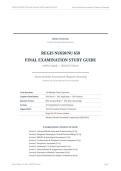
REGIS NU650/NU 650 Final Exam SG (100% Graded) 2026/2027 Advanced Health Assessment & Diagnostic Reasoning
REGIS COLLEGE
School of Nursing & Health Sciences
REGIS NU650/NU 650
FINAL EXAMINATION STUDY GUIDE
(100% Graded) — 2026/2027 Edition
Advanced Health Assessment & Diagnostic Reasoning
Graduate Nursing & Advanced Practice Education
Total Questions: 120 Multiple-Choice Questions
Cognitive Distribution: 20% Recall • 50% Application • 30% Analysis
Question Format: 80% Scenario-Based • 20% Direct Knowledge
Sections: 10 Comprehensive Content Domains
Aligned With: AACN Essentials of Master’s Education
Regis NU 650 Course Syllabus
Advanced Health Assessment Competencies (2026/2027)
EXAMINATION CONTENT OUTLINE
Section 1: Advanced Health Assessment & Interviewing (15 Q)
Section 2: Diagnostic Reasoning & Clinical Decision-Making (15 Q)
Section 3: HEENT & Neurological Assessment (15 Q)
Section 4: Cardiovascular & Peripheral Vascular Assessment (15 Q)
Section 5: Respiratory Assessment (12 Q)
Section 6: Abdominal, GI, & Renal Assessment (12 Q)
Section 7: Musculoskeletal & Integumentary Assessment (10 Q)
Section 8: Endocrine & Metabolic Assessment (10 Q)
Section 9: Special Populations & Lifespan Considerations (8 Q)
Regis College • NU 650 • 2026/2027 Edition Page 1
,REGIS NU650/NU 650 Final Exam SG (100% Graded) 2026/2027 Advanced Health Assessment & Diagnostic Reasoning
Section 10: Comprehensive Case Studies & Documentation (8 Q)
This study guide is designed for graduate nursing students preparing for the NU 650 Advanced Health Assessment &
Diagnostic Reasoning final examination. Each question includes a rationale grounded in current clinical guidelines
and Regis NU 650 curriculum standards.
Regis College • NU 650 • 2026/2027 Edition Page 2
,REGIS NU650/NU 650 Final Exam SG (100% Graded) 2026/2027 Advanced Health Assessment & Diagnostic Reasoning
Section 1: Advanced Health Assessment & Interviewing
Q1: A 62-year-old male presents to the clinic for an initial visit. The advanced practice nurse (APN) is
conducting a comprehensive health history. Which component of the history should the APN elicit
FIRST according to the patient-centered interviewing model described in the Regis NU 650
curriculum?
A. Review of systems (ROS) using a head-to-toe approach
B. Chief complaint (CC) in the patient's own words *[CORRECT]*
C. Past medical history (PMH) including hospitalizations and surgeries
D. Family history (FH) with a three-generation pedigree
Correct Answer: B
Rationale: In patient-centered interviewing, the chief complaint (CC), recorded in the patient's own words
and often quoted in quotation marks, is always elicited first after establishing rapport. The CC frames the
entire encounter and directs the subsequent History of Present Illness (HPI). ROS, PMH, and FH are
gathered after the CC and HPI are established to provide context, not at the opening of the interview.
Q2: A 45-year-old female reports chest pain for the past three days. The APN uses the OLDCARTS
mnemonic to structure the HPI. Which element of OLDCARTS addresses the patient's report that the
pain 'feels like an elephant sitting on my chest'?
A. O — Onset
B. L — Location
C. C — Character *[CORRECT]*
D. R — Radiation
Correct Answer: C
Rationale: The 'C' in OLDCARTS represents Character, which captures the descriptive quality of the
symptom in the patient's own words (e.g., 'crushing,' 'burning,' 'elephant on chest'). Onset refers to when the
symptom began, Location identifies where it is felt, and Radiation describes spread to other areas. Character
is essential for generating accurate differential diagnoses because descriptors like 'crushing' vs. 'sharp'
distinguish ischemic from pleuritic etiologies.
Q3: An APN is assessing a 78-year-old Vietnamese-American woman with limited English proficiency
who presents with abdominal discomfort. The patient's adult son offers to interpret. What is the
MOST appropriate action?
A. Accept the son's offer to expedite the visit and respect family hierarchy
B. Politely decline and use a trained medical interpreter via phone or video service *[CORRECT]*
C. Proceed with nonverbal assessment only until a family interpreter is available
D. Use a translation app on a smartphone to obtain the chief complaint
Correct Answer: B
Rationale: Federal law (Title VI of the Civil Rights Act, ACA Section 1557) requires healthcare organizations
receiving federal funding to provide qualified language assistance free of charge. Using a family member,
particularly a child or relative of a different gender, violates confidentiality, introduces bias, and risks
Regis College • NU 650 • 2026/2027 Edition Page 3
, REGIS NU650/NU 650 Final Exam SG (100% Graded) 2026/2027 Advanced Health Assessment & Diagnostic Reasoning
inaccurate translation of medical terminology. Trained medical interpreters ensure accuracy, cultural
mediation, and patient privacy. Translation apps are insufficient for clinical decision-making.
Q4: During a motivational interviewing (MI) session, a 52-year-old male with type 2 diabetes says, 'I
know I should check my blood sugar, but I just can't seem to remember.' Which response by the APN
BEST exemplifies the MI technique of reflective listening?
A. 'You really need to check your blood sugar at least twice a day for your health.'
B. 'It sounds like you understand the importance but are struggling to make it part of your routine.'
*[CORRECT]*
C. 'Why don't you try setting an alarm on your phone to remind you?'
D. 'Have you considered asking your wife to remind you each morning?'
Correct Answer: B
Rationale: Reflective listening in MI involves restating the patient's words to confirm understanding and
amplify their own motivation for change (change talk). Option B is a complex reflection that captures both the
patient's awareness ('understand the importance') and ambivalence ('struggling to make it part of your
routine'). The other options are directive ('you really need'), prescriptive ('try setting an alarm'), or
problem-solving ('ask your wife') — all inconsistent with the MI spirit of collaboration, evocation, and
autonomy.
Q5: An APN is documenting a telehealth visit using the SOAP format. The patient is a 35-year-old
female with a 3-day history of dysuria and urinary frequency. Which entry belongs in the Assessment
(A) section of the SOAP note?
A. Urine dipstick positive for leukocyte esterase and nitrites
B. Uncomplicated lower urinary tract infection (cystitis) *[CORRECT]*
C. Prescribed trimethoprim-sulfamethoxazole DS BID x 3 days
D. Patient reports dysuria rated 4/10 and urinary frequency q1h
Correct Answer: B
Rationale: The Assessment section of a SOAP note contains the APN's clinical reasoning, differential
diagnosis, and final diagnosis. Option B (uncomplicated cystitis) is the diagnostic conclusion. Options A and
D belong in Subjective/Objective (data). Option C belongs in the Plan. Proper SOAP organization supports
clear clinical reasoning and meets documentation standards required by CMS and accrediting bodies.
Q6: A patient presents with chronic low back pain. Using the PQRST mnemonic for pain assessment,
which statement corresponds to the 'Q' (Quality/Provokes) component?
A. Pain radiates from the lower back to the left lateral thigh
B. Pain is described as 'dull, aching, and burning' *[CORRECT]*
C. Pain is rated 7/10 at rest and 9/10 with movement
D. Pain began three weeks ago after lifting a heavy box
Correct Answer: B
Rationale: The 'Q' in PQRST stands for Quality (or Provoking/Palliating factors, depending on the variant).
Quality descriptors — such as 'dull, aching, burning, sharp, stabbing' — characterize the nature of the pain
and help differentiate neuropathic ('burning, shooting') from nociceptive ('aching, throbbing') mechanisms.
Radiation (R), Severity (S), and Timing (T) are distinct PQRST components captured separately.
Regis College • NU 650 • 2026/2027 Edition Page 4
REGIS COLLEGE
School of Nursing & Health Sciences
REGIS NU650/NU 650
FINAL EXAMINATION STUDY GUIDE
(100% Graded) — 2026/2027 Edition
Advanced Health Assessment & Diagnostic Reasoning
Graduate Nursing & Advanced Practice Education
Total Questions: 120 Multiple-Choice Questions
Cognitive Distribution: 20% Recall • 50% Application • 30% Analysis
Question Format: 80% Scenario-Based • 20% Direct Knowledge
Sections: 10 Comprehensive Content Domains
Aligned With: AACN Essentials of Master’s Education
Regis NU 650 Course Syllabus
Advanced Health Assessment Competencies (2026/2027)
EXAMINATION CONTENT OUTLINE
Section 1: Advanced Health Assessment & Interviewing (15 Q)
Section 2: Diagnostic Reasoning & Clinical Decision-Making (15 Q)
Section 3: HEENT & Neurological Assessment (15 Q)
Section 4: Cardiovascular & Peripheral Vascular Assessment (15 Q)
Section 5: Respiratory Assessment (12 Q)
Section 6: Abdominal, GI, & Renal Assessment (12 Q)
Section 7: Musculoskeletal & Integumentary Assessment (10 Q)
Section 8: Endocrine & Metabolic Assessment (10 Q)
Section 9: Special Populations & Lifespan Considerations (8 Q)
Regis College • NU 650 • 2026/2027 Edition Page 1
,REGIS NU650/NU 650 Final Exam SG (100% Graded) 2026/2027 Advanced Health Assessment & Diagnostic Reasoning
Section 10: Comprehensive Case Studies & Documentation (8 Q)
This study guide is designed for graduate nursing students preparing for the NU 650 Advanced Health Assessment &
Diagnostic Reasoning final examination. Each question includes a rationale grounded in current clinical guidelines
and Regis NU 650 curriculum standards.
Regis College • NU 650 • 2026/2027 Edition Page 2
,REGIS NU650/NU 650 Final Exam SG (100% Graded) 2026/2027 Advanced Health Assessment & Diagnostic Reasoning
Section 1: Advanced Health Assessment & Interviewing
Q1: A 62-year-old male presents to the clinic for an initial visit. The advanced practice nurse (APN) is
conducting a comprehensive health history. Which component of the history should the APN elicit
FIRST according to the patient-centered interviewing model described in the Regis NU 650
curriculum?
A. Review of systems (ROS) using a head-to-toe approach
B. Chief complaint (CC) in the patient's own words *[CORRECT]*
C. Past medical history (PMH) including hospitalizations and surgeries
D. Family history (FH) with a three-generation pedigree
Correct Answer: B
Rationale: In patient-centered interviewing, the chief complaint (CC), recorded in the patient's own words
and often quoted in quotation marks, is always elicited first after establishing rapport. The CC frames the
entire encounter and directs the subsequent History of Present Illness (HPI). ROS, PMH, and FH are
gathered after the CC and HPI are established to provide context, not at the opening of the interview.
Q2: A 45-year-old female reports chest pain for the past three days. The APN uses the OLDCARTS
mnemonic to structure the HPI. Which element of OLDCARTS addresses the patient's report that the
pain 'feels like an elephant sitting on my chest'?
A. O — Onset
B. L — Location
C. C — Character *[CORRECT]*
D. R — Radiation
Correct Answer: C
Rationale: The 'C' in OLDCARTS represents Character, which captures the descriptive quality of the
symptom in the patient's own words (e.g., 'crushing,' 'burning,' 'elephant on chest'). Onset refers to when the
symptom began, Location identifies where it is felt, and Radiation describes spread to other areas. Character
is essential for generating accurate differential diagnoses because descriptors like 'crushing' vs. 'sharp'
distinguish ischemic from pleuritic etiologies.
Q3: An APN is assessing a 78-year-old Vietnamese-American woman with limited English proficiency
who presents with abdominal discomfort. The patient's adult son offers to interpret. What is the
MOST appropriate action?
A. Accept the son's offer to expedite the visit and respect family hierarchy
B. Politely decline and use a trained medical interpreter via phone or video service *[CORRECT]*
C. Proceed with nonverbal assessment only until a family interpreter is available
D. Use a translation app on a smartphone to obtain the chief complaint
Correct Answer: B
Rationale: Federal law (Title VI of the Civil Rights Act, ACA Section 1557) requires healthcare organizations
receiving federal funding to provide qualified language assistance free of charge. Using a family member,
particularly a child or relative of a different gender, violates confidentiality, introduces bias, and risks
Regis College • NU 650 • 2026/2027 Edition Page 3
, REGIS NU650/NU 650 Final Exam SG (100% Graded) 2026/2027 Advanced Health Assessment & Diagnostic Reasoning
inaccurate translation of medical terminology. Trained medical interpreters ensure accuracy, cultural
mediation, and patient privacy. Translation apps are insufficient for clinical decision-making.
Q4: During a motivational interviewing (MI) session, a 52-year-old male with type 2 diabetes says, 'I
know I should check my blood sugar, but I just can't seem to remember.' Which response by the APN
BEST exemplifies the MI technique of reflective listening?
A. 'You really need to check your blood sugar at least twice a day for your health.'
B. 'It sounds like you understand the importance but are struggling to make it part of your routine.'
*[CORRECT]*
C. 'Why don't you try setting an alarm on your phone to remind you?'
D. 'Have you considered asking your wife to remind you each morning?'
Correct Answer: B
Rationale: Reflective listening in MI involves restating the patient's words to confirm understanding and
amplify their own motivation for change (change talk). Option B is a complex reflection that captures both the
patient's awareness ('understand the importance') and ambivalence ('struggling to make it part of your
routine'). The other options are directive ('you really need'), prescriptive ('try setting an alarm'), or
problem-solving ('ask your wife') — all inconsistent with the MI spirit of collaboration, evocation, and
autonomy.
Q5: An APN is documenting a telehealth visit using the SOAP format. The patient is a 35-year-old
female with a 3-day history of dysuria and urinary frequency. Which entry belongs in the Assessment
(A) section of the SOAP note?
A. Urine dipstick positive for leukocyte esterase and nitrites
B. Uncomplicated lower urinary tract infection (cystitis) *[CORRECT]*
C. Prescribed trimethoprim-sulfamethoxazole DS BID x 3 days
D. Patient reports dysuria rated 4/10 and urinary frequency q1h
Correct Answer: B
Rationale: The Assessment section of a SOAP note contains the APN's clinical reasoning, differential
diagnosis, and final diagnosis. Option B (uncomplicated cystitis) is the diagnostic conclusion. Options A and
D belong in Subjective/Objective (data). Option C belongs in the Plan. Proper SOAP organization supports
clear clinical reasoning and meets documentation standards required by CMS and accrediting bodies.
Q6: A patient presents with chronic low back pain. Using the PQRST mnemonic for pain assessment,
which statement corresponds to the 'Q' (Quality/Provokes) component?
A. Pain radiates from the lower back to the left lateral thigh
B. Pain is described as 'dull, aching, and burning' *[CORRECT]*
C. Pain is rated 7/10 at rest and 9/10 with movement
D. Pain began three weeks ago after lifting a heavy box
Correct Answer: B
Rationale: The 'Q' in PQRST stands for Quality (or Provoking/Palliating factors, depending on the variant).
Quality descriptors — such as 'dull, aching, burning, sharp, stabbing' — characterize the nature of the pain
and help differentiate neuropathic ('burning, shooting') from nociceptive ('aching, throbbing') mechanisms.
Radiation (R), Severity (S), and Timing (T) are distinct PQRST components captured separately.
Regis College • NU 650 • 2026/2027 Edition Page 4


