
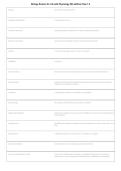
Biology Science for Life with Physiology (6th edition) Chps 1-5
biology the study of living organisms
testable and falsifiable a hypothesis must be....
inductive reasoning combining specific observations to make a general statement
deductive reasoning using a general principle to predict an expected observation
science a body of knowledge, using it to test and explore
modifiable science is...
truth in science what we know and understand based on all currently available information
model systems used by scientists when testing hypotheses that would raise ethical or practical
problems when tested on people
correlation a relationship between two variables, not causation
epidemiology the study of the distribution and causes of disease
statistically significant result that is unlikely to be due to chance differences between the experimental and
control groups
sampling error the difference between a sample and the population from which it was drawn, 5% or
less
standard error a statistical measure of the amount of variability in a sample
anecdotal evidence advice based on one individual's personal experience
common characteristics of life common set of biological molecules, composed of cells, growth, movement,
reproduction, evolve, response to external stimuli, metabolism, homeostasis
, Biology Science for Life with Physiology (6th edition) Chps 1-5
elements fundamental forms of matter, composed of atoms that cannot be broken down by
normal physical means
atoms smallest units of matter; composed of protons, neutrons, and electrons
nucleus protons and neutrons form the..... of an atom
ions electrically charged atoms that have gained or lost electrons.
neutral atom an atom with the same number of protons and electrons
solute a substance that dissolves when mixed with another substance
solvent liquid a solute dissolves in
solution when a solute is dissolved in a solvent
polar molecule different regions/poles of the molecule have different charges
electronegative more attractive to electrons
nonpolar molecule atoms of a molecule carry no partial charge
hydrogen bond weak chemical bond that forms when a partially positive hydrogen atom is attracted
to a partially negative atom
hydrophilic polar molecules; able to dissolve in water; "water-loving"
hydrophobic don't easily mix with water; "water fearing"
chemical reactions changes in chemical composition of substances
biology the study of living organisms
testable and falsifiable a hypothesis must be....
inductive reasoning combining specific observations to make a general statement
deductive reasoning using a general principle to predict an expected observation
science a body of knowledge, using it to test and explore
modifiable science is...
truth in science what we know and understand based on all currently available information
model systems used by scientists when testing hypotheses that would raise ethical or practical
problems when tested on people
correlation a relationship between two variables, not causation
epidemiology the study of the distribution and causes of disease
statistically significant result that is unlikely to be due to chance differences between the experimental and
control groups
sampling error the difference between a sample and the population from which it was drawn, 5% or
less
standard error a statistical measure of the amount of variability in a sample
anecdotal evidence advice based on one individual's personal experience
common characteristics of life common set of biological molecules, composed of cells, growth, movement,
reproduction, evolve, response to external stimuli, metabolism, homeostasis
, Biology Science for Life with Physiology (6th edition) Chps 1-5
elements fundamental forms of matter, composed of atoms that cannot be broken down by
normal physical means
atoms smallest units of matter; composed of protons, neutrons, and electrons
nucleus protons and neutrons form the..... of an atom
ions electrically charged atoms that have gained or lost electrons.
neutral atom an atom with the same number of protons and electrons
solute a substance that dissolves when mixed with another substance
solvent liquid a solute dissolves in
solution when a solute is dissolved in a solvent
polar molecule different regions/poles of the molecule have different charges
electronegative more attractive to electrons
nonpolar molecule atoms of a molecule carry no partial charge
hydrogen bond weak chemical bond that forms when a partially positive hydrogen atom is attracted
to a partially negative atom
hydrophilic polar molecules; able to dissolve in water; "water-loving"
hydrophobic don't easily mix with water; "water fearing"
chemical reactions changes in chemical composition of substances


