

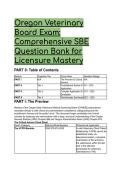
Oregon Veterinary
Board Exam:
Comprehensive SBE
Question Bank for
Licensure Mastery
PART 0: Table of Contents
Section Cognitive Tier Focus Area Question Range
PART I N/A The Preview & Critical N/A
Axioms
PART II Tier 1 Foundational Syntax & Q1 – Q10
Application
PART II Tier 2 Complex Application & Q11 – Q20
Simulation
PART II Tier 3 Grandmaster Synthesis Q21 – Q30
PART I: The Preview
Mastery of the Oregon State Veterinary Medical Examining Board (OVMEB) jurisprudence
translates directly to elite clinical and administrative competence, safeguarding both the
practitioner's license and the public's trust. This document forges candidates into A-level
scholars by replacing rote memorization with a deep, structural understanding of the Oregon
Revised Statutes (ORS) Chapter 686 and Oregon Administrative Rules (OAR) Chapter 875.
The Critical Axioms Cheat Sheet
Axiom Category Statutory/Rule Baseline Professional Application
The VCPR Mandate OAR 875-015-0035 A valid Veterinary Client Patient
Relationship (VCPR) cannot be
established solely via
telecommunication; a physical
examination of the animal by
the veterinarian within the last
year is the absolute
prerequisite for Veterinary
Telemedicine (VTM).
,Axiom Category Statutory/Rule Baseline Professional Application
Mandatory Reporting ORS 686.445 & 686.455 Veterinarians possess a strict
legal duty to report aggravated
animal abuse to law
enforcement (a Class A
violation if omitted), while
reporting standard neglect
remains voluntary but is
protected by civil immunity.
Record & Pharmacy Security OAR 875-015-0030 & 0040 Medical records must be
retained for a minimum of three
years, and dispensing records
for all prescription therapies
must be maintained separately
from the patient chart in a
locked, secure area.
Managing Veterinarian OAR 875-010-0031 Every veterinary facility must
designate an Oregon-licensed
Managing Veterinarian who
assumes responsibility for
minimum facility standards,
though they are strictly shielded
from vicarious liability for the
isolated malpractice of
associate veterinarians.
Delegation Architecture OAR 875-030-0040 Certified Veterinary Technicians
(CVTs) may operate under
indirect supervision for specific
duties only if a valid VCPR
exists, whereas student interns
and unlicensed personnel are
bound by strict direct
supervision parameters.
PART II: The Elite Test Bank
Tier 1: Foundational Syntax & Application
Q1: An Oregon-licensed veterinarian is contacted via a digital telehealth platform by a new
client residing in Portland. The client requests a prescription for a non-steroidal
anti-inflammatory drug (NSAID) for a dog exhibiting acute lameness. The veterinarian has never
physically examined this dog. Based on the principles of OAR 875-015-0035 (Veterinary
Telemedicine), which action is the MOST ACCURATE? A) The veterinarian may establish the
VCPR digitally and prescribe the medication, provided a high-definition video evaluation of the
lameness is recorded in the patient chart. B) The veterinarian may legally prescribe a maximum
of a 72-hour emergency supply of the NSAID without a physical examination to alleviate
immediate suffering. C) The veterinarian must refuse the prescription request because a VCPR
cannot be established via telemedicine without a prior physical examination of the animal within
, the last year. D) The veterinarian may delegate the initial physical examination to a Certified
Veterinary Technician (CVT) via telehealth to establish the VCPR on the clinic's behalf.
● Answer: C (The veterinarian must refuse the prescription request because a VCPR
cannot be established via telemedicine without a prior physical examination of the animal
within the last year.)
● Distractor Analysis:
○ A is incorrect: Novice practitioners frequently conflate relaxed human telemedicine
standards with veterinary regulations. OAR 875-015-0035 explicitly demands a
physical examination of the animal to establish a valid Veterinary Client Patient
Relationship (VCPR); high-definition video cannot substitute for tactile, physical
evaluation.
○ B is incorrect: There is no statutory "emergency 72-hour bypass" for prescribing
legend drugs or NSAIDs to a completely novel, unexamined patient without an
existing VCPR under normal Oregon administrative rules.
○ D is incorrect: A CVT lacks the statutory authority to establish a VCPR. The law
mandates that the licensed veterinarian must personally conduct the physical
examination.
The Mentor's Analysis: The core underlying principle dictates that the Veterinary Client Patient
Relationship is the legal bedrock of all diagnostics and prescribing in Oregon. When facing
requests from unexamined patients, the immediate priority is protecting the public by refusing
prescription authorization until an in-person physical baseline is established. By utilizing the
strict VCPR physical prerequisite, the practitioner bypasses the critical liability of remote
misdiagnosis. Professional/Academic Intuition: No physical exam within the last 365 days
equates to no VCPR, and no VCPR unequivocally eliminates prescribing authority.
Q2: A veterinary clinic is undergoing an internal audit of its pharmaceutical and medical
documentation. A recently hired practice manager is reviewing how long historical patient files
and drug logs must be kept on site before they can be legally destroyed. Based on the
principles of OAR 875-015-0030 and OAR 875-015-0040 (Minimum Veterinary Practice
Standards), which conclusion regarding record retention is the MOST ACCURATE? A) Patient
medical records must be retained for seven years, while drug dispensing records may be
destroyed after three years. B) Drug dispensing logs must be integrated directly into the
chronological patient medical chart and retained as a single document for a minimum of five
years. C) Patient medical records must be retained for three years, but controlled substance
logs must be submitted directly to the Oregon Board of Pharmacy annually. D) Both patient
medical charts and distinct, separate drug dispensing records must be retained by the facility for
a minimum of three years.
● Answer: D (Both patient medical charts and distinct, separate drug dispensing records
must be retained by the facility for a minimum of three years.)
● Distractor Analysis:
○ A is incorrect: Seven-year retention is a legacy standard derived from federal tax
codes and human medical billing, but it is technically inaccurate here. OAR
875-015-0030 explicitly designates a three-year minimum for veterinary medical
records.
○ B is incorrect: OAR 875-015-0040(8)(a) strictly mandates that dispensing records
for all drugs must be maintained separately from the patient chart to allow for rapid,
isolated pharmaceutical auditing.
○ C is incorrect: While records are kept for three years, controlled substance logs are
retained on-site for immediate inspection by the OVMEB or DEA; they are not
Board Exam:
Comprehensive SBE
Question Bank for
Licensure Mastery
PART 0: Table of Contents
Section Cognitive Tier Focus Area Question Range
PART I N/A The Preview & Critical N/A
Axioms
PART II Tier 1 Foundational Syntax & Q1 – Q10
Application
PART II Tier 2 Complex Application & Q11 – Q20
Simulation
PART II Tier 3 Grandmaster Synthesis Q21 – Q30
PART I: The Preview
Mastery of the Oregon State Veterinary Medical Examining Board (OVMEB) jurisprudence
translates directly to elite clinical and administrative competence, safeguarding both the
practitioner's license and the public's trust. This document forges candidates into A-level
scholars by replacing rote memorization with a deep, structural understanding of the Oregon
Revised Statutes (ORS) Chapter 686 and Oregon Administrative Rules (OAR) Chapter 875.
The Critical Axioms Cheat Sheet
Axiom Category Statutory/Rule Baseline Professional Application
The VCPR Mandate OAR 875-015-0035 A valid Veterinary Client Patient
Relationship (VCPR) cannot be
established solely via
telecommunication; a physical
examination of the animal by
the veterinarian within the last
year is the absolute
prerequisite for Veterinary
Telemedicine (VTM).
,Axiom Category Statutory/Rule Baseline Professional Application
Mandatory Reporting ORS 686.445 & 686.455 Veterinarians possess a strict
legal duty to report aggravated
animal abuse to law
enforcement (a Class A
violation if omitted), while
reporting standard neglect
remains voluntary but is
protected by civil immunity.
Record & Pharmacy Security OAR 875-015-0030 & 0040 Medical records must be
retained for a minimum of three
years, and dispensing records
for all prescription therapies
must be maintained separately
from the patient chart in a
locked, secure area.
Managing Veterinarian OAR 875-010-0031 Every veterinary facility must
designate an Oregon-licensed
Managing Veterinarian who
assumes responsibility for
minimum facility standards,
though they are strictly shielded
from vicarious liability for the
isolated malpractice of
associate veterinarians.
Delegation Architecture OAR 875-030-0040 Certified Veterinary Technicians
(CVTs) may operate under
indirect supervision for specific
duties only if a valid VCPR
exists, whereas student interns
and unlicensed personnel are
bound by strict direct
supervision parameters.
PART II: The Elite Test Bank
Tier 1: Foundational Syntax & Application
Q1: An Oregon-licensed veterinarian is contacted via a digital telehealth platform by a new
client residing in Portland. The client requests a prescription for a non-steroidal
anti-inflammatory drug (NSAID) for a dog exhibiting acute lameness. The veterinarian has never
physically examined this dog. Based on the principles of OAR 875-015-0035 (Veterinary
Telemedicine), which action is the MOST ACCURATE? A) The veterinarian may establish the
VCPR digitally and prescribe the medication, provided a high-definition video evaluation of the
lameness is recorded in the patient chart. B) The veterinarian may legally prescribe a maximum
of a 72-hour emergency supply of the NSAID without a physical examination to alleviate
immediate suffering. C) The veterinarian must refuse the prescription request because a VCPR
cannot be established via telemedicine without a prior physical examination of the animal within
, the last year. D) The veterinarian may delegate the initial physical examination to a Certified
Veterinary Technician (CVT) via telehealth to establish the VCPR on the clinic's behalf.
● Answer: C (The veterinarian must refuse the prescription request because a VCPR
cannot be established via telemedicine without a prior physical examination of the animal
within the last year.)
● Distractor Analysis:
○ A is incorrect: Novice practitioners frequently conflate relaxed human telemedicine
standards with veterinary regulations. OAR 875-015-0035 explicitly demands a
physical examination of the animal to establish a valid Veterinary Client Patient
Relationship (VCPR); high-definition video cannot substitute for tactile, physical
evaluation.
○ B is incorrect: There is no statutory "emergency 72-hour bypass" for prescribing
legend drugs or NSAIDs to a completely novel, unexamined patient without an
existing VCPR under normal Oregon administrative rules.
○ D is incorrect: A CVT lacks the statutory authority to establish a VCPR. The law
mandates that the licensed veterinarian must personally conduct the physical
examination.
The Mentor's Analysis: The core underlying principle dictates that the Veterinary Client Patient
Relationship is the legal bedrock of all diagnostics and prescribing in Oregon. When facing
requests from unexamined patients, the immediate priority is protecting the public by refusing
prescription authorization until an in-person physical baseline is established. By utilizing the
strict VCPR physical prerequisite, the practitioner bypasses the critical liability of remote
misdiagnosis. Professional/Academic Intuition: No physical exam within the last 365 days
equates to no VCPR, and no VCPR unequivocally eliminates prescribing authority.
Q2: A veterinary clinic is undergoing an internal audit of its pharmaceutical and medical
documentation. A recently hired practice manager is reviewing how long historical patient files
and drug logs must be kept on site before they can be legally destroyed. Based on the
principles of OAR 875-015-0030 and OAR 875-015-0040 (Minimum Veterinary Practice
Standards), which conclusion regarding record retention is the MOST ACCURATE? A) Patient
medical records must be retained for seven years, while drug dispensing records may be
destroyed after three years. B) Drug dispensing logs must be integrated directly into the
chronological patient medical chart and retained as a single document for a minimum of five
years. C) Patient medical records must be retained for three years, but controlled substance
logs must be submitted directly to the Oregon Board of Pharmacy annually. D) Both patient
medical charts and distinct, separate drug dispensing records must be retained by the facility for
a minimum of three years.
● Answer: D (Both patient medical charts and distinct, separate drug dispensing records
must be retained by the facility for a minimum of three years.)
● Distractor Analysis:
○ A is incorrect: Seven-year retention is a legacy standard derived from federal tax
codes and human medical billing, but it is technically inaccurate here. OAR
875-015-0030 explicitly designates a three-year minimum for veterinary medical
records.
○ B is incorrect: OAR 875-015-0040(8)(a) strictly mandates that dispensing records
for all drugs must be maintained separately from the patient chart to allow for rapid,
isolated pharmaceutical auditing.
○ C is incorrect: While records are kept for three years, controlled substance logs are
retained on-site for immediate inspection by the OVMEB or DEA; they are not


