

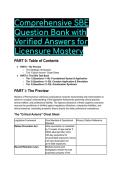
Comprehensive SBE
Question Bank with
Verified Answers for
Licensure Mastery
PART 0: Table of Contents
● PART I: The Preview
○ The Strategic Introduction
○ The "Critical Axioms" Cheat Sheet
● PART II: The Elite Test Bank
○ Tier 1 (Questions 1–10): Foundational Syntax & Application
○ Tier 2 (Questions 11–20): Complex Application & Simulation
○ Tier 3 (Questions 21–30): Grandmaster Synthesis
PART I: The Preview
Mastery of Pennsylvania veterinary jurisprudence requires transcending rote memorization to
achieve a surgical understanding of the legislative frameworks governing clinical practice,
animal welfare, and professional liability. The rigorous dissection of these cognitive scenarios
ensures the practitioner is fortified against regulatory infractions, malpractice liabilities, and
ethical breaches, translating academic theory directly into elite professional competence.
The "Critical Axioms" Cheat Sheet
Legislative Framework Core Mandate & Operational Primary Citation Reference
Standard
Rabies Prevention Act Initial vaccination is mandated
by 12 weeks of age (earlier if
USDA label permits); strict
120-day quarantine for
unvaccinated exposures versus
a 45-day observation for
up-to-date exposures.
Record Retention Laws Medical records and
radiographs remain the sole
proprietary property of the
,Legislative Framework Core Mandate & Operational Primary Citation Reference
Standard
veterinary facility and must be
retained for an absolute
minimum of three years
post-treatment.
Scope of Practice Unlicensed assistants may
induce anesthesia only under
immediate supervision;
Certified Veterinary Technicians
(CVTs) may perform the same
under direct supervision.
Libre's Law (Act 10) Grants absolute civil immunity
to veterinary professionals
reporting suspected animal
cruelty in good faith; strictly
limits extreme weather
tethering to 30 minutes.
Corporate Practice (CPOM) Unlicensed entities (e.g.,
private equity MSOs) may own
physical/administrative assets,
but licensed veterinarians must
absolutely own clinical records
and employ medical staff.
PART II: The Elite Test Bank
Tier 1: Foundational Syntax & Application
Q1: A client presents a 10-week-old canine for a routine wellness examination and requests a
rabies vaccination prior to crossing state lines. Based on the principles of the Pennsylvania
Rabies Prevention and Control in Domestic Animals and Wildlife Act, which action is the MOST
ACCURATE? A) Administer the vaccine immediately to ensure the animal is protected prior to
interstate travel, as travel exemptions supersede state age minimums. B) Decline the
vaccination, as the statute strictly requires the animal to reach 16 weeks of age prior to
inoculation under all circumstances. C) Administer the vaccine, provided the manufacturer's
label permits use at 10 weeks, acknowledging the statutory mandate requires vaccination by 12
weeks of age. D) Administer the vaccine but mandate a booster within 28 days to comply with
early-administration off-label protocols.
● Answer: C (Administer the vaccine, provided the manufacturer's label permits use at 10
weeks, acknowledging the statutory mandate requires vaccination by 12 weeks of age.)
● Distractor Analysis:
○ A is incorrect: The novice assumption that interstate travel supersedes state public
health mandates is a fundamental error in regulatory hierarchy; administration is
governed by the vaccine label, not the client's itinerary.
○ B is incorrect: Relying on outdated legacy assumptions of a 16-week absolute floor
ignores the explicit statutory language of Pennsylvania law, which mandates
vaccination by 12 weeks of age and permits earlier use if USDA-licensed vaccine
, instructions allow.
○ D is incorrect: There is no statutory requirement for a 28-day booster based solely
on early administration; the legal requirement remains a booster one year after the
initial dose.
The Mentor's Analysis: Statutory compliance requires a precise alignment between state
mandates and biological product labeling. When facing early vaccination requests, the
immediate priority is verifying the USDA manufacturer label. By utilizing manufacturer
guidelines, you bypass the common trap of rigid age-limit misconceptions.
Professional/Academic Intuition: Rabies vaccinations are legally mandated by 12 weeks
of age in Pennsylvania, but earlier administration is strictly governed by the biological
manufacturer's approved labeling.
Q2: A practitioner suspects a severe case of intentional starvation and physical trauma in a
feline patient. The practitioner fears retaliatory litigation from the well-connected client if law
enforcement is notified. Based on the principles of Act 10 of 2017 (Libre's Law), which
conclusion is the MOST ACCURATE? A) The practitioner is completely shielded from civil
liability when reporting suspected animal cruelty in good faith. B) The practitioner must first
obtain a second opinion from another licensed veterinarian before statutory immunity applies. C)
The practitioner is immune from civil liability only if the client is successfully convicted of a felony
cruelty charge. D) The practitioner holds no statutory immunity and must rely exclusively on the
clinic's malpractice insurance for legal defense.
● Answer: A (The practitioner is completely shielded from civil liability when reporting
suspected animal cruelty in good faith.)
● Distractor Analysis:
○ B is incorrect: Libre's Law does not require a secondary confirmation or peer review
prior to reporting; injecting bureaucratic delays contradicts the spirit of emergency
intervention.
○ C is incorrect: Civil immunity is predicated entirely on the "good faith" reporting of
the suspicion at the time of the incident, not on the ultimate judicial outcome or
successful conviction of the perpetrator.
○ D is incorrect: Act 10 specifically enacted civil immunity for veterinary professionals
reporting cruelty, eliminating this exact legacy fear that historically paralyzed clinical
intervention.
The Mentor's Analysis: The legislative intent of Libre's Law is to remove all legal barriers to the
immediate reporting of animal abuse. When facing suspected cruelty, the immediate priority is
protecting the animal and notifying authorities. By utilizing statutory civil immunity, you bypass
the common trap of clinical hesitation driven by fear of retaliatory litigation.
Professional/Academic Intuition: Act 10 of 2017 grants absolute civil immunity to
veterinary professionals reporting suspected animal abuse in good faith, prioritizing
animal welfare over the threat of civil suits.
Q3: A client terminates their relationship with a veterinary clinic and demands the immediate
surrender of their dog's original medical records and radiographs. Based on the principles of 49
Pa. Code § 31.22, which action is the MOST ACCURATE? A) Relinquish the original records
and radiographs to the client immediately to avoid a Board complaint regarding continuity of
care. B) Relinquish the written medical records but retain the original radiographs as proprietary
imaging data. C) Retain the original records and radiographs, as they are the sole property of
the veterinary facility, and provide copies upon the written request of the subsequent
veterinarian. D) Destroy the records immediately to legally sever the Veterinarian-Client-Patient
Relationship (VCPR) and protect patient confidentiality.
Question Bank with
Verified Answers for
Licensure Mastery
PART 0: Table of Contents
● PART I: The Preview
○ The Strategic Introduction
○ The "Critical Axioms" Cheat Sheet
● PART II: The Elite Test Bank
○ Tier 1 (Questions 1–10): Foundational Syntax & Application
○ Tier 2 (Questions 11–20): Complex Application & Simulation
○ Tier 3 (Questions 21–30): Grandmaster Synthesis
PART I: The Preview
Mastery of Pennsylvania veterinary jurisprudence requires transcending rote memorization to
achieve a surgical understanding of the legislative frameworks governing clinical practice,
animal welfare, and professional liability. The rigorous dissection of these cognitive scenarios
ensures the practitioner is fortified against regulatory infractions, malpractice liabilities, and
ethical breaches, translating academic theory directly into elite professional competence.
The "Critical Axioms" Cheat Sheet
Legislative Framework Core Mandate & Operational Primary Citation Reference
Standard
Rabies Prevention Act Initial vaccination is mandated
by 12 weeks of age (earlier if
USDA label permits); strict
120-day quarantine for
unvaccinated exposures versus
a 45-day observation for
up-to-date exposures.
Record Retention Laws Medical records and
radiographs remain the sole
proprietary property of the
,Legislative Framework Core Mandate & Operational Primary Citation Reference
Standard
veterinary facility and must be
retained for an absolute
minimum of three years
post-treatment.
Scope of Practice Unlicensed assistants may
induce anesthesia only under
immediate supervision;
Certified Veterinary Technicians
(CVTs) may perform the same
under direct supervision.
Libre's Law (Act 10) Grants absolute civil immunity
to veterinary professionals
reporting suspected animal
cruelty in good faith; strictly
limits extreme weather
tethering to 30 minutes.
Corporate Practice (CPOM) Unlicensed entities (e.g.,
private equity MSOs) may own
physical/administrative assets,
but licensed veterinarians must
absolutely own clinical records
and employ medical staff.
PART II: The Elite Test Bank
Tier 1: Foundational Syntax & Application
Q1: A client presents a 10-week-old canine for a routine wellness examination and requests a
rabies vaccination prior to crossing state lines. Based on the principles of the Pennsylvania
Rabies Prevention and Control in Domestic Animals and Wildlife Act, which action is the MOST
ACCURATE? A) Administer the vaccine immediately to ensure the animal is protected prior to
interstate travel, as travel exemptions supersede state age minimums. B) Decline the
vaccination, as the statute strictly requires the animal to reach 16 weeks of age prior to
inoculation under all circumstances. C) Administer the vaccine, provided the manufacturer's
label permits use at 10 weeks, acknowledging the statutory mandate requires vaccination by 12
weeks of age. D) Administer the vaccine but mandate a booster within 28 days to comply with
early-administration off-label protocols.
● Answer: C (Administer the vaccine, provided the manufacturer's label permits use at 10
weeks, acknowledging the statutory mandate requires vaccination by 12 weeks of age.)
● Distractor Analysis:
○ A is incorrect: The novice assumption that interstate travel supersedes state public
health mandates is a fundamental error in regulatory hierarchy; administration is
governed by the vaccine label, not the client's itinerary.
○ B is incorrect: Relying on outdated legacy assumptions of a 16-week absolute floor
ignores the explicit statutory language of Pennsylvania law, which mandates
vaccination by 12 weeks of age and permits earlier use if USDA-licensed vaccine
, instructions allow.
○ D is incorrect: There is no statutory requirement for a 28-day booster based solely
on early administration; the legal requirement remains a booster one year after the
initial dose.
The Mentor's Analysis: Statutory compliance requires a precise alignment between state
mandates and biological product labeling. When facing early vaccination requests, the
immediate priority is verifying the USDA manufacturer label. By utilizing manufacturer
guidelines, you bypass the common trap of rigid age-limit misconceptions.
Professional/Academic Intuition: Rabies vaccinations are legally mandated by 12 weeks
of age in Pennsylvania, but earlier administration is strictly governed by the biological
manufacturer's approved labeling.
Q2: A practitioner suspects a severe case of intentional starvation and physical trauma in a
feline patient. The practitioner fears retaliatory litigation from the well-connected client if law
enforcement is notified. Based on the principles of Act 10 of 2017 (Libre's Law), which
conclusion is the MOST ACCURATE? A) The practitioner is completely shielded from civil
liability when reporting suspected animal cruelty in good faith. B) The practitioner must first
obtain a second opinion from another licensed veterinarian before statutory immunity applies. C)
The practitioner is immune from civil liability only if the client is successfully convicted of a felony
cruelty charge. D) The practitioner holds no statutory immunity and must rely exclusively on the
clinic's malpractice insurance for legal defense.
● Answer: A (The practitioner is completely shielded from civil liability when reporting
suspected animal cruelty in good faith.)
● Distractor Analysis:
○ B is incorrect: Libre's Law does not require a secondary confirmation or peer review
prior to reporting; injecting bureaucratic delays contradicts the spirit of emergency
intervention.
○ C is incorrect: Civil immunity is predicated entirely on the "good faith" reporting of
the suspicion at the time of the incident, not on the ultimate judicial outcome or
successful conviction of the perpetrator.
○ D is incorrect: Act 10 specifically enacted civil immunity for veterinary professionals
reporting cruelty, eliminating this exact legacy fear that historically paralyzed clinical
intervention.
The Mentor's Analysis: The legislative intent of Libre's Law is to remove all legal barriers to the
immediate reporting of animal abuse. When facing suspected cruelty, the immediate priority is
protecting the animal and notifying authorities. By utilizing statutory civil immunity, you bypass
the common trap of clinical hesitation driven by fear of retaliatory litigation.
Professional/Academic Intuition: Act 10 of 2017 grants absolute civil immunity to
veterinary professionals reporting suspected animal abuse in good faith, prioritizing
animal welfare over the threat of civil suits.
Q3: A client terminates their relationship with a veterinary clinic and demands the immediate
surrender of their dog's original medical records and radiographs. Based on the principles of 49
Pa. Code § 31.22, which action is the MOST ACCURATE? A) Relinquish the original records
and radiographs to the client immediately to avoid a Board complaint regarding continuity of
care. B) Relinquish the written medical records but retain the original radiographs as proprietary
imaging data. C) Retain the original records and radiographs, as they are the sole property of
the veterinary facility, and provide copies upon the written request of the subsequent
veterinarian. D) Destroy the records immediately to legally sever the Veterinarian-Client-Patient
Relationship (VCPR) and protect patient confidentiality.


