This BIO 253 Exam 3 2026/2027 study resource contains 20 main question-and-answer entries focused on the nervous system, neuron physiology, neuroglia, neurotransmitters, and clinical assessment of the cranial nerves. The material begins by distinguishing the central nervous system (brain and spinal cord) from the peripheral nervous system (cranial and spinal nerves). It reviews astrocytes, ependymal cells, neurotransmitter-receptor interactions, depolarization and repolarization, and the characteristics of unipolar, bipolar, and multipolar neurons.
A major part of the document concentrates on the 12 cranial nerves and their sensory, motor, or mixed functions. Students review the sensory cranial nerves—olfactory (I), optic (II), and vestibulocochlear (VIII); motor cranial nerves including oculomotor (III), trochlear (IV), abducens (VI), accessory (XI), and hypoglossal (XII); and mixed nerves including trigeminal (V), facial (VII), glossopharyngeal (IX), and vagus (X). The material also highlights the vagus nerve in relation to respiratory, cardiac, and digestive functions.
The resource additionally emphasizes cranial nerve assessment and neurological examination techniques. It describes testing smell for CN I, visual acuity for CN II, eye movements and pupillary responses for CN III, IV, and VI, facial sensation and muscles of mastication for CN V, facial movement and taste for CN VII, hearing and balance for CN VIII, oral and pharyngeal responses for CN IX and X, shoulder movement for CN XI, and tongue movement for CN XII. This clinical emphasis makes the material particularly useful for students who need to connect nervous-system anatomy with practical neurological assessment.
Relevant students: This document is relevant to BIO 253 students and students taking comparable anatomy, physiology, neuroscience, nursing, pre-nursing, allied health, medical assisting, or health-science courses that cover the nervous system and cranial nerve assessment. The uploaded document does not provide a university or institution name, so a specific university cannot be accurately added to the title from the available source.
Academic reference: The subject matter corresponds to standard undergraduate anatomy and physiology coverage of nervous tissue, membrane potentials, neuroglia, the peripheral nervous system, and cranial nerves. Appropriate supplementary references include Human Anatomy & Physiology by Elaine N. Marieb and Katja Hoehn and Anatomy & Physiology by OpenStax. These are supporting academic references rather than sources explicitly cited by the uploaded document.
Keywords: BIO 253 Exam 3, BIO 253 questions and answers, BIO , nervous system exam, nervous system questions and answers, central nervous system, peripheral nervous system, cranial nerves, cranial nerve assessment, neurological assessment, sensory cranial nerves, motor cranial nerves, mixed cranial nerves, olfactory nerve, optic nerve, oculomotor nerve, trochlear nerve, trigeminal nerve, abducens nerve, facial nerve, vestibulocochlear nerve, glossopharyngeal nerve, vagus nerve, accessory nerve, hypoglossal nerve, astrocytes, ependymal cells, neurotransmitters, depolarization, repolarization, unipolar neurons, bipolar neurons, multipolar neurons, nursing neurological assessment, anatomy and physiology Exam 3, nervous system study guide
Content preview
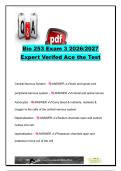
Bio 253 Exam 3 2026/2027
Expert Verifed Ace the Test
Central Nurvous System - ANSWER ✔✔brain and spinal cord
peripheral nervous system - ANSWER ✔✔cranial and spinal nerves
Astrocytes - ANSWER ✔✔Carry blood & nutrients, nutrients &
oxygen to the cells of the central nervous system
Deploralization - ANSWER ✔✔Sodium channels open and sodium
rushes into cell
reploralization - ANSWER ✔✔Potassium channels open and
potassium move out of the cell