
• Wrong document? Swap it for free
  • Written by students who passed
  • Immediately available after payment
  • Read online or as PDF
Sell
Where do you study
Your language
Document preview thumbnail
Preview 3 out of 18 pages
Exam (elaborations)

ATI PEDS Proctored Exam 2025/2026 | 75 Complete Questions & Answers | Pediatrics ATI Test | Summer Updated Study Guide.

Document preview thumbnail
Preview 3 out of 18 pages

ATI Proctored Pediatrics (PEDS) Exam | 75 Complete Questions & Answers | Updated Summer 2025/2026 | ATI Nursing Exam Prep Below are the **questions and multiple-choice options only** from the uploaded **Peds ATI 2026 Updated Practice Review**. I removed all correct-answer markings and rationales. The document title says **75 questions**, but the numbered content available in the PDF runs from **Question 1 through Question 74**, so I have not invented a missing Question 75. ### 1. A nurse is completing an admission assessment on an adolescent who follows a lacto-vegetarian diet. The adolescent consumes milk products but does not like beans. Which lunch item should the nurse suggest to provide nutrients most likely to be lacking in the adolescent's diet? A. Grilled cheese sandwich with applesauce B. Peanut butter and jelly sandwich on enriched whole-grain bread C. Garden salad with fat-free dressing D. Fresh fruit cup with gelatin ### 2. A nurse is caring for a 1-month-old infant who weighs 3,540 g and is prescribed cefazolin 50 mg/kg IV per dose three times daily. How many milligrams should the nurse administer per dose? A. 118 mg B. 150 mg C. 177 mg D. 354 mg ### 3. A nurse is performing a pre-college health assessment on an adolescent whose routine childhood immunizations are up to date. Which immunization should the nurse anticipate verifying or administering during later adolescence? A. Rotavirus vaccine B. Haemophilus influenzae type b vaccine C. DTaP vaccine D. Meningococcal ACWY vaccine ### 4. A nurse is assessing a client who has left-sided heart failure. Which finding should the nurse expect? A. Dependent peripheral edema B. Bibasilar crackles C. Jugular venous distention D. Hepatomegaly ### 5. A nurse is caring for a client with active tuberculosis who is beginning rifampin therapy. Which expected medication effect should the nurse include in teaching? A. Red-orange discoloration of body secretions B. Permanent blue-gray skin pigmentation C. Severe hypoglycemia after each dose D. Gingival overgrowth ### 6. A nurse is caring for a 6-week-old infant who has pyloric stenosis. Which manifestation should the nurse expect? A. Projectile nonbilious vomiting B. Currant-jelly stools C. Bilious diarrhea D. Generalized edema ### 7. A parent calls the nurse because a child with von Willebrand disease has a nosebleed. Which instruction should the nurse provide? A. Have the child lie flat and tilt the head back B. Insert tissue deeply into the nostril and have the child blow the nose C. Have the child sit upright, lean forward, and pinch the soft part of the nose for 10 to 15 minutes D. Apply a warm compress over the bridge of the nose ### 8. A nurse is assessing a child who is experiencing a sickle cell vaso-occlusive crisis. Which finding should the nurse expect? A. Severe bone or joint pain B. Painless generalized edema C. Bradycardia with hypertension D. Profuse watery diarrhea ### 9. A nurse is providing preoperative teaching about diaphragmatic breathing. Which action should the nurse include in the demonstration? A. Take rapid shallow breaths through the mouth B. Place the hands over the lower rib cage or upper abdomen and inhale slowly so the abdomen rises C. Raise the shoulders during each inspiration D. Exhale forcefully before every inhalation ### 10. A nurse is assessing a 3-year-old child who has aortic stenosis. Which findings are consistent with this condition? **Select all that apply.** A. Systolic ejection murmur B. Exertional chest pain C. Dizziness or syncope with exertion D. Bounding peripheral pulses ### 11. A nurse is planning care for a client who has immune thrombocytopenia (ITP). Which manifestation is most important for the nurse to monitor? A. Petechiae, ecchymoses, and mucosal bleeding B. Polyuria and polydipsia C. Expiratory wheezing D. Dependent edema ### 12. A nurse is teaching the parent of a child with Hirschsprung disease who is scheduled for the initial surgical procedure. Which statement by the parent indicates understanding? A. “My child will never need another procedure after the colostomy.” B. “The ostomy is usually temporary until the definitive pull-through surgery is completed.” C. “The surgery will eliminate the need to monitor bowel function.” D. “The ostomy is expected to remain permanent in every child with Hirschsprung disease.” ### 13. A school nurse teaches the parents of a child with pediculosis capitis. Which statement by the parents indicates understanding? A. “We will wash recently used clothing, bedding, and towels in hot water and dry them on high heat.” B. “Family members should share combs so we can identify who else is affected.” C. “Only the child needs to be checked; close contacts do not need assessment.” D. “We should spray the entire home with insecticide.” ### 14. A nurse is providing dietary teaching to the parents of a breastfed infant. At what age can the infant generally transition to whole cow's milk as the primary milk beverage? A. 6 months B. 9 months C. 12 months D. 18 months ### 15. A nurse is assessing a 6-month-old infant at a well-child visit. Which finding is expected? A. Persistent Moro reflex B. Closed posterior fontanel C. Complete absence of head control D. Inability to roll in either direction ### 16. A nurse is preparing to administer phenytoin oral suspension to a 2-year-old child. Which action should the nurse take before each dose? A. Shake the suspension thoroughly B. Mix the dose with an antacid C. Dilute the medication in a full bottle of formula D. Withhold oral hygiene for several hours ### 17. A nurse is planning care for a client with a T4 spinal cord injury who is at risk for urinary tract infection. Which action should the nurse include? A. Restrict fluids to 1,000 mL/day B. Encourage adequate fluid intake at and between meals unless contraindicated C. Administer prophylactic antibiotics indefinitely D. Limit bladder emptying to twice daily ### 18. A nurse is planning care for a child with suspected epiglottitis. Which action should the nurse take? A. Use a tongue depressor to inspect the throat B. Place the child supine and encourage oral fluids C. Keep the child upright and calm while preparing for airway support D. Obtain a throat culture before assessing airway status ### 19. A nurse is teaching clients about calcium-rich foods. Which item is the best source of calcium? A. 1 cup of milk B. 1 medium apple C. 1 cup of white rice D. 1 cup of chicken broth ### 20. A nurse is caring for an 8-month-old infant who cries when the parent leaves the room. Which response should the nurse make to the parent? A. “This behavior suggests a developmental delay.” B. “This is a normal example of separation anxiety for an infant of this age.” C. “This usually indicates pain or illness.” D. “This occurs only when parenting routines are inconsistent.” ### 21. A nurse is caring for a 4-year-old child who is resistant to taking oral medication. Which strategy is most appropriate? A. Force the child to take the medication immediately B. Threaten an injection if the child refuses C. Offer a limited choice, such as taking the medication with juice or water D. Hide the medication in an entire meal without telling the caregiver ### 22. A nurse enters the room of a client who requires droplet precautions to set up a meal tray. Which personal protective equipment is required? A. Fit-tested N95 respirator B. Surgical or procedure mask C. Sterile gown only D. Protective goggles only ### 23. A nurse teaches a client how to use an albuterol metered-dose inhaler. Which action by the client indicates understanding? A. Exhales immediately after pressing the inhaler B. Holds the breath for about 10 seconds after inhaling the medication C. Takes several rapid puffs without pausing D. Inhales through the nose while actuating the inhaler ### 24. A nurse is caring for a 2-month-old infant following surgical repair of a cleft lip. Which action should the nurse take? A. Place the infant prone after feeding B. Use elbow restraints as prescribed and protect the suture line C. Offer a pacifier frequently to soothe the infant D. Perform vigorous oral suctioning after each feeding ### 25. A nurse is caring for a child who has Kawasaki disease. Which body system requires the most focused monitoring for complications? A. Endocrine B. Renal C. Cardiovascular D. Gastrointestinal ### 26. A nurse is teaching a client who has oral candidiasis and a prescription for nystatin oral suspension. Which statement indicates understanding? A. “I will swallow the medicine immediately and then rinse my mouth with water.” B. “I will keep the medicine in contact with the affected areas as long as possible before swallowing and avoid eating or drinking for a short period afterward.” C. “I will stop the medication as soon as the white patches disappear.” D. “I should freeze the medicine between doses.” ### 27. A nurse is assessing the foot of a client with diabetes mellitus who reports foot pain. Which findings can indicate infection? **Select all that apply.** A. Localized warmth and erythema B. Purulent drainage C. Localized swelling D. Cool, dry, intact skin without tenderness ### 28. A nurse is removing personal protective equipment after providing direct care to a client in isolation. Which item should generally be removed first? A. Gown B. Mask C. Face shield D. Gloves ### 29. A nurse is assessing a client who is receiving packed red blood cells. Which finding is characteristic of an acute hemolytic transfusion reaction? A. Low back or flank pain B. Mild drowsiness C. Increased appetite D. Painless constipation ### 30. A nurse teaches a group about emergency first aid for a suspected venomous snakebite. Which instruction is appropriate? A. Apply a tight tourniquet proximal to the bite B. Apply ice directly to the bite C. Keep the person calm, immobilize the affected extremity at about heart level or lower, and seek emergency care D. Cut the bite and attempt to suction out the venom ### 31. A nurse is assessing a client who has right ventricular failure. Which finding should the nurse expect? A. Fine inspiratory crackles only B. Pink frothy sputum C. Hepatomegaly D. Isolated orthopnea without edema ### 32. A nurse is planning care for a 6-year-old child with bacterial meningitis. Which intervention is unnecessary for routine monitoring? A. Measuring head circumference every shift B. Monitoring neurologic status C. Maintaining appropriate transmission-based precautions D. Monitoring for seizures and changes in level of consciousness ### 33. A nurse is caring for a preschool child with suspected epiglottitis. Which action is a priority? A. Encourage the child to cough forcefully B. Inspect the posterior pharynx with a tongue blade C. Monitor oxygen saturation and be prepared for emergency airway management D. Place the child flat for a complete throat examination ### 34. A nurse is caring for a child 2 hours after a tonsillectomy. Which item is appropriate to offer? A. Orange juice B. Crushed ice C. Hot cocoa D. Red gelatin ### 35. A nurse is assessing a client with a femur fracture. Which change most strongly suggests a serious complication such as fat embolism syndrome? A. Heart rate decreases from 88/min to 76/min B. Temperature decreases from 37.2°C to 36.9°C C. Blood pressure increases from 118/72 to 124/78 mm Hg D. Respiratory rate increases from 18/min to 44/min ### 36. A nurse is providing discharge teaching to a client who has systemic lupus erythematosus (SLE). Which instruction should the nurse include? A. Use sunscreen and avoid excessive ultraviolet exposure B. Stop corticosteroids abruptly when symptoms improve C. Avoid all physical activity D. Use tanning beds to maintain vitamin D levels ### 37. A nurse is caring for an infant with a congenital heart defect. Which defect is associated with increased pulmonary blood flow? A. Tetralogy of Fallot B. Pulmonary atresia C. Patent ductus arteriosus D. Tricuspid atresia ### 38. A community health nurse is reviewing routine immunizations for a healthy 12-year-old whose earlier childhood series is complete. Which vaccines are routinely recommended at this age? **Select all that apply.** A. Tdap B. Human papillomavirus (HPV) vaccine C. Meningococcal ACWY vaccine D. Rotavirus vaccine ### 39. A nurse is presenting an in-service about postural drainage for infants with cystic fibrosis. Which position should the nurse identify as generally contraindicated because it can worsen reflux and aspiration risk? A. Upright sitting B. Head-down Trendelenburg position C. Side-lying with the head elevated D. Supported prone with the head elevated ### 40. A nurse is preparing to administer digoxin 0.25 mg PO to a client whose apical pulse is 54/min. What should the nurse do? A. Administer the medication with food B. Give half the dose now and half later C. Withhold the dose and notify the provider according to parameters D. Administer the medication and recheck the pulse in 30 minutes ### 41. A nurse is speaking with the mother of a 6-year-old child. Which statement should concern the nurse and prompt further assessment? A. “My child enjoys playing pretend games.” B. “My child can dress with minimal help.” C. “My child has started losing primary teeth.” D. “The teacher says my child has to squint to see the board.” ### 42. A nurse performs a primary survey on a client after a motor-vehicle crash. Which sequence is correct? A. Open the airway with a jaw-thrust → assess breathing/ventilation → establish circulation/IV access → assess neurologic disability such as GCS → expose the client for a full assessment B. Assess GCS → establish IV access → expose the client → assess breathing → open the airway C. Establish IV access → open the airway → assess GCS → expose the client → assess breathing D. Expose the client → assess breathing → assess GCS → open the airway → establish IV access ### 43. A nurse is reinforcing infant-feeding teaching with the mother of an 8-month-old. Which statement indicates a need for further teaching? A. “I will introduce one new food at a time.” B. “I can offer soft, age-appropriate finger foods while supervising closely.” C. “I can sweeten cereal with honey.” D. “I will continue breast milk or iron-fortified formula as the main milk source.” ### 44. A nurse in the emergency department is caring for a client with partial-thickness burns to both lower legs, the chest, face, and both forearms. Which action is the priority? A. Calculate daily protein intake B. Assess the mouth and airway for signs of inhalation injury C. Apply lotion to burned areas D. Measure calf circumference ### 45. A charge nurse is assigning a room to a client who has scabies. Which placement is most appropriate? A. A negative-pressure room B. A room with a client receiving chemotherapy C. A room with a client who has influenza D. A private room with contact precautions when available ### 46. A nurse is reviewing laboratory results for a client who has immune thrombocytopenia (ITP). Which value should the nurse expect to be decreased? A. Platelet count B. Serum sodium C. Serum calcium D. White blood cell count ### 47. A nurse is assessing a client who has systemic lupus erythematosus. Which finding is expected? A. Orange discoloration of the sclera B. Unilateral facial paralysis C. Malar “butterfly” rash D. Fixed dilated pupils ### 48. A client has a respiratory rate of 7/min. Arterial blood gases are pH 7.22, PaCO₂ 68 mm Hg, HCO₃⁻ 26 mEq/L, PaO₂ 78 mm Hg, and oxygen saturation 80%. How should the nurse interpret these results? A. Metabolic alkalosis B. Uncompensated respiratory acidosis with hypoxemia C. Compensated metabolic acidosis D. Respiratory alkalosis ### 49. A nurse in an infectious disease unit should wear a fit-tested N95 respirator when caring for a client with which infection? A. Scabies B. Pertussis C. Clostridioides difficile infection D. Active pulmonary tuberculosis ### 50. A nurse is teaching a client about diphenhydramine. Which adverse effect should the nurse emphasize? A. Sedation and drowsiness B. Severe hypertension in most clients C. Profound hypoglycemia D. Persistent diarrhea ### 51. A nurse is admitting a child with leukemia. Which roommate is the most appropriate choice? A. A child with active varicella B. A child with RSV bronchiolitis C. A child with nephrotic syndrome and no signs of infection D. A child with streptococcal pharyngitis ### 52. A nurse is teaching the parents of a child who has a new prescription for methylphenidate. Which instruction should the nurse include? A. Give the medication at bedtime to reduce daytime effects B. Give doses early in the day as prescribed and monitor appetite, weight, and sleep C. Double the next dose if one dose is missed D. Expect increased appetite and excessive sleepiness as the desired effects ### 53. A nurse is caring for a client who is experiencing anaphylactic shock after penicillin administration. Which medication should the nurse administer first? A. Diphenhydramine orally B. Prednisone orally C. Albuterol only D. Intramuscular epinephrine ### 54. A nurse is teaching a parent about appropriate snacks for a toddler. Which food is a good choice? A. Sliced bananas B. Whole grapes C. Whole nuts D. Hard candy ### 55. A nurse is creating a teaching plan for a client with thrombocytopenia. Which instructions should the nurse include? **Select all that apply.** A. Use a soft toothbrush B. Use an electric razor instead of a blade C. Use a water-soluble lubricant on dry lips and avoid tissue trauma D. Use aspirin for minor headaches ### 56. A nurse is admitting a toddler with respiratory syncytial virus (RSV). Which action should the nurse take? A. Share equipment with nearby clients after wiping it once B. Use only airborne precautions C. Keep dedicated equipment, such as a thermometer, in the toddler's room D. Place the toddler with a child receiving chemotherapy ### 57. An adolescent with hemophilia A is scheduled for wisdom-tooth extraction. Which product should the nurse anticipate administering before the procedure? A. Packed red blood cells B. Factor VIII concentrate C. Platelet concentrate D. Vitamin K ### 58. A nurse is assessing a school-age child whose blood glucose is 280 mg/dL. Which finding is most consistent with hyperglycemia? A. Bradycardia B. Pinpoint pupils C. Decreased urine output D. Polyuria and polydipsia ### 59. A nurse is assessing a client with dark skin for cyanosis. Which site is most useful? A. Oral mucous membranes and tongue B. Hair shafts C. Abdomen only D. Soles of the feet only ### 60. A nurse is caring for a client with heart failure who takes digoxin daily. The client refuses breakfast and reports nausea and weakness. What should the nurse do first? A. Give the digoxin with juice B. Encourage ambulation C. Assess the apical pulse for a full minute and further evaluate for possible digoxin toxicity D. Administer an antacid and continue the medication ### 61. A nurse is teaching a client who has a new prescription for prednisone to treat rheumatoid arthritis. Which therapeutic effect should the nurse expect? A. Increased platelet production B. Decreased inflammation C. Permanent eradication of rheumatoid arthritis D. Increased gastric acid neutralization ### 62. A nurse is caring for a client after a femoral cardiac catheterization. Which interventions should be included in the plan of care? A. Encourage immediate ambulation B. Flex the affected hip frequently C. Apply heat directly over the insertion site D. Keep the affected leg straight as prescribed, monitor the insertion site, and assess distal pulses ### 63. A nurse in an urgent care center is caring for a client with an acute asthma exacerbation. Which action is the highest priority? A. Administer a rapid-acting inhaled beta₂-adrenergic agonist such as nebulized albuterol B. Begin long-term inhaled corticosteroid teaching before treating symptoms C. Restrict fluids immediately D. Administer a sedative to reduce anxiety ### 64. A nurse is assessing a 9-month-old infant. Which finding requires further evaluation? A. Sits without support B. Transfers objects from hand to hand C. Positive Moro reflex D. Responds to own name ### 65. A nurse is caring for a client who has HIV. Which laboratory result requires priority follow-up because it indicates severe immunosuppression? A. Hemoglobin 13.8 g/dL B. CD4 T-cell count 180 cells/mm³ C. Platelet count 230,000/mm³ D. Sodium 139 mEq/L ### 66. A nurse is providing dietary teaching to a client with a burn injury who follows a vegan diet. Which food is the best protein source to promote wound healing? A. 1 cup applesauce B. 1 cup lettuce C. 1 cup fruit juice D. 1 cup cooked lentils ### 67. A nurse is caring for a client with hemophilia A who has hemarthrosis of the left knee. Which action is appropriate? A. Administer prescribed factor VIII replacement and use rest, ice, compression as appropriate, and elevation B. Massage the knee vigorously C. Give aspirin for pain relief D. Encourage weight-bearing exercise immediately ### 68. A nurse is assessing a client with infective endocarditis. Which finding should be reported to the provider as a priority? A. Mild fatigue B. Decreased appetite C. New dyspnea D. Occasional sweating ### 69. A well-hydrated client shows no evidence of anemia. Which laboratory value best reflects longer-term adequacy of protein intake and hepatic protein synthesis? A. Serum potassium B. Serum albumin C. Serum chloride D. Platelet count ### 70. A child is admitted with a suspected Wilms tumor. Which warning should the nurse place above the bed? A. “No oral fluids.” B. “Avoid all visitors.” C. “Do not measure blood pressure.” D. “Do not palpate the abdomen.” ### 71. A nurse is caring for a client with extensive partial- and full-thickness burns of the head, neck, and chest. Which risk is the priority for assessment and intervention? A. Airway obstruction B. Constipation C. Impaired vision from refractive error D. Urinary retention ### 72. A client tells the nurse that the provider said the client has a heart murmur. Which explanation is accurate? A. A murmur always means the heart is enlarged B. A murmur is caused only by a slow heart rate C. A murmur is a sound produced by turbulent blood flow through the heart or valves D. A murmur indicates that the heart has stopped pumping effectively ### 73. A nurse is administering nasal decongestant drops. Which action should the nurse take? A. Ask the client to inhale forcefully through the nose before administration B. Have the client blow the nose gently before instillation C. Place the client prone with the head flat D. Tell the client to use the drops continuously for several weeks ### 74. A nurse is caring for an 8-year-old child with acute rheumatic fever. Which assessment is the priority immediately after admission? A. Measure abdominal girth B. Assess visual acuity C. Inspect the oral cavity for dental caries D. Auscultate the rate, rhythm, and characteristics of the child's heart sounds

Content preview

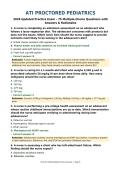
ATI PROCTORED PEDIATRICS
2026 Updated Practice Exam – 75 Multiple-Choice Questions with
Answers & Rationales
1. A nurse is completing an admission assessment on an adolescent who
follows a lacto-vegetarian diet. The adolescent consumes milk products but
does not like beans. Which lunch item should the nurse suggest to provide
nutrients most likely to be lacking in the adolescent's diet?
A. Grilled cheese sandwich with applesauce
B. Peanut butter and jelly sandwich on enriched whole-grain bread
C. Garden salad with fat-free dressing
D. Fresh fruit cup with gelatin
✓ Correct answer: B
Rationale: A lacto-vegetarian who avoids beans may have a lower intake of iron and protein.
Peanut butter provides plant protein and iron, while enriched or whole-grain bread adds
additional iron and nutrients. Dairy foods already contribute calcium and vitamin B12.

2. A nurse is caring for a 1-month-old infant who weighs 3,540 g and is
prescribed cefazolin 50 mg/kg IV per dose three times daily. How many
milligrams should the nurse administer per dose?
A. 118 mg
B. 150 mg
C. 177 mg
D. 354 mg
✓ Correct answer: C
Rationale: Convert 3,540 g to kilograms: 3.54 kg. Multiply 3.54 kg × 50 mg/kg = 177 mg per
dose.

3. A nurse is performing a pre-college health assessment on an adolescent
whose routine childhood immunizations are up to date. Which immunization
should the nurse anticipate verifying or administering during later
adolescence?
A. Rotavirus vaccine
B. Haemophilus influenzae type b vaccine
C. DTaP vaccine
D. Meningococcal ACWY vaccine
✓ Correct answer: D
Rationale: Adolescents routinely receive meningococcal ACWY vaccination, including a booster
in later adolescence. Rotavirus, Hib, and DTaP are primarily childhood vaccines.

4. A nurse is assessing a client who has left-sided heart failure. Which
finding should the nurse expect?
A. Dependent peripheral edema
B. Bibasilar crackles

Peds ATI 2026 Updated Practice Review | Page 1

,C. Jugular venous distention
D. Hepatomegaly
✓ Correct answer: B
Rationale: Left-sided heart failure causes pulmonary congestion, so crackles, dyspnea,
orthopnea, and reduced oxygenation are expected. Peripheral edema, JVD, and hepatomegaly
are more typical of right-sided failure.

5. A nurse is caring for a client with active tuberculosis who is beginning
rifampin therapy. Which expected medication effect should the nurse include
in teaching?
A. Red-orange discoloration of body secretions
B. Permanent blue-gray skin pigmentation
C. Severe hypoglycemia after each dose
D. Gingival overgrowth
✓ Correct answer: A
Rationale: Rifampin commonly causes harmless orange-red discoloration of urine, sweat, saliva,
and tears. Clients should be warned that contact lenses can also become stained.

6. A nurse is caring for a 6-week-old infant who has pyloric stenosis. Which
manifestation should the nurse expect?
A. Projectile nonbilious vomiting
B. Currant-jelly stools
C. Bilious diarrhea
D. Generalized edema
✓ Correct answer: A
Rationale: Pyloric stenosis causes gastric outlet obstruction, producing forceful projectile
vomiting that is typically nonbilious because the obstruction is proximal to the duodenum.

7. A parent calls the nurse because a child with von Willebrand disease has a
nosebleed. Which instruction should the nurse provide?
A. Have the child lie flat and tilt the head back
B. Insert tissue deeply into the nostril and have the child blow the nose
C. Have the child sit upright, lean forward, and pinch the soft part of the nose for 10
to 15 minutes
D. Apply a warm compress over the bridge of the nose
✓ Correct answer: C
Rationale: Leaning forward prevents blood from being swallowed, and continuous direct
pressure to the soft part of the nose promotes hemostasis. Tilting the head back increases the
risk of swallowing or aspirating blood.

8. A nurse is assessing a child who is experiencing a sickle cell vaso-
occlusive crisis. Which finding should the nurse expect?
A. Severe bone or joint pain
B. Painless generalized edema
C. Bradycardia with hypertension
D. Profuse watery diarrhea

Peds ATI 2026 Updated Practice Review | Page 2

, ✓ Correct answer: A
Rationale: Vaso-occlusion reduces blood flow and causes tissue ischemia, which commonly
produces intense pain in bones, joints, chest, or abdomen.

9. A nurse is providing preoperative teaching about diaphragmatic
breathing. Which action should the nurse include in the demonstration?
A. Take rapid shallow breaths through the mouth
B. Place the hands over the lower rib cage or upper abdomen and inhale slowly so
the abdomen rises
C. Raise the shoulders during each inspiration
D. Exhale forcefully before every inhalation
✓ Correct answer: B
Rationale: Diaphragmatic breathing emphasizes slow deep inspiration using the diaphragm.
Hand placement over the lower ribs or abdomen helps the client feel abdominal expansion rather
than upper-chest movement.

10. A nurse is assessing a 3-year-old child who has aortic stenosis. Which
findings are consistent with this condition? Select all that apply.
A. Systolic ejection murmur
B. Exertional chest pain
C. Dizziness or syncope with exertion
D. Bounding peripheral pulses
✓ Correct answer: A, B, C
Rationale: Aortic stenosis obstructs left ventricular outflow. A systolic ejection murmur is typical,
and more significant obstruction can cause exertional chest pain, dizziness, or syncope. Bounding
pulses are not characteristic.

11. A nurse is planning care for a client who has immune thrombocytopenia
(ITP). Which manifestation is most important for the nurse to monitor?
A. Petechiae, ecchymoses, and mucosal bleeding
B. Polyuria and polydipsia
C. Expiratory wheezing
D. Dependent edema
✓ Correct answer: A
Rationale: ITP causes a low platelet count and an increased risk for bleeding. The nurse should
closely monitor for petechiae, bruising, epistaxis, gum bleeding, hematuria, or other signs of
hemorrhage.

12. A nurse is teaching the parent of a child with Hirschsprung disease who
is scheduled for the initial surgical procedure. Which statement by the
parent indicates understanding?
A. “My child will never need another procedure after the colostomy.”
B. “The ostomy is usually temporary until the definitive pull-through surgery is
completed.”
C. “The surgery will eliminate the need to monitor bowel function.”
D. “The ostomy is expected to remain permanent in every child with Hirschsprung disease.”

Peds ATI 2026 Updated Practice Review | Page 3

Document information

Uploaded on
September 15, 2026
Number of pages
18
Written in
2025/2026
Type
Exam (elaborations)
Contains
Questions & answers
$17.84

Wrong document? Swap it for free Within 14 days of purchase and before downloading, you can choose a different document. You can simply spend the amount again.
Written by students who passed
Immediately available after payment
Read online or as PDF

Seller avatar
Reputation scores are based on the amount of documents a seller has sold for a fee and the reviews they have received for those documents. There are three levels: Bronze, Silver and Gold. The better the reputation, the more your can rely on the quality of the sellers work.
MindCraft
3.9
(55)
Sold
459
Followers
11
Items
2946
Last sold
13 hours ago


Why students choose Stuvia

Created by fellow students, verified by reviews

Quality you can trust: written by students who passed their tests and reviewed by others who've used these notes.

Didn't get what you expected? Choose another document

No worries! You can instantly pick a different document that better fits what you're looking for.

Pay as you like, start learning right away

No subscription, no commitments. Pay the way you're used to via credit card and download your PDF document instantly.

Student with book image

“Bought, downloaded, and aced it. It really can be that simple.”

Alisha Student

Working on your references?

Create accurate citations in APA, MLA and Harvard with our free citation generator.

Working on your references?

Frequently asked questions

