This Health Promotion Module 3 2026/2027 exam study guide contains 25+ questions and answers across 8 pages, providing focused preparation on health promotion, disease prevention, the Ottawa Charter, primordial through tertiary prevention, Canadian Community Health Nursing standards, health literacy, health education, health communication, social marketing, intersectionality, health inequities, harm reduction, and major Canadian health-promotion reports. The document frames health promotion as addressing both individual health behaviours and the underlying determinants of health, making it particularly useful for understanding how nursing and public-health interventions operate at individual, community, environmental, and policy levels. The source does not provide a specific course code or university name, so neither has been invented for the listing.
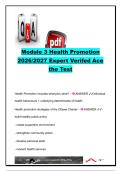
The opening section examines the Ottawa Charter for Health Promotion and its five strategies: building healthy public policy, creating supportive environments, strengthening community action, developing personal skills, and reorienting health services. These principles establish the document's broader approach to health promotion by emphasizing that improvements in health require more than individual behavior change. Students are expected to understand how policy, environments, community capacity, personal skills, and health services collectively influence health outcomes.
A major exam area is the distinction among primordial, primary, secondary, and tertiary prevention. The source defines primordial prevention as preventing risk factors themselves through changes to the social and environmental conditions in which risks develop. Primary prevention consists of upstream actions taken before signs and symptoms occur, while secondary prevention uses midstream approaches for early detection. Tertiary prevention consists of downstream actions intended to minimize residual disability and help people live productively with established disease. COVID-related examples are used throughout the document to differentiate these levels.
The guide also covers health protection and community health nursing practice. It describes health-protection legislation as providing public-health authorities with powers to establish policies, mandates, and regulations during health threats, with examples involving safe food and water, environmental hazards, infectious-disease control, restaurant food handling, and smoke-free bylaws. The Canadian Community Health Nursing standards of practice reviewed in the material include health promotion, prevention and health protection, health maintenance and restoration, professional relationships, capacity building, access and equity, and professional responsibility and accountability.
Another substantial section focuses on health literacy and patient understanding. Health literacy is defined in the source as the capacity to obtain, process, and understand basic health information and services, make appropriate healthcare decisions, and navigate the healthcare system. Practical strategies for healthcare professionals include focusing on what patients need to know and need to do, using plain language, limiting teaching to approximately three to five key points, being specific and concrete, demonstrating concepts or using pictures and models, repeating and summarizing information, applying the teach-back method, and communicating in a positive and empowering manner.
The document then outlines the health education process, beginning with assessment of needs and assets and progressing through setting goals and objectives, planning an intervention, implementing it, and evaluating results. It distinguishes health education from health communication according to audience and delivery: education is commonly conducted one-to-one or through smaller groups and classes, whereas health communication typically targets larger audiences. Health communication can use mass media, print materials, social media, and face-to-face communication to inform and influence health-related choices.
The social-marketing section defines social marketing as the strategic use of marketing practices to influence social behavior for the benefit of a target audience. The guide identifies ParticipACTION as the first Canadian government program in its material to incorporate communication and social-marketing strategies. Students review the **4 Ps of social marketing—Product, Price, Place, and Promotion—**as well as six benchmark activities: voluntary behavior change with measurable objectives, consumer research, segmentation and targeting, the 4 Ps, exchange, and competition.
The later material introduces intersectionality, identifying Kimberlé Crenshaw as the scholar who coined the term. The source presents intersectionality as a framework for understanding how multiple sources of disadvantage—including race, class, gender identity, sexual orientation, religion, and other identity markers—can intersect. Nursing responses to systemic health inequities include advocacy, political action, collaboration with professional nursing organizations, challenging stigma and discrimination, engaging colleagues and leaders in discussions about systemic problems, and using publications to increase public awareness.
The final section addresses self-help groups, harm reduction, disease prevention, and Canadian health-policy history. Self-help is described as a process in which people with common experiences or problems support one another as equals, particularly when professional or family support is unavailable. Harm reduction refers to programs or policies intended to reduce harm without requiring cessation of a behavior or addiction. The Epp Report is presented as moving health responsibility beyond individual or victim-blaming explanations by incorporating socioeconomic and environmental factors, while the Lalonde Report is described as expanding thinking beyond a purely biomedical model to include behavior and lifestyle factors such as diet and physical activity.
Relevant students: This document is particularly relevant for Health Promotion students, nursing students, BSN and RN students, community health nursing students, public health nursing students, population health students, Canadian nursing students, advanced practice nursing students, health sciences students, and learners studying health education and disease prevention. It is especially useful for Module 3 exam preparation involving the Ottawa Charter, prevention levels, community health nursing, health literacy, patient education, social marketing, intersectionality, health equity, and Canadian health-promotion frameworks.
Keywords: Health Promotion Module 3, Health Promotion Module 3 questions and answers, Health Promotion , health promotion exam questions, Ottawa Charter, Ottawa Charter strategies, primordial prevention, primary prevention, secondary prevention, tertiary prevention, levels of prevention, disease prevention, health protection, Health Protection Act, Canadian Community Health Nursing, CCHN standards, community health nursing, public health nursing, health literacy, health literacy nursing, teach back method, patient education, health education process, health communication, social marketing, 4 Ps of social marketing, ParticipACTION, intersectionality, Kimberle Crenshaw, health inequities, systemic health inequities, nursing advocacy, harm reduction, self help groups, determinants of health, Epp Report, Lalonde Report, health behavior, supportive environments, healthy public policy, community action, population health, health promotion study guide, Module 3 exam preparation
Content preview
Module 3 Health Promotion
2026/2027 Expert Verifed Ace
the Test
Health Promotion includes what plus what? - ANSWER ✔✔individual
health behaviours + underlying determinants of health
Health promotion strategies of the Ottawa Charter - ANSWER ✔✔-
build healthy public policy
- create supportive environment
- strengthen community action
- develop personal skills
- reorient health services
, Primordial prevention - ANSWER ✔✔prevention of the risk factors
themselves. beginning with a change in social and environmental
conditions in which these factors are thought to develop
example: staying home to avoid getting covid
primary prevention - ANSWER ✔✔upstream actions to protect
against disease/ injury before the signs and symptoms occur (prevention
against the disease itself) (more individual compared to a population)
example: getting the covid vaccine
secondary prevention - ANSWER ✔✔"midstream actions" that
promote early detection of a disease/injury.
ex/ covid testing (even if asymptomatic)
tertiary prevention - ANSWER ✔✔"downstream" actions that
minimize residual disability from disease and help the clients to live
productively without limitations (minimize the effects)