Physical Assessment Test 3 (Neurologic Assessment)
Physical Assessment Test 3 (Neurologic Assessment)
Study online at https://quizlet.com/_1roein
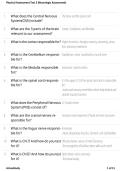
1. What does the Central Nervous The brain and the spinal cord
System(CNS) include?
2. What are the 3 parts of the brain Cortex, Cerebellum, and Medulla
relevant to our assessment?
3. What is the cortex responsible for? Higher functions- thought, memory, reasoning, sensa-
tion, voluntary movement
4. What is the Cerebellum responsi- Equilibrium, motor coordination, muscle tone.
ble for?
5. What is the Medulla responsible Autonomic control centers
for?
6. What is the spinal cord responsi- It is the upper 2/3 of the spinal canal and is responsible
ble for? for:
-motor and sensory nerve fibers which help skeletal and
smooth muscles function
7. What does the Peripheral Nervous 12 Cranial nerves
System (PNS) consist of?
8. What are the cranial nerves re- Sensation and movement of head and neck structures
sponsible for?
9. What is the Vagus nerve responsi- Innervates
ble for? -Heart, Respiratory muscles, Stomach, and Gall bladder.
10. What is CN I? And how do you test Olfactory Nerve -sense of smell (Sensory)
for it? -Test recognition of familiar odors with each nostril
11. What is CN II? And how do you test Optic Nerve- vision (sensory)
for it? -Test visual acuity:
Actualstudy 1 of 11
, Physical Assessment Test 3 (Neurologic Assessment)
Physical Assessment Test 3 (Neurologic Assessment)
Study online at https://quizlet.com/_1roein
-Snellen chart- upclose
- Jaeger chart- far away
-Test visual fields:
- confrontation test
12. What are normal fields for the 50 degrees superior, 70 degrees inferior, 60 degrees
Confrontation Test? nasal, 90 degrees temporal
13. What is CN III? And how do you Oculomotor- pupillary constriction, opening the eye (lid
test for it? elevation), and most extraocular movements (Motor)
-Direct and Consensual pupillary response
-Test Accommodation
-Test Extraocular Movements
14. What is the Direct and Consensual Used to test CN III, IV, VI
pupillary response test? Abnormal: sluggish, fixed, unequal
15. What is mydriasis dilated pupils
16. What is myosis constricted pupils
17. Whats an abnormal finding when Hemianopsia- which is a decrease of vision or blindness
doing the confrontation test?
18. When you do the Accommodation PERRLA- Pupils, Equal, Round, Reactive, Light, Accom-
Test what are you looking for? modation
19. When you test for extraocular All 6 positions of gaze
movements what are you looking Asses for nystagmus (normal twitching of the eye) in
for? lateral and upward gaze
20. What is nystagmus? Fluttering or twitching of the eyeball (normal finding)
21.
Actualstudy 2 of 11
Physical Assessment Test 3 (Neurologic Assessment)
Study online at https://quizlet.com/_1roein
1. What does the Central Nervous The brain and the spinal cord
System(CNS) include?
2. What are the 3 parts of the brain Cortex, Cerebellum, and Medulla
relevant to our assessment?
3. What is the cortex responsible for? Higher functions- thought, memory, reasoning, sensa-
tion, voluntary movement
4. What is the Cerebellum responsi- Equilibrium, motor coordination, muscle tone.
ble for?
5. What is the Medulla responsible Autonomic control centers
for?
6. What is the spinal cord responsi- It is the upper 2/3 of the spinal canal and is responsible
ble for? for:
-motor and sensory nerve fibers which help skeletal and
smooth muscles function
7. What does the Peripheral Nervous 12 Cranial nerves
System (PNS) consist of?
8. What are the cranial nerves re- Sensation and movement of head and neck structures
sponsible for?
9. What is the Vagus nerve responsi- Innervates
ble for? -Heart, Respiratory muscles, Stomach, and Gall bladder.
10. What is CN I? And how do you test Olfactory Nerve -sense of smell (Sensory)
for it? -Test recognition of familiar odors with each nostril
11. What is CN II? And how do you test Optic Nerve- vision (sensory)
for it? -Test visual acuity:
Actualstudy 1 of 11
, Physical Assessment Test 3 (Neurologic Assessment)
Physical Assessment Test 3 (Neurologic Assessment)
Study online at https://quizlet.com/_1roein
-Snellen chart- upclose
- Jaeger chart- far away
-Test visual fields:
- confrontation test
12. What are normal fields for the 50 degrees superior, 70 degrees inferior, 60 degrees
Confrontation Test? nasal, 90 degrees temporal
13. What is CN III? And how do you Oculomotor- pupillary constriction, opening the eye (lid
test for it? elevation), and most extraocular movements (Motor)
-Direct and Consensual pupillary response
-Test Accommodation
-Test Extraocular Movements
14. What is the Direct and Consensual Used to test CN III, IV, VI
pupillary response test? Abnormal: sluggish, fixed, unequal
15. What is mydriasis dilated pupils
16. What is myosis constricted pupils
17. Whats an abnormal finding when Hemianopsia- which is a decrease of vision or blindness
doing the confrontation test?
18. When you do the Accommodation PERRLA- Pupils, Equal, Round, Reactive, Light, Accom-
Test what are you looking for? modation
19. When you test for extraocular All 6 positions of gaze
movements what are you looking Asses for nystagmus (normal twitching of the eye) in
for? lateral and upward gaze
20. What is nystagmus? Fluttering or twitching of the eyeball (normal finding)
21.
Actualstudy 2 of 11