psyc 301 - neurological examination answer keys
psyc 301 - neurological examination
Study online at https://quizlet.com/_frm7rb
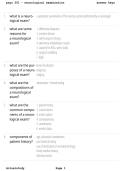
1. what is a neuro- a systematic examination of the nervous system performed by a neurologist
logical exam?
2. what are some 1. differential diagnosis
reasons for 2. monitor disease
a neurological 3. calrify impact of injury
exam? 4. determine rehabilitation needs
5. capacity for ADLs, work, study
6. surgical candidacy
7. legal
3. what are the pur- lesion localization
poses of a neuro- diagnosis
logical exam? triaging
4. what are the observation + formal testing
compositions of
a neurological
exam?
5. what are the 1. patient history
common compo- 2. cranial nerves
nents of a neuro- 3. motor system
logical exam? 4. somatosensory
5. coordination
6. mental status
6. components of age, education, handedness
patient history? past medical history
use of medication or recreational drugs
family medical history
disease process
1/5
Actualstudy Page 1
, psyc 301 - neurological examination answer keys
psyc 301 - neurological examination
Study online at https://quizlet.com/_frm7rb
7. components of 12 nerve pairs
testing cranial afferent, efferent or both
nerves? localize deficits to particular systems
8. cranial nerve I Olfactory (smell)
test: identify familiar smells, one nostril at a time
anosmia = loss of smell
9. cranial nerve II Optic (vision)
test: snellen chart or "near card"
10. cranial nerve III, control eye position via paired muscles that move and hold the eye
IV, VI test: follow object without moving head
gaze palsy: weakness/loss of eye movement
11. cranial nerve V Trigeminal (3 parts)
motor: feel activation of muscles when biting down, hold mouth open
sensory: detection of location, sharp/dull, hot/cold
12. cranial nerve VII Facial - controls most facial expressions & secretion of tears & saliva & taste
bell's palsy: paralysis of facial nerve
13. cranial nerve VIII Vestibulocochlear (hearing and balance)
test: hearing with tuning fork touching/not touching skull bone
14. cranial nerve IX glossopharyngeal and vagus
and X asses voice, swallowing, gag reflex, cough
15. what is pseudob- The inability to control voluntary facial movements, but can make voluntary move-
ulbar palsy? ments.
16. what is bulbar bilateral peripheral lesions
palsy? nasal speech
gag absent
2/5
Actualstudy Page 2
psyc 301 - neurological examination
Study online at https://quizlet.com/_frm7rb
1. what is a neuro- a systematic examination of the nervous system performed by a neurologist
logical exam?
2. what are some 1. differential diagnosis
reasons for 2. monitor disease
a neurological 3. calrify impact of injury
exam? 4. determine rehabilitation needs
5. capacity for ADLs, work, study
6. surgical candidacy
7. legal
3. what are the pur- lesion localization
poses of a neuro- diagnosis
logical exam? triaging
4. what are the observation + formal testing
compositions of
a neurological
exam?
5. what are the 1. patient history
common compo- 2. cranial nerves
nents of a neuro- 3. motor system
logical exam? 4. somatosensory
5. coordination
6. mental status
6. components of age, education, handedness
patient history? past medical history
use of medication or recreational drugs
family medical history
disease process
1/5
Actualstudy Page 1
, psyc 301 - neurological examination answer keys
psyc 301 - neurological examination
Study online at https://quizlet.com/_frm7rb
7. components of 12 nerve pairs
testing cranial afferent, efferent or both
nerves? localize deficits to particular systems
8. cranial nerve I Olfactory (smell)
test: identify familiar smells, one nostril at a time
anosmia = loss of smell
9. cranial nerve II Optic (vision)
test: snellen chart or "near card"
10. cranial nerve III, control eye position via paired muscles that move and hold the eye
IV, VI test: follow object without moving head
gaze palsy: weakness/loss of eye movement
11. cranial nerve V Trigeminal (3 parts)
motor: feel activation of muscles when biting down, hold mouth open
sensory: detection of location, sharp/dull, hot/cold
12. cranial nerve VII Facial - controls most facial expressions & secretion of tears & saliva & taste
bell's palsy: paralysis of facial nerve
13. cranial nerve VIII Vestibulocochlear (hearing and balance)
test: hearing with tuning fork touching/not touching skull bone
14. cranial nerve IX glossopharyngeal and vagus
and X asses voice, swallowing, gag reflex, cough
15. what is pseudob- The inability to control voluntary facial movements, but can make voluntary move-
ulbar palsy? ments.
16. what is bulbar bilateral peripheral lesions
palsy? nasal speech
gag absent
2/5
Actualstudy Page 2